"I'm not so sure I'd go into film today," says Peter Weir. "I might go into television, but I'm not sure about film. We're in the midst of a tremendous sea change in the last 10 years. It's really swung over to being a children's system of entertainment."
Weir was talking about his new survival drama, "The Way Back," following a showing of the film Wednesday night at the ArcLight Sherman Oaks. Hosted by TheWrap's Dominic Patten, it was part of the site's ongoing Academy Screening Series. (Photographs by Jonathan Alcorn.)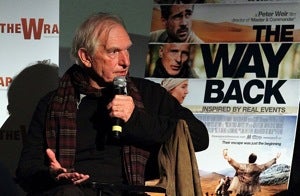
The six-time Oscar nominee was quick to point a finger at mainstream Hollywood. "Sometimes it's a long hard slog to get something to the screen. I don't want to knock 'em, but yeah — let's knock 'em," Weir said.
"A studio take on this story would've been more action-oriented, which I think was one of the approaches when a studio was looking at it, like it was 'The Fugitive' or something. It's another approach, but there are plenty of those films out there."
Eventually, the studios passed, and Weir decided to do it on his own.
Starring Ed Harris, Colin Farrell and Jim Sturgess, "The Way Back" arrives seven years after Weir made "Master and Commander: The Far Side of the World" for 20th Century Fox. A grueling survival drama, it's based on Slavomir Rawicz's novel about three men who escaped from a Siberian gulag and walked 4,000 miles through brutal conditions to freedom in India.
Weir confessed that he was initially reluctant to do the film because he questioned the veracity of Rawicz's book. "There is some question about whether the author was actually on the walk. Did he take someone else's story? We don't really know, so there was a time when I thought I wouldn't do it for that reason."
Eventually though, Weir and Levin came to an agreement. "There's not a lot to go on, but if we could find evidence that the walk had taken place that satisfied me, I'd do it."
As a result, Weir immersed himself in research. "When I said I wanted to fictionalize the story, at the same time, I wanted to make everything as true as possible, so there's hardly a detail in the film that doesn't stem from a book or a first-hand account."
Weir also relied on historical advisor Anne Applebaum, a Pulitzer Prize-winning author whose book "Gulag" is "the current go-to lexicon of the camps," Weir said. "I'd call her up and ask, what do you know about this? Can you put me in touch with someone? So it was just painstaking detective work really, but it was rewarding."
Weir shot the "The Way Back" in three different countries (Bulgaria, Morocco and India) over 65 days. "I had to make every day because we were always moving, so I had to meet those key dates. We'd be driving to different spots and checking the time because of the light. We had to get back before it got dark or else we'd get lost in the mountains. So that was my real pressure. I had to call on all of my experience."
While Weir certainly carries a certain prestige as a filmmaker, even he had to make compromises while shooting the indie film. "You have to make it for the right price, and I think we did. We're at the top of what an independent film might cost to make. We did it for just under $30 million."
"There were days" he added, "when I really wanted to take 17 shots but I could only do 11, so the question became, which 11? So that's just what i had to do."
As for the actors, Harris has worked with Weir before, having earned an Oscar nomination for his supporting performance in the director's "The Truman Show."
"I always had Ed somewhere in the back of my mind," said Weir, who added that he became "very interested" in Sturgess after seeing him in Julie Taymor's "Across the Universe." "I thought he had a certain quality. There was something about him that was appealing to me. He's not the typical hero-type," the director explained.
He also confessed he'd been a fan of for a while of Farrell, who gives a commanding performance as a Russian ruffian. "I've watched Colin over the years like everybody else. I really got interested in him after seeing 'In Bruges,' but I wondered, can he do the Russian? We got talking together and he had such an interesting take on the character that it was an easy decision.
"He didn't come and say 'I can do this.' In fact, he said just the opposite, that it was going to take some work to really understand who that character is. And while he's played plenty of tough guys in the past, he rightfully avoided any thought that he was simply a strong-arm guy. He was more like a tribal person really, bringing a culture of violence to that role."
In order to prepare his actors for the hardships they were about to endure on location, he put them in touch with researchers and gave them an edited version of all of his files along with several documentaries to watch.
Sturgess, he said, "was put in touch with the only escapee of the group of interviewees, who'd escaped as a 15-year-old boy from a resettlement area in Siberia. It was like a 'Sophie's Choice' situation. His mother had these two boys and she was dumped in the middle of nowhere with no means of survival, and she said to the younger boy, 'You have to run away. You have to try and escape.' And he said, 'Can my brother come?'
"She said, 'No, he's going to look after me.' And so his mother and brother disappeared, so he was a bit more like the Saoirse Ronan character or the Colin Farrell character when he was forced to live on the streets."
And for those wondering about the possibilty of a sequel to "Master and Commander," don't get your hopes up – despite star Russell Crowe's Twitter campaign. "I don't think so. It's too expensive. It didn't return enough money. Simple as that," lamented Weir.