
He said yes. Then he said no. Then he felt bad, so he called to apologize for saying no, found that the job was still available, and said yes again.
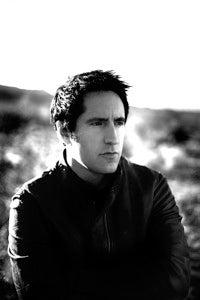 Trent Reznor may have taken a circuitous route to writing the music for David Fincher’s “The Social Network,” but he and his longtime collaborator Atticus Ross made the most of the gig once they took it.
The Nine Inch Nails mastermind and his co-composer have created one of the year’s most imaginative and bracing film scores, a piano-rooted, synthesizer-drenched work that is by turns plaintive and assaultive, and always adventurous and unconventional.
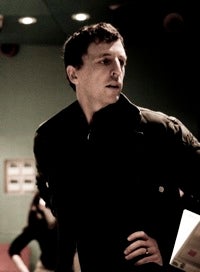
Reznor (left) and Ross (below), who also make up the band How to Destroy Angels with Reznor’s wife Mariqueen Maandig, spoke to TheWrap about writing the music that plays such a crucial role in Fincher’s masterful film.
On his introduction to the material:
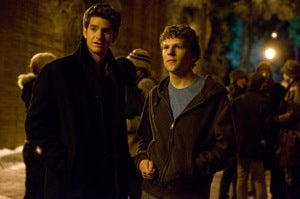
REZNOR: The first thing that struck me was, I don’t think it’s the obvious choice for someone like me. If it was a very dark subject matter, a horror film, mass murder, something like that, it would be a more connect-the-dots scenario. But here’s a movie primarily of people in rooms talking. Okay, what do we do with this thing?
 But when I read the script, any initial balking I might have had about a movie about the founding of Facebook was quickly eradicated.
We sat and watched maybe 40 minutes of a rough cut to get an idea of the tone and the actors and the overall look. And then we just went off and started working on broad stroke ideas to see what might resonate.
On their basic approach:
REZNOR: Right off the bat, everybody leaned in the direction of “let’s not do an orchestral score.” David wanted something that had electronic leanings and was a bit iconic. He referenced things from “Tron,” “Blade Runner,” and talked about a Tangerine Dream-ish kind of sound. Something that would feel like it had a uniqueness and a presence in the film.
And then Atticus and I went into our studio and started thinking about the overall themes of the film, which seemed to revolve around the act of creativity, the sacrifices made to pursue that dream in its pure form regardless of the consequences, the inevitable betrayals involved, and the moral consequences of choices made, of putting the pursuit of this thing ahead of everything else, including friendship.
We just sat there without the script or the picture, and blindly created music. We adhered to something that was a bit electronic sounding, or rooted in synthesized sound, but something that had a vulnerability to it, a human element.
ROSS: That’s one of the funnest bits for me, knowing some general themes and talking a lot about the direction with Trent. I know that some people talk about how they won’t touch anything until they get the locked picture, but we were coming at it from a different place.
 On David Fincher's reaction:
REZNOR: What we intended to do was to send David 10 to 20 rough drafts of things. I thought that would be the first of several times that we’d be doing that, just to kind of say, “Here’s some things that feel to us like they’re in the ballpark. Are they close?”
Much to our surprise, we got back, “I think the lion’s share of composition has been done, because this works perfectly.”
And when we saw how he’d placed some of those things in the movie, that’s when it kicked into more traditional scoring: a lot of revising and reworking and setting things around dialogue, getting theme-specific cues.
On the “Social Network” sound:
REZNOR: We didn’t take the approach of, “Here’s the Mark Zuckerberg/Darth Vader theme creeping in every time he shows up.” We just thought in terms of textures and sounds and the range of emotion.
Generally, we use a piano as kind of a human centerpiece. Anytime there’s something that’s rooted in melody, it’ll be anchored by piano, and that piano will have a sense of humanity and frailness or vulnerability to it. And then we’ll drop that piano down into an alien landscape, which might be icy and synthetic.
On inspiration and loneliness:
REZNOR: We were consciously thinking that there should be some things that sound like inspiration. Like the track that wound up being called “In Motion.” We wanted something that had a propulsion to it, that sounded like ideas, like light bulbs being turned on. We wanted that adrenaline one gets in the act of creativity: “Hey, this is a good idea!” That feeling of movement and forwardness.
ROSS: There is this notion of transcendent creativity, and then there’s this emotional journey that’s a much lonelier one. And getting the balance between the two, I think, took a bit of time.
 On one key scene:
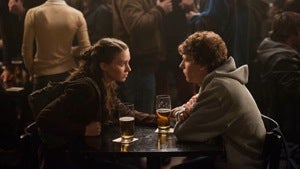
ROSS: There’s that moment at the front of the film, where it kind of goes from the bar music and then cuts to the intro to “Hand Covers Bruise,” the title sequence. It does cast things in a different light. The bar scene seems familiar, and you’re thinking, maybe it’s that kind of movie. And then to me, when that music starts up, you think, oh, what type of movie is this going to be?
REZNOR: It sets the tone of the film as something different from what it could be.
On the score’s one piece of non-original music, a raw revved-up Grieg’s “In the Hall of the Mountain King”:
ROSS: Our asses were kicked somewhat in that sequence.
REZNOR: The whole film had been shot, aside from the Henley Regatta scene, which he wanted to shoot at the actual event. David said, “I need an iconic piece of music, and I’m thinking of something like ‘Hall of the Mountain King,’ and what if we did it like [“Switched-On Bach” and “Clockwork Orange” composer/arranger] Wendy Carlos would do it?
I’ll take the blame that I took that a bit literally. I went nuts with walls of analog synthesizers, and went down the wrong path. We created a version that sounded like Wendy Carlos would have done it in the ‘70s, perhaps, but it wound up being a bit too comical and corny.
Finally, once I eased off my preconceptions, we created something that worked. But it’s also a very meticulous piece of music that has a lot of detail, because everyone knows that track. And that was the one where I thought, If I hear that one more time I’m going to jump out the window. I felt that way, my dog felt that way, my neighbors probably felt that way. And I could probably live another lifetime without hearing that again.
On the awards buzz:
REZNOR: I know from my experience with rock music, once it leaves the studio and goes out in the world, I’m pretty powerless about how people feel about it. But it’s nice when it resonates with people.
We got some very nice compliments from people who know what they’re talking about – and I’ve got to say, this being a new discipline for me, I’ve gotten quite a charge out of that. And when I hear whispers of Academy Award nominations, it’s incredibly flattering.
I realize that what we’ve done isn’t completely traditional in terms of instrumentation or how we did it. But when we got into this thing, the only agenda we had was, how can we best serve the picture? How can we enhance the viewers’ reaction to the film and take it up a notch? To hear that people feel we’ve done that, that’s mission accomplished.