
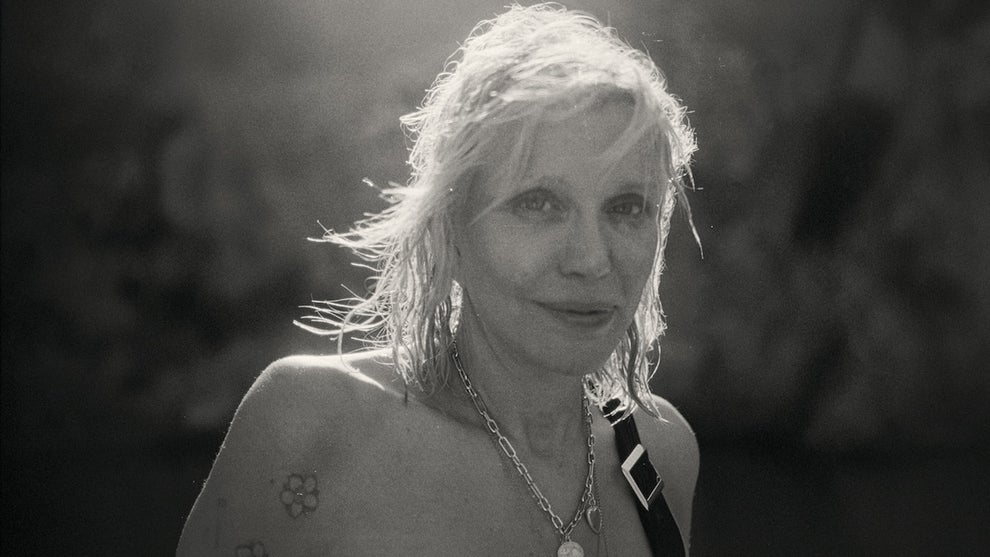
In “Antiheroine,” James Hall and Edward Lovelace’s thoughtful documentary about the iconic musician and actor Courtney Love, their subject is not here to entertain you. She’s spent many lifetimes doing that already, going from being the lead of the acclaimed alternative rock band Hole to later starring in movies like “The People vs. Larry Flynt” and “Man on the Moon.” She’s been through more than her share of pain and loss along the way, all of which she had to navigate while facing down abuse from people who, despite not knowing anything about who she really is, turned her into someone to tear down.
While “Antiheroine” is not here to build Love back up, it’s part of a recent trend of documentaries about high-profile female artists that serve as a corrective of sorts to the horrific treatment they’ve often received in the public eye. It doesn’t shy away from the challenges she went through and the harm she caused to others, but it also critically shines a light on how others cheaply crucified her for her flaws.
The fascinating film doesn’t shy away from the parts of Love that others closer to her have often struggled with, as it chronicles her humble beginnings in music through to her massive success, relationship with Kurt Cobain, the explosion of Seattle grunge, shift into doing more film acting and eventual decision to step away from the spotlight.
Just as importantly, it grants her a humanity that far too many did not, capturing all of who she was and all of who she now wants to be. It’s a candid, compassionate and comprehensive portrait that, while somewhat standardly constructed, taps into something much more incisive than is common for this type of work. It’s a film that doubles as an appreciation of Love and a deeper, more incisive analysis about her fraught relationship to fame.

As we hear Love’s narration over the documentary’s early montage of scenes from her life and in recurring moments throughout it, she’s similarly candid in discussing what it is that she thinks of the path she’s gone down. Now 61 and hoping to make a new solo album, she’s having to take stock of the person she was when she was first making music.
Is she doing this documentary now to bring attention to her album? Possibly, but Love is open about her hunger for people to pay attention to her, so this doesn’t feel like some sort of promotional project in disguise. Her rise to prominence is something that both gave her life and then upended it, a double-edged sword of an achievement.
In “Antiheroine,” Love discusses all of this, a cigarette usually in hand and a sense of wry, if wearied, wit. She does so without sugarcoating her struggles with drugs, insecurity and fame, as the humor she uses as armor gives way to vulnerable sadness about how much of this still lingers with her. The thing she’s always done to shake free of her pain is to lean further into fame and the performance of it.
It’s as though, when she has to be “Courtney Love” the rock star, she doesn’t have to think about the parts of herself that still hurt. While she’s honest about how she hopes her new album will allow her to reenter this world from a more stable place, this is no mere vanity project. Instead, it’s about an artist openly reflecting on why it was that everything fell apart and how she tried to hold everything together.

It’s this element where “Antiheroine” proves most compelling, offering up more messy reflections on how Love was drawn to fame as a way of escape. Multiple other voices from her personal and professional life weigh in on how she was fixated on being famous from quite early on, each of them doing so not entirely uncritically just as they clearly still care about her. The film utilizes an impressive amount of well-edited archival footage to accompany to all that’s being discussed, with talking heads largely appearing as faceless voices.
“Antiheroine” tackles head-on Love’s passionate relationship with Cobain before everything came crumbling apart, responding to the horrible rumors that came from this, while also not giving them any more time than they deserve. Instead, as Love and those who knew the talented musician recount, the lifestyle both were living was something he had a harder time leaving behind. The doc demythologizes the two artists without shifting into being exploitative, offering up more humane entry points to the happy life they were living together for a painfully short time in Seattle.
Love has never been interested in making herself palatable to her audience just for the sake of doing so. She’s instead always been ambitious and driven by a deep desire to be famous, even changing her style in order to do so. This film, though not formally revolutionary, is the type of defining, delicate portrait that moves beyond the often tiresome trend of music documentaries that simply shower praise on their subjects. It never once falls into hagiography, refusing to smooth over the rough edges of a complicated person still trying to write her own story for herself.
That might not be possible as her rise to fame meant surrendering more about herself and her life than she might have realized. But within the confines of this engaging documentary, we get to see the world through her eyes and hear her discuss it in her own, more raspy and weathered, but still powerful voice.
