


This week, we look at a couple of fresh opportunities to make bank in show business.
Movies are back and ticket sales are getting closer to pre-COVID levels. Analysts say it’s time to buy stock in theater owners, particularly Cinemark Theatres, which, during the lean times learned to operate more efficiently, work harder to attract film fans and push concession stand and merchandise sales. All of that means that big movies will lead to more profits and rising share prices.
The World Cup should also bring money with it to select North American businesses. Other than fans, who’s looking forward to soccer? Try TV networks, digital media, hotels and more. See exactly what Deutsche Bank recommends below.
Thanks for reading.
Jon Lafayette
P.S.: Send your tips and pitches to jon.lafayette@thewrap.com.
THE DEEP DIVE
Cinemark Rides a Box Office Revival, With Strong Summer Expected
Rebounding box office results aren’t just cheering up Hollywood moguls. Wall Street is noticing, and top theater operator Cinemark stock is getting rave reviews.
Back in January, an early tease of a movie business rebound and the lineup of films coming in 2026 prompted Robert Fishman of MoffettNathanson to upgrade Cinemark stock to “buy” and set a target price of $30 a share.
The stock started the year at $23.53 and it topped $30 a share on April 9. In May, Fishman raised his target price to $35 a share and it closed Thursday at $30.81. Here are some key takeaways:
- Cinemark is riding the recovery of movie box office results, which have nearly returned to pre-pandemic levels.
- A remarkable slate of movies in 2026 is likely to continue to drive the recovery and boost revenue from ticket sales.
- Online viewing of trailers gives analysts a new way of tracking the popularity of upcoming films.
- The box office boom is also fueling sales of food and beverages in theaters, further lifting the bottom line.
Cinemark this week said it had its highest May domestic box office ever last month. That’s notable considering the industry as a whole is down 2% from May 2019, before the COVID pandemic that emptied theaters.
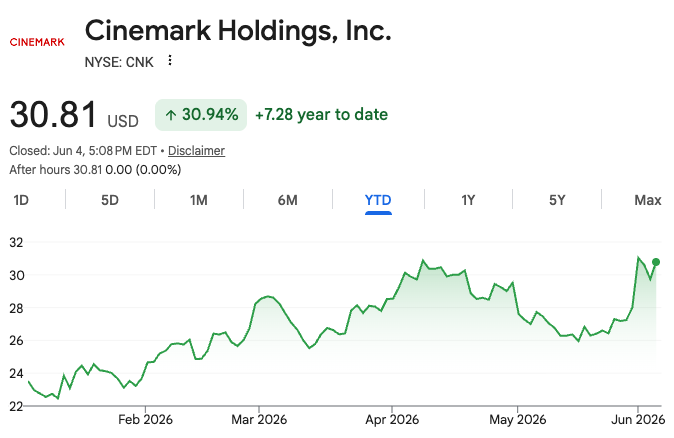
For the first quarter, Cinemark’s revenue rose 19% to $643 million, beating expectations, and EBITDA (earnings before interest, taxes, depreciation and amortization) rose 143% to $88 million.
“Actions we pursued to increase engagement and stimulate food and beverage consumption drove record high concession sales and diligent labor and overall cost management, combined with improved operating leverage contributed to our significant margin expansion in the quarter,” CEO Sean Gamble said on the company’s earnings call.
In a new note, Fishman said that the May box office figures reinforce his forecast that the 2026 film slate has the potential to fuel a meaningful box office recovery. In fact, the summer slate of movies could be one of the strongest in recent memory, he said.
Great Slate
So far this year, original, non-franchise films like “Project Hail Mary,” “Michael,” “Hoppers,” “Obsession,” “GOAT” and “Backrooms” have been selling lots of tickets. “Disclosure Day” and “The Odyssey,” two more originals, are expected to be hits as well.
“This matters for exhibitors: not only do fresh, original films combat potential franchise fatigue, but non-franchise films typically carry lower film rental costs than their franchise counterparts,” Fishman said.
Social media engagement is driving ticket sales, so Moffett Nathanson is tracking online trailer views as a predictor of box-office trends. That is a positive sign for upcoming films including “Spider-Man: Brand New Day,” “Scary Movie 6,” “Street Fighter” and “Wildwood.”
Fishman had forecast a flat second quarter for the industry but now thinks it might do better. He sees the third quarter up 13% from a year ago and the fourth quarter up 8%.
On top of ticket sales, the big box office cooked up record food and beverage sales for May. With its growing movie club and a strong balance sheet, “we believe Cinemark remains well-positioned to continue winning the rebound,” he said.
DEAL SHEET
- Barry Diller’s People Inc. offered $48.39 a share to buy a majority stake in MGM Resorts, which would value the company at $18 billion, including debt. Diller, a renowned media executive who helped start the Fox broadcast network, sees the casino operator as a real-world asset that can’t be “replicated or disintermediated” by AI. MGM stock rose $7.48 to $50.67 after the announcement.
- Versant Media took part in a Series A funding round for GammaTime, a microdrama streaming platform, becoming a minority investor in the company. GammaTime will work with Versant to develop original programming with prominent showrunners as well as using intellectual property from Versant’s library, which include networks like CNBC and MS NOW. “We’re building originals at scale, and Versant gives us the IP, brand equity and creative DNA to do it right,” said Bill Block, founder and CEO of GammaTime.
- Suno, which uses AI to generate music, said it raised $400 million in a Series D funding round that values the company at $5.4 billion. The round was led by Bond Capital, with IVP, Forerunner, Union Square Ventures, Alkeon and Quiet in the mix, along with existing investors Matrix, Lightspeed, Menlo Ventures and Schroders Capital. Some artists, producers and songwriters also invested, the company said. With the new funding, the company plans to roll out its first music model developed in partnership with the music industry, co-founder and CEO Mikey Shulman said. Suno has been sued by music companies for training its AI on copyrighted songs, but settled and reached a licensing deal with Warner Music Group in November.
WRAP 20 INDEX
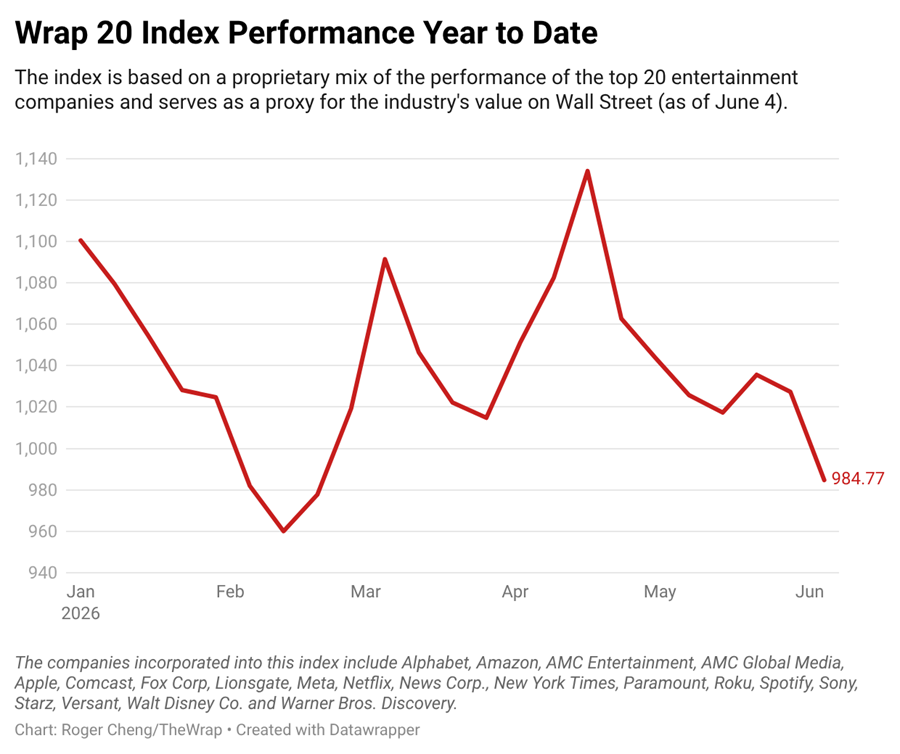
The Wrap20 Index fell another 4% this past week and is down 10.5% for the year despite a 7.3% rise in the DJIA.
FINANCIAL ROUNDUP
Gooooooooooal
Analysts at Deutsche Bank issued a report titled “How to Play the World Cup,” which points to which companies stand to benefit from the global soccer tournament, which kicks off on June 11 in the Americas.
Broadcast: Deutsche Bank expects the World Cup to generate the most U.S. ad revenue in the history of the event because of where the matches will be played, the expanded number of teams and the expanded schedule. The key beneficiaries are Fox, the English-language network carrying the World Cup, and Comcast’s Telemundo, which will air the games in Spanish. Fox could see upside in its June and September quarters, while Comcast will get less of a tailwind.
Digital: Google’s YouTube will benefit from its agreement to air highlights from the men’s World Cup within 10 minutes after each game.
Gaming: There will be betting on World Cup games. Deutsche Bank estimates that FanDuel’s handle, or total amount of money wagered, will be $1.3 billion in the U.S.; DraftKings will see $1.1 billion, BetMGM $250 million, Caesars $120 million and TheScoreBet $83 million.
Other: Deutsche Bank sees hotel chains Hyatt, Hilton and Marriott cashing in on World Cup gains, as well as Uber, Lyft and Airbnb.
Profit for Peacock
Matthew Strauss, chairman of NBCUniversal Media Group, spoke at Evercore’s Global TMT Conference and confirmed that, as predicted on Comcast’s first quarter earnings call, the Peacock streaming service would be profitable in the second quarter.
Some analysts have called Peacock an also-ran in the streaming race; Strauss called getting out of the red “a validation of the strategy that we’ve had from the beginning.”
In answering analyst Kutgun Maral’s questions, Strauss made some other points:
Scale without an international business: “I don’t think we need to be global in order for us to continue growing the service,” Strauss said. “Maybe this is just another example of zigging while others are zagging.”
There’s room to raise prices: Strauss said Peacock is currently undervalued, with services that don’t have as much content charging twice or three times as much.
“We’ve also built a very, very strong portfolio of sports rights. And so, I do think that there is opportunity for [higher rates] just based on the value of what we offer in the market,” he said.
FROM THEWRAP
Hollywood’s AI Appetite Has Sped Up – Here’s What’s on the Menu
Comcast to Invest Over $6 Billion in Universal’s UK Theme Park
European Commission Aims to Wrap Paramount-Warner Bros. Merger Review in July
HEARD AROUND
Report Highlights Risks to Documentary Films After Rescission of Pubmedia Funding
Ken Burns on What He Will and Won’t Allow When Financing His Films
Golf Is Now Cooler and Younger. The Stock Market Has Noticed