
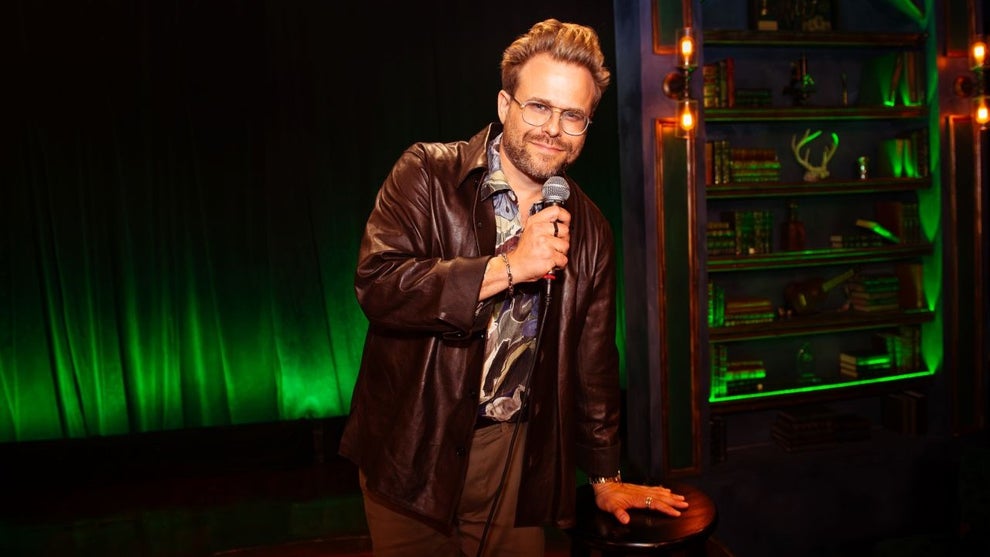
It’s a complicated time to be Adam Conover. He has navigated the end of a long-term relationship, has spent tens of thousands of dollars of his own money to produce a new stand-up special, and now his fans can see how he’s handled both with “Big Divorce Energy,” which unlike his previous specials is being self-distributed through his YouTube channel.
It’s a means of release that Conover said may not make him a single cent, and he is at peace with that.
“If it is as big as the biggest specials I’ve ever put out, maybe I’ll get my money back,” he told TheWrap. “But I’m looking at the landscape and I’m wondering if it make sense to do that again with my next hour of material. It’s so much to put into one piece while the audience wants something that’s more stripped down. Josh Johnson is getting loads of views just riffing on the news for an hour a week. Maybe the future of standup isn’t the high-produced hour special, but putting out a couple of 20 minute videos per month during my tour. That may be where things end up.”

Filmed at the Den Theatre in Chicago, “Big Divorce Energy” shows a more introspective side of the CollegeHumor alum than he has shown in past standup work, where he’s focused his jokes and observations more outward than inward. But after splitting with his longtime partner Lisa Hanawalt, Conover said he went back to the roots of his comedic career in his 20s, when he was doing open mics in New York.
And as he turned his jokes on himself and how he was processing his heartbreak, Conover said he learned many things not just about himself, but about comedians in general. Take for example, the best compliment he got from one of his peers during his latest tour: that he jokes about sex the way women do.
“Plenty of men do jokes about sex, but about the concept of sex. They don’t do jokes about their own sex lives,” he said, explaining how making jokes about how he had become sexually repressed by not talking about his wants to anyone was one of many factors that led to his breakup.

“There are certain male stand-up comics who have this image of how brave and provocative and unforgiving they are, but they don’t talk about their inner lives. They don’t talk about their desires and fears, and that’s honestly kind of cowardly and pathetic,” he said. “So I wanted to dive into myself through my material and have that honesty. I wanted to liberate myself sexually. I wanted to figure out, emotionally and in every other part of my life, who I actually was, and talking about it onstage was part of that process.”
Anyone who has watched Conover’s standup, his TruTV series “Adam Ruins Everything,” or his current events podcast “Factually!” knows that he has a lot on his mind, and he spoke at length to TheWrap about the process of self-distribution, the economics of comedy and why he’s sad and furious about the ability of artists to make a living in the wake of Skydance’s acquisition of Warner Bros.
The interview below has been edited for length and clarity.
When taking a more introspective approach with your material, did you find it difficult to really dig deep and talk honestly about yourself before an audience?
Conover: Well, what’s funny is I started writing a lot of the material as it was happening. When Lisa and I “officially” separated, I went to New York for about a month in June 2024 and just spent a month clearing my head and dating for the first time and stuff like that, and also was just doing stand up at open mics, where I started, right? And so I started with my experiences trying dating apps again and that turned into jokes about what it’s like to be alone again and have to stand up on your own two feet.
I sort of felt from the beginning that I was tapping into something new in terms of my writing that I hadn’t done before. Previously, I had been looking for observations about the world, or I was talking about myself in a relatable way. It was still outward facing. Most of my comedy, I realized, had been pointed outwards, and this was the first time I was really pointing it inwards, and it felt like it felt like the comedy came easier. It felt more like my real self on stage, and so that really felt like a right direction. Up to that point I had been treating jokes like armor. But now, talking about my breakup, it was a fundamentally insecure position, and I had to learn to present myself, warts and all, and not put up a front out of fear that if people see the real me, they’ll judge harshly.

When you decided to self-distribute “Big Divorce Energy,” what went into that decision? Were you looking at other comedians who went that route?
It seemed like the only viable option. It seemed like the only way to do it from a business perspective, because the truth is that the industry, both the entertainment industry overall and specifically the comedy industry, has destroyed itself over the last five to 10 years. The kind of comedy infrastructure we used to have no longer exists. Comedy Central used to be an entire, not just a brand, but a pillar of the comedy industry, right? They would take people from premium blend type show to album to half hour to hour to having their own show.
That doesn’t exist anymore. Netflix doesn’t do that. They have a couple comics, some of the biggest comics in the country. HBO is very boutique-y. They know what comedians they like and they’ll work exclusively with them. Then there’s smaller companies like 800 Pound Gorilla that will produce those specials and try to sell them to a streamer. But when I had a meeting with one of those companies, I won’t say which one, they said that the streamers don’t buy specials anymore and they were going to put the special on their YouTube channel.
Well, I checked and I had more subscribers on my YouTube channel from years of doing podcasts and other stuff on there, so it just seemed like if this is the way the business is, I’ll just have to self-distribute. Dropout put out my last special, and they were wonderful, and they paid me well and I got my health insurance from that release, but I’m trying to reach a wider audience, so YouTube is the only way to expand that audience. But this is it. There’s no other revenue stream. I’m not selling it for five bucks. I’m not going to be able to sell the audio to SiriusXM. I am just putting an hour out there, hope newcomers will find me and like my work, and then come out and see me on tour. But I am in a privileged position from having worked on a TV show that a lot of people watched and having a lot of income from a well-followed YouTube channel and Patreon to be able to do this. This is not something a lot of up-and-comers can do.

Along with working on this special, you spent a lot of time working with the Block the Merger coalition trying to stop the Paramount-Warner Bros. merger. To put it bluntly, where does that coalition go now?
Well, the tech industry has invaded Hollywood, right? How else can you call the Ellisons with their money from Oracle coming in and buying up two legacy studios in as many years? All that’s going to happen as a result of that is Hollywood is going to shrink, right? That’s it. There’s no better or more. There’s just less and worse as a result of that. Paramount is just going to lay off thousands of people and they are going to make less stuff regardless of what they promise.
And what’s going on in comedy is part of this trend of less and less, because it’s going to be harder for the next wave of comedians to get anywhere with their careers. It’s the job of these companies to connect the artists with the audience. That’s what Comedy Central was, and by chasing Netflix and killing the cable model, that was allowed to die. So now comedians have to self-release.
My friend Benny Feldman, a wonderful comic in New York, up and coming, also just recorded and self-released his own stand-up special on his own YouTube channel, and it’s a wonderful special. It’s called “Butterfly Pavilion.” He’s a really unique joke writer. Audiences love him. He’s got you know a great amount of heat on social media, right? But he did the same thing I did. He sunk a bunch of his own money into filming a special that he then just released on YouTube, and he didn’t have the advantage that I have with my follower count. He’s going to get less views, but he did it anyway, because there’s nothing else aside from those companies like 800 Pound Gorilla and All Things Comedy trying to rebuild a new standup distribution system from the rubble.
Hollywood used to have a bargain. The bargain was: You give the companies your intellectual property. You let them distribute it, you let them profit off of it, and they pay you a sustainable, handsome living. You get an upper-middle class life in L.A. or New York, you get health insurance, and they make you famous, right? Nobody’s doing that anymore. They’ve broken the promise with these mergers, and now what’s left is creatives turning to YouTube and other online platforms and trying to find an audience through the algorithm.
All we can hope for at this point is that somehow Lina Khan takes control of the FTC again in some future administration and turns her eye to rebuilding Hollywood, that somehow we get Fin-Syn regulations to build a proper independent production system in entertainment. Otherwise, YouTube is going to turn all but the most privileged artists, and I include myself among those lucky few, into glorified Uber drivers.

Elon Musk Invests $1 Billion in Skydance
To take this back to your standup career, now that you have found this new form of introspective comedy that helped you through a difficult time in your life, are you thinking about staying in that lane?
I think this is the direction I’ll take for the rest of my career. I’ll still continue to do the political and the observational comedy. Those things are all important, but what I realized doing this special is that the reason I got into art, the reason I got into comedy, is just the act of living my life, having experiences, having them strike me a certain way, as funny, as profound, as beautiful, and then sharing them with people.
I’ve learned that if I put down the artifice, if I put down the attempt to seem funny and to seem perfect, then the online audience actually likes it more, and I feel like I’m doing more authentic work. When I watch the special now, because I’m always self-critical, the jokes that I really like are the ones where I feel like I’ve done that. That’s going to be my north star going forward.
