
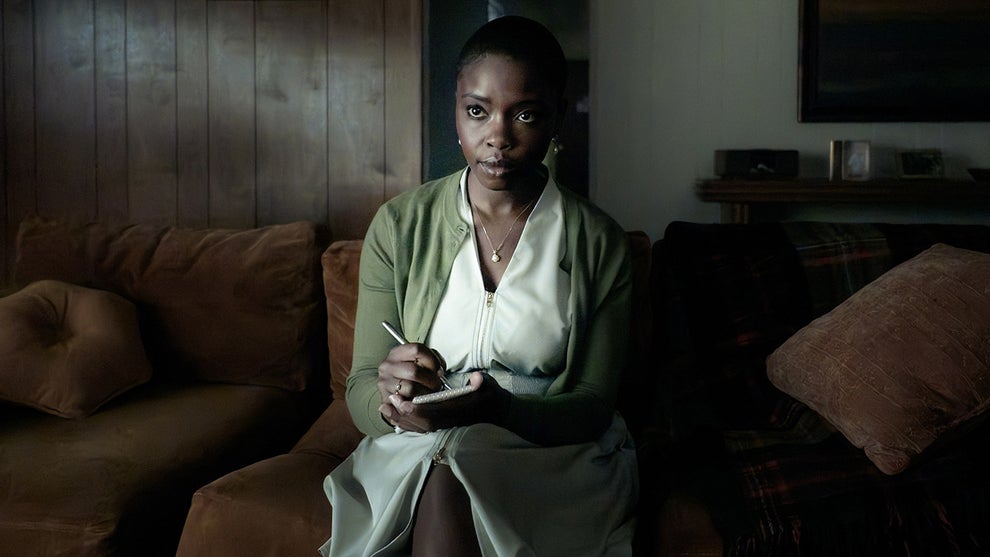
When Joy Sunday first read the script for the “DTF St. Louis” pilot, there was one thing that struck her immediately about her character, “porn positive” special-crimes police officer Jodie Plumb.
“Her rhythm,” Sunday said. “It was just so staccato and weird. Throughout the show, pretty much everyone is, but I was playing this character who is supposed to be this source of empathy and compassion for all these people, while still being stilted in a way. That was really fun to discover.”
Sunday’s Jodie stands out for that very reason in the HBO limited series, creator and director Steven Conrad’s somber, darkly comic story of a messy love triangle involving a sexually frustrated weatherman (Jason Bateman), his bumbling, debt-ridden best friend (David Harbour) and the latter’s no-nonsense wife (Linda Cardellini). Jodie is one of two law enforcement officials tasked with unpacking the consequences of that entanglement, which ends with Harbour’s Floyd Smernitch dead under mysterious circumstances.

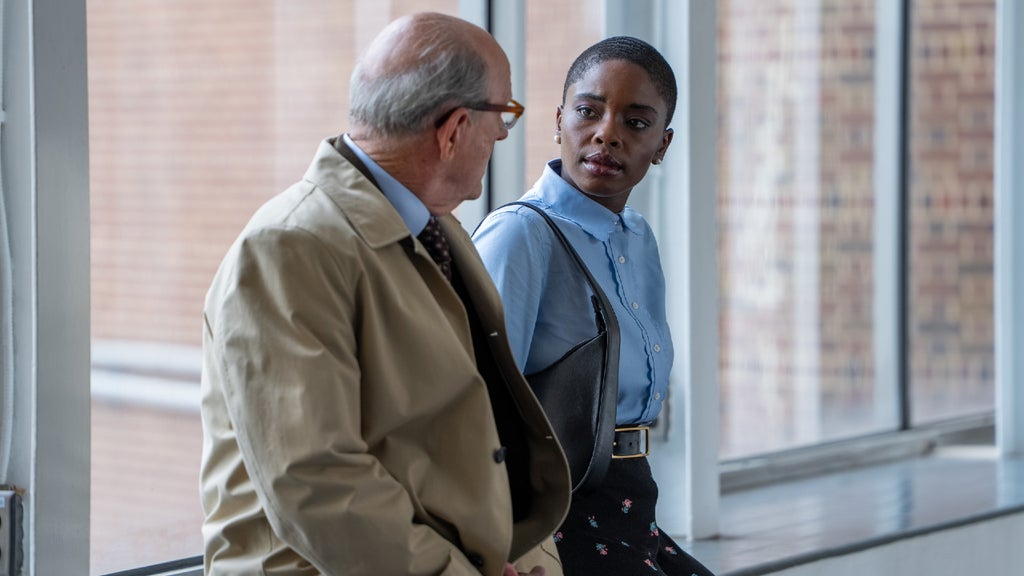
The other is Richard Jenkins’ county detective Donoghue Homer, an old-school, trench-coat-wearing investigator. He knows how to find the truth but is not nearly as well-suited to understanding the sexual complexity of “DTF St. Louis’” tangled romantic geometry as Jodie, who handles each character’s individual, private desires and sources of shame with understanding and grace. Unexpectedly, the two prove to be a complementary pair.
Jenkins and Sunday have an oddball kind of chemistry that reinforces the unlikely sweetness of their characters’ bond. Sunday, notably, credits him with helping her master the very same staccato rhythm that drew her to her character in the first place. “Richard was really instrumental in helping me along the way,” she explained. “He taught me to just say the words.”
She spoke highly about the faith that Jenkins gifted her on their very first day, calling it “immeasurable.” “To be taken in by someone like him is really just such a rare, special honor that I did not take lightly any day that I came into work,” she said. Both actors earned Emmy nominations for their wonderfully understated supporting performances. Along with leads Bateman, Harbour and Cardellini, all of whom submitted in the supporting categories, they gave the program five acting noms (the most of any limited series) out of the show’s 13 total noms.
While most of the “DTF” actors were considered likely nominees, Sunday was a surprise to awards watchers and to herself. She called it “mind-boggling” to learn that she had been nominated along with her co-stars and other highly-regarded contenders from other limited series. “I know I’m a new face,” she said. “I saw the list of eligible names. It had me shaking in my boots. It feels really amazing to be one of the chosen, alongside these people that I’ve respected for years.”
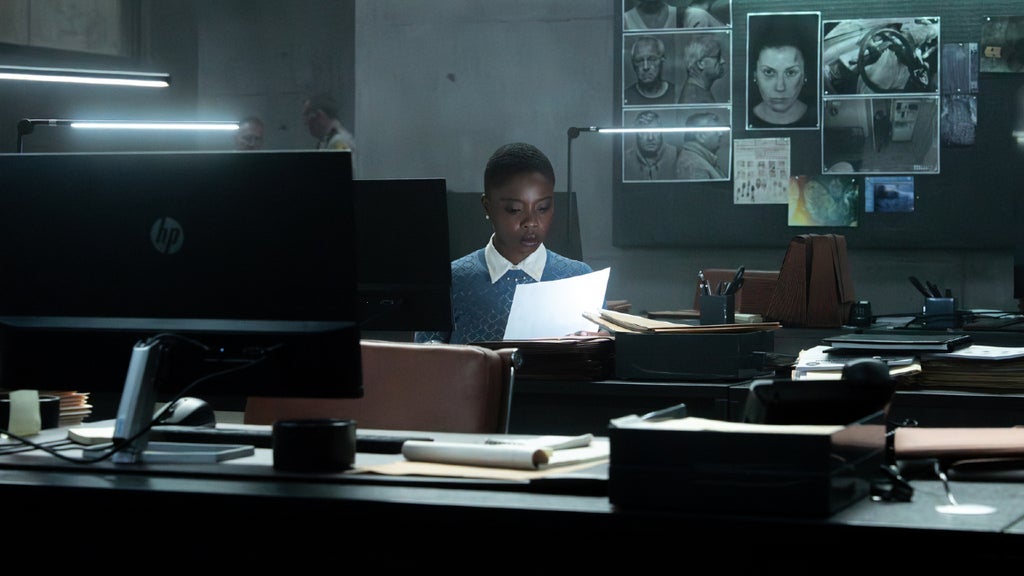
That Sunday’s performance made enough of a mark to stick out in a crowd of memorable performances speaks to the dramatic power of “DTF St. Louis.” Conrad’s tonally nimble dark comedy uses genre conventions to create a portrait of desperate, unvarnished middle-aged humanity so striking that nearly every aspect of it proves hard to forget. Sunday points to the finale, a devastating, shockingly tragic hour of television, as the reason “DTF” was so warmly embraced by viewers and Emmy voters alike.

“It takes you through these moments that feel so natural to the human experience,” she said. “Not to be all woo-woo about it, but you laugh, you smile, you smirk, you cry and, despite the sad ending, feel embraced in a way. It’s beautiful. It exists in this in-between place, which is very much how we live our lives. There’s no clear-cut answer for anything, and so to have such a touching experience in something that doesn’t give you any direct answers as to what’s right or what’s wrong goes a long way, I think.”
Her own experience making the series also changed her perspective on the industry as a whole. “Every single day, everybody showed up so happy to contribute to this weird little thing,” she said. “Now I can’t accept that the industry we’re in needs to be anything other than pleasant. It can be a dream and it can also be a success.”
This story first ran in the Down to the Wire Drama issue of TheWrap’s awards magazine. Read more from the issue here.