
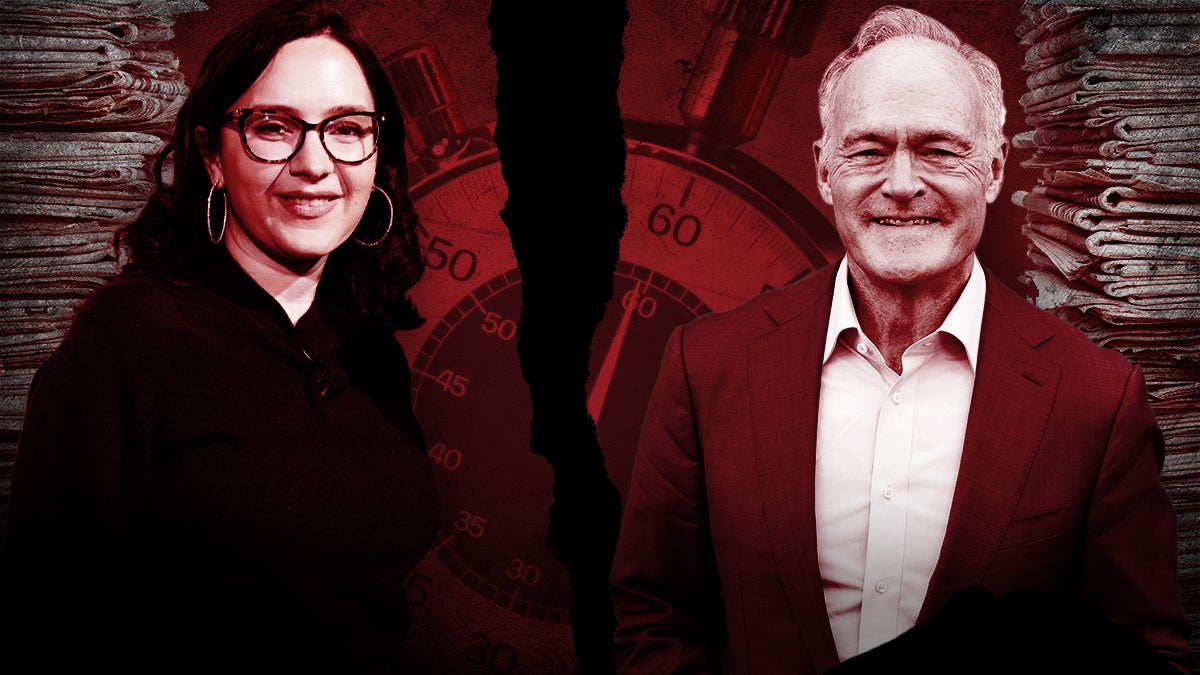
Can “60 Minutes” be saved?
That’s the question on everyone’s mind following the firing of veteran correspondent Scott Pelley in a spectacularly nasty and public blow up.
The firing along with the other shake-ups at the newsmagazine last month leaves only Lesley Stahl, Bill Whitaker and Jon Wertheim as remaining correspondents to pick up the pieces.
But it’s unclear if those pieces can ever be put back together. Will “60 Minutes” be the same show viewers have relied on for 57 years? With the clear shift in approach by CBS News editor in chief Bari Weiss and the avalanche of negative scrutiny from respected journalists across the country, it’s unclear that public trust will remain unperturbed.
Trust within her news organization is something Weiss continues to fritter away.
“The audience is going to have a hard time trusting CBS if it keeps seeing stories like this,” Susie Banikarim, former head of global newsgathering and EVP of Vice News and contributor to Columbia Journalism Review, told TheWrap. “Fueling these stories with the very aggressive public firing of Scott Pelley isn’t helpful. Part of good leadership is diffusing situations, and when they start to spiral out of control, it feels like a rookie move to throw a log on the fire.”
That fire continued to blaze on Wednesday, as Weiss and Pelley traded barbs via the press in an exchange that raises even more questions about how the new “60 Minutes” is being run. Weiss claimed in a staff call that was made public that Pelley broke a foundation of “trust and mutual respect” when he railed against her and new executive producer Nick Bilton on Monday.
Pelley fired back in his own note.
“Bari Weiss knows what she said is not true. In the meeting on Tuesday, in which I was effectively fired, there was no effort of any kind to ‘find a way back,’ as Weiss said in the editorial meeting,” he said in a statement. “At no point did anyone in the Tuesday meeting suggest that there could be steps taken by either side that would lead to a resolution. Weiss and (CBS News President) Tom Cibrowski were openly hostile from the start. ‘Firing’ was raised by Cibrowski in the first 15 seconds.”

His comments followed an earlier statement that leveled damning charges that strike at the heart of the trust that “60 Minutes” has built up over the decades.
“For my part, new management has instructed me to inject falsehoods and bias into a politically sensitive story,” Pelley said in an additional statement. “I’ve been told to include assertions that are unverified.”
CBS News declined to comment on Pelley’s statements.
His comments once again revives the chatter that Weiss’ goal to “modernize” “60 Minutes” is really an excuse to destroy an institution that has applied a critical lens to the Trump administration — all to help Paramount CEO David Ellison curry favor with the president amid its parent company’s bid to acquire Warner Bros. Discovery.
“I don’t know Bari Weiss’ motivations, but it’s hard to imagine that you would create so much turmoil in such a profitable show if what you really cared about was the bottom line,” Banikarim said. “It’s hard to take at face value what she’s saying her motivations are, and that’s why there’s so much suspicion around them.”
Former “60 Minutes” correspondent Steve Kroft was even more blunt.
“This is journalistic interference,” Kroft told “PBS NewsHour” co-anchor Geoff Bennett on Wednesday. “It makes no business sense whatsoever. It’s the highest rated news program on television, and it has been that way for more than 50 years. The audience was up about 9% last year. Why would you mess with that?”

This very public blowup could land on the radar of California State Attorney General Rob Bonta, who is looking at a potential case against the Paramount-Warner Bros. deal.
“Scott’s willingness to stand up really should be giving Bonta and his team some ideas,” Jonathan Handel, an entertainment attorney for Feig/Finkel, said on the matter.
Beyond trust, “60 Minutes” will also lose a level of familiarity when it returns to air in September. Pelley’s departure comes after Anderson Cooper opted to leave last month and Weiss last week sacked fellow correspondents Cecilia Vega and Sharyn Alfonsi alongside Tanya Simon, the top executive in charge of the show, and executive editor Draggan Mihailovich.
“The fact is the audience has a relationship with those people.” Banikarim noted. “They have watched them for years when they show up on their television screen. They have a level of comfort with them. They know what they’re getting. And it’s really easy to underestimate that if you haven’t worked in the medium.”
Bilton, for his part, has maintained that the show would continue the hard-hitting journalism that it’s been known for.
“I will prove it with the work,” Bilton said in an interview with CNBC. “I’m dedicated to holding people in power to account.”
But whether audiences will accept the dramatic changes and stick around to see that work remains to be seen.
“The ‘60 Minutes’ brand is not just the ticking clock,” Banikarim said. “It’s the people who make that show on camera and off.”
