

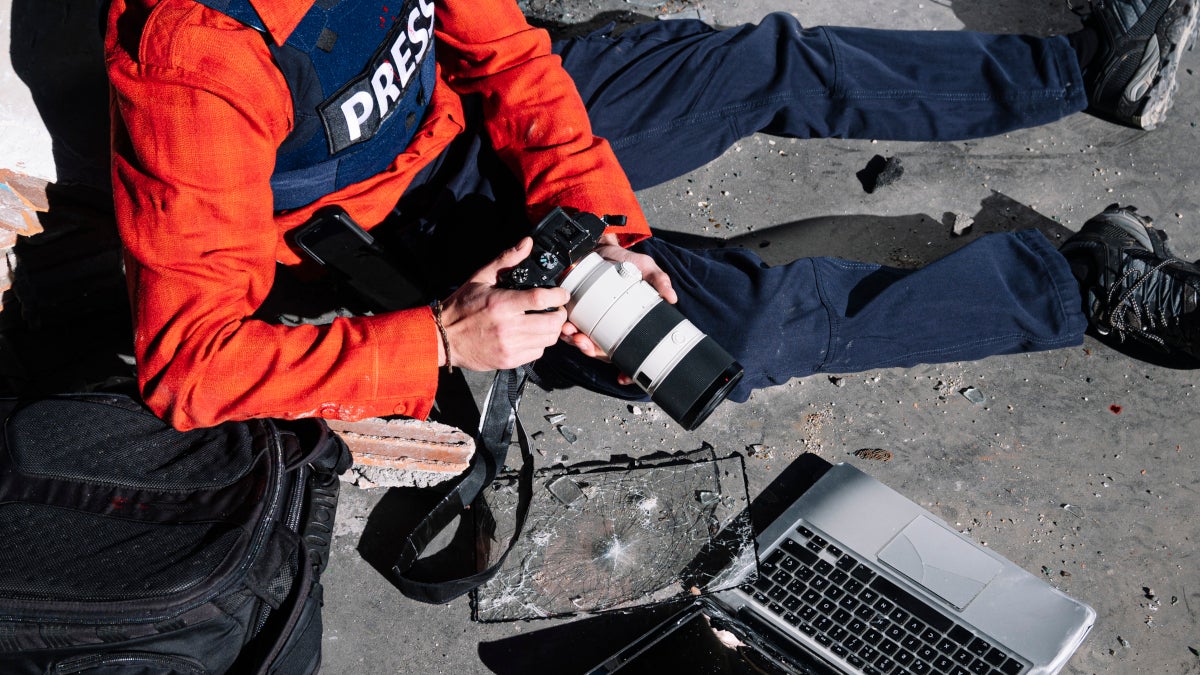
How much is a functioning free press worth to you?
That’s the question posed to potential investors in the Media Development Investment Fund, a non-profit investment opportunity. Yes, you read right. MDIF is set up to funnel capital into independent news sources in nations hostile to the media. It provides returns of 2-5%, more modest than your standard mutual or hedge fund, but the feeling of supporting free expression is priceless.
MDIF makes the argument that money can help people and society without being charity. It also argues that its investments help all investors by keeping markets functioning with accurate, trustworthy information.
For investors looking to make a difference who don’t necessarily need massive returns on their capital, MDIF may be for you.
Its pitch is that without the free flow of information, markets will cease to function. “You can forget your Rolex, forget your Boxster,” said the fund’s Patrice Schneider. “Your children are going to have to live in this world.”
Elsewhere in the financial world, it’s a busy week of M&A with Google making a surprising investment in A24 and Paramount-Warner Bros. Discovery inching towards getting the approvals it needs to close its merger — even as the state AGs seem poised to rain on its parade. I also break down May’s VC investing activity courtesy of our partners from PitchBook.

The Ledger: The Human Investing Approach
THE DEEP DIVE

Investing in News Media in Repressive Countries
Journalism is a tough business, with the cost of producing quality content high and a fragmented media world siphoning away audiences and ad revenue. But imagine how much harder it is in countries that are more hostile to the press or outright banned by the government.
With an anti-press wave hitting around the world, it doesn’t seem like a good time to invest in the news business. Just ask Jeff Bezos.
The Media Development Investment Fund would disagree. It calls itself a fund, but the MDIF is a non-profit set up to funnel capital into independent sources of information in nations hostile to the media. The fund seeks loans and investments from governments and foundations as well as high net worth individuals and family offices, according to Patrice Schneider, chief strategy officer for MDIF and a former war correspondent.
“We are a mixture of a human rights organization and investment fund,” Schneider said. “We act like an investment fund, but we do it for the societal value of a free flow of information.”
- MDIF has invested $280 million in independent media in 50 countries over the past 30 years.
- It offers sub-market returns of 2% to 5%.
- Investments are justified because without the free flow of accurate information, financial markets cannot function. A free press offers political and social benefits as well.
- Last year, MDIF made $9.6 million in new investments, none in the U.S.
MDIF is looking for “concessional capital” from investors willing to accept a lower payoff. Schneider said MDIF has given investors an annual return of between 2% and 5%. “If you’re a rich person and you want me to give you 20% like KKR, I’m not your person.”
Over the 30 years it has existed, MDIF has invested $280 million in independent media in 50 countries and returned $134 million to investors, writing off only 10% of its capital, a rate he said was below the norms for venture capital.

Last year, it made $9.6 million in new investments, adding six more portfolio companies. It returned $6.6 million to investors.
MDIF will not invest in countries where there is no rule of law. “We wouldn’t go into Afghanistan or Iraq right now,” Schneider said. And it won’t lend or invest with people who won’t be able to pay it back. “Our due diligence is based on a very specific process.”
The group aims to back groups looking to provide the population with information while providing a counterparty to the country’s government and rulers. It is important that ownership is independent of the government and has no political, religious or ethical agenda.
Once those boxes are checked, the MDIF assesses whether the management team can execute a commercial strategy.
Success Story
One example of an impactful MDIF investment came in Slovakia, where the government refused to print a newspaper called SMI, which competed with the communist-government-owned paper Smena. MDIF lent SMI €250,000 so it could build its own printing press. Today the company is called Petit Press. It is the second-largest publishing group in Slovakia and has one of the best track records in terms of independent journalism, according to Schneider.
“This is a pretty good success for us,” he said, noting that things have gotten tougher in Slovakia since Robert Fico returned to power in 2023.
Petit Press has also been able to diversify online. It started Piano, one of the first platforms enabling newspapers to sell subscriptions.
MDIF also helped set up a €100 million fund in Europe to prevent state-owned companies in Eastern Europe from buying independent media companies.
So far, MDIF has not made any investments in the U.S., where to European eyes, press freedom appears to be under pressure.
Schneider said that the issue of supporting independent U.S. media is increasingly on people’s radar. “I am afraid we’re about to see what it looks like when information is bad and people don’t trust that the markets function in one of the greatest countries in the world,” he said.
DEAL SHEET
- Ari Emanuel’s Mari Group is in advanced talks to buy ATG Entertainment for $6 billion, according to the Financial Times. ATG, which owns theaters in London and on Broadway, is controlled by private-equity firm Providence, with Blackstone holding a minority stake. Emanuel is also executive chair of WME Group. Mari is backed by Apollo, RedBird Capital and the Qatar Investment Authority.
- Sony Pictures Entertainment invested $100 million in shared reality technology company Cosm. As the leader of Cosm’s Series C financing round, SPE will be a minority owner of Cosm and SPE CEO Ravi Ahuja will become a Cosm director. “Cosm sits at the intersection of several trends shaping the future of entertainment,” Ahuja said. “We’ve followed Cosm since before launch and have been impressed with the quality of the experience and the enthusiasm it’s generating with audiences.”
- The Daily Wire, a politically conservative media company, is in talks with Highmount Capital on a $100 million fundraising round that would value it at $750 million, according to Semafor. After securing the minority investment, The Daily Wire is eyeing an IPO at a $2 billion valuation, although the report said that could take 18 months or more. The company had $48 million in adjusted EBITDA last year, the Semafor report said.
- Google is investing $75 million into A24 to create AI tools for movie production and distribution. The deal does not give Google, which also owns YouTube, access to A24’s film and television library as a data source for training AI models. A24’s last fund-raising round valued the company at $3.5 billion. Google’s investment is reportedly at a similar valuation.
- Piers Morgan’s Uncensored YouTube venture raised $27 million in a funding round that values the company at $145 million. The round was led by Raine Ventures and Antenna Group. Other investors include Simon and David Reuben and Elisabeth Murdoch. The funds will be used to broaden Uncensored’s slate of channels and expand into live events and subscription products.
- Walmart agreed to acquire Vibe.co, which offers a platform that enables small- and mid-sized brands to buy connected TV ad campaigns with the help of a media buying agency. Walmart is looking to increase the advertising revenues of its Walmart Connect commerce and media platform. “Together, we can help more businesses connect with customers across streaming environments while measuring the impact of those campaigns through Walmart’s commerce capabilities,” said Ryan Mayward, GM and senior VP, Walmart Connect U.S.
- Samba TV, a TV data company, acquired Bestever AI, a generative AI platform focused on advertisers and markets. Financial terms were not disclosed. Bestever founder and CEO Apporva Govind is joining Samba as director of product.
WRAP 20 INDEX
It was another big down week for media as the Wrap 20 hit a new low for the year.

FUNDING FILE
Venture capital deal activity in U.S. media companies increased to 28 deals worth $204.8 million in May, more than doubling the 11 deals worth $148 million struck in April, according to data from PitchBook. A year ago, there were 26 deals worth $198.1 million.
The biggest deals were music festival operator Breakaway getting $48.94 million in later VC funding and shopping app company Phia receiving $44.47 million in early VC money.

Under the U.S. entertainment software, publishing and media information category, there were 32 venture capital deals worth $103.2 million in May, down from 41 deals worth $608 million a month earlier. A year ago, there were 58 deals worth $555.4 million.
Some of the bigger deals in the former category included AI game builder Astrocade getting $24 million in funding from a group led by Dentsu Ventures, AI image generator Wirestock getting $23 million in funding from a group led by Formula VC and role-play video game creator Mother Games getting $15 million in a pre-seed/seed round led by BoxGroup.
FINANCIAL ROUNDUP
The Paramount-WBD Saga (Continued)
The European Union is set to approve Paramount Skydance’s $111 billion acquisition of Warner Bros. Discovery with certain conditions, according to the Financial Times. The conditions could include forcing Paramount to quit its joint venture with Universal Pictures, which distributes films in a number of international markets.
Meanwhile in the U.S., California Attorney General Rob Bonta and New York AG Letitia James are reportedly planning to lead a multi-state lawsuit to block the deal, despite the transaction being approved by the U.S. Department of Justice. State AGs have had success blocking deals cleared by federal regulators, including getting an injection halting Nexstar’s integration with Tegna despite the deal already closing.
With the EU set to potentially clear the deal in early July, the clock is ticking for the states to act.
FROM THEWRAP
Inside Hollywood’s Plan to Sell Congress and Trump on a Federal Film Tax Credit
We Made an ‘Off Campus’ Microdrama for $150 Using AI: The Results Are Shocking
DDA Talent and Worldwide Production Agency Merge to Form New Global Below-the-Line Agency
HEARD AROUND
Christopher Nolan Just Fulfilled a Lifelong Dream, After Daring Imax to do Something Groundbreaking
Vegas Golden Knights Owner Bill Foley Seeks NBA Franchise With Morgan Stanley
Procter & Gamble Scripted Dramas Are Coming to a Supermarket Near You