In January of 1940, just prior to Japan’s attack on Pearl Harbor in the international settlement of Shanghai, everyone felt relatively calm and safe. That was despite the fact that the Japanese army was camped across the Huangpo river. This past May 21, I traveled to visit Beijing and Shanghai; it was my third trip to Shanghai and my second to Beijing. Shanghai was the city of my birth.
 I was born to Russian-Jewish parents who had gone there as children in the 1920s, escaping the persecution of Jews in Russia and Europe. At the time, there were about 25,000 to 30,000 Jewish refugees in Shanghai, predominantly Russians, who managed to escape in the 1920s.
My mother was born in Harbin, Manchuria, of parents born in Odessa. This was the final stop of the Trans-Siberian railroad. My father was born in the Ukraine in 1918. My grandfather, on my father’s side, had fought in World War I; on my mother’s side, both her grandparents were rabbis. They had sent their young children, age 14 and 15, now married, to Manchuria with the hope that they would survive both anti-Semitism and famine.
This time, unlike my past visits, I decided to see several of the places that had been a part of my childhood that I had not been able to see on previous occasions.
The Shanghai of today is obviously a different city. The enormous economic boom has brought architects from all over the world to build extraordinary monuments, with lightning speed. Gone were the dead bodies on the street filled with rickshaws and pedicabs, replaced by Western designer clothes, brand-new cars and freeways.
My host, Jonathan Shen, and his wife, Iris, introduced me to Dr. Pan Guang (right), a professor from Nanjing University, whose main study was the history of the Jewish people in China. He seemed to know every detail of their lives in Shanghai.
 I had come to Shanghai 12 years earlier as an adviser to the first Shanghai Film Festival. At the time, I was able to bring my parents, who got a chance to see it after an absence of nearly 50 years. They got to visit the places of their youth.
By the ‘30s, my dad had started as an apprentice garage mechanic and became the head of a division of ITT. My mother had a dress shop catering to Chinese actresses. Upon arrival in Shanghai’s airport, I noticed my father’s tears. I asked him why he was crying, and he replied, “Son, this is the place that saved our lives. These are the people who made sure all of us are alive today.”
This time, I would try to go back and see what that their experience had been. Dr. Pan Guang and his delegation of researchers took me to my former school, the Shanghai Jewish Public School. I had seen it in pictures (below). But here I was, in front of it, newly painted. On that same property was the synagogue that had been the scene of my parents’ wedding, dancing to Al Jolson’s wedding song, now freshly painted and restored (below right).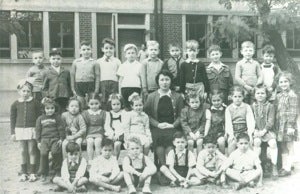
From there, I picked up my cell phone and called my mother to find out where the apartment was, and it was within walking distance. However, as I got there, I saw that it was no longer there. Now there was just a highrise. I was happy to find out that my parents had seen it on their last visit.
We then proceeded to the Shanghai Ghetto. This was mainly used for the arrival of German and Austrian Jews who had managed to escape right before the beginning of World War II. A lot of the old buildings had been preserved. The estimates of how many Jews were there varies. 
Also in the area there was a Jewish museum (below left) with pictures of famous Shanghai Jews and objects of the time. Among them, pictures of Michael Blumenthal, former U.S. secretary of Treasury, Yosef Tekoah, former U.N. Israeli ambassador, and other famous names who had come to Shanghai, such as Albert Einstein.
The Chinese people I met welcomed me with open arms. Now I understood quite clearly why my dad had cried when he returned to Shanghai. I felt connected to the place and I feel no fear of what China will do on the world stage. They certainly seem to be going in the right direction. My hope is that they will deal with it responsively.
The rise of China is both a challenge and an opportunity. Legend has it that Napoleon once said of China: “There lies a sleeping giant; let it sleep, for when she wakes she will shake the world.” The question is whether she is a constructive competitor, which will require engagement, or the sleeping giant waiting to pounce.
How lucky can one be to survive the turmoil of that time? I feel a certain amount of pride to be a part of that history and get a full measure of its connections to who I am.
In 1947 my parents, my younger sister Ronnie and I left for Chile. I feel lucky to have had some success in my chosen profession. I have always wanted to make sure that my sons, Brian and Nicholas, and my wife, Irena, would never live in those kinds of times. Irena’s parents, who were Russian Orthodox, had both been in German concentration camps. Like my parents, who had gone to Chile, hers strangely enough had gone to Morocco and had arrived in America in the same year, 1957.
I’m happy that I’ve been able to get back and revisit my roots and relationship to my family. It gives one a clearer vision of one’s “self.”
If you’re lucky, life is a long quest for learning how and why we’re here. Inevitably, everyone makes mistakes. Some of them can be attributed to youth and immaturity. But those of us who get to grow older and see the resemblance to our parents and ancestors are very lucky.
My father passed away five years ago, I miss him every day. My mom is still alive, 89 years old and taking what is, perhaps, her last trip to Chile. Irena’s parents are no longer with us, but my hope is that someday my children will understand all of this and decide that life, while complicated and beautiful, inevitably leads you to believe that it is about connecting to your past and about doing something for others, that is, living outside yourself and generations of their families, some of whom had suffered through persecution and famine, was a part of their history.