

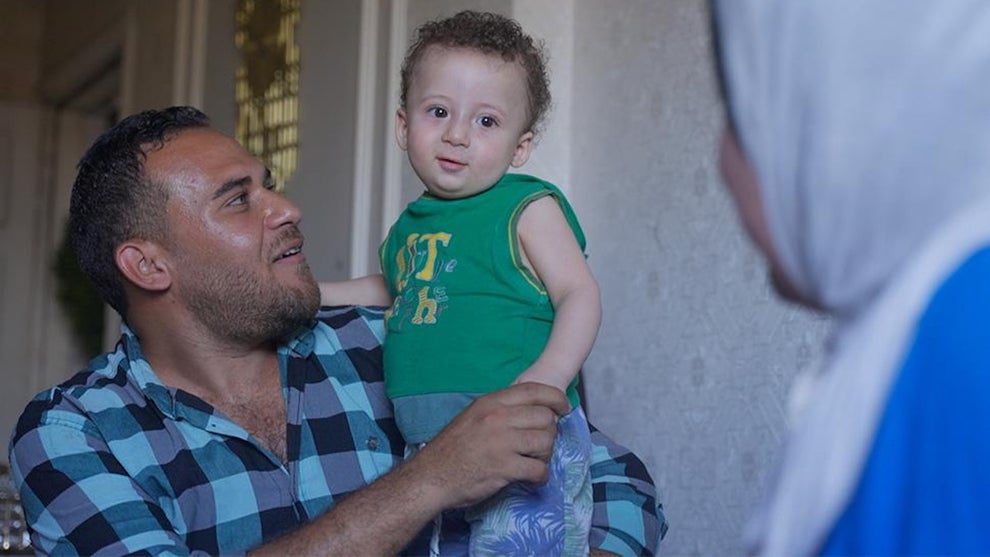
The frustration of trying to understand what is happening in Gaza is exemplified in a new documentary screening at the Venice film festival called “Citizen Osama” by Ahmed Hassouna, which was also recently chosen as the Palestinian entry in the Best International Feature Film category at the next Academy Awards.
Through the daily life of a young Palestinian father named Osama al-Ashi, the documentary reveals up close and in detail the suffering of Gazans and their struggle to survive during the devastating war that has killed more than 70,000 people in the tiny strip. The war in Gaza followed Hamas’s invasion of Israel on October 7, 2023, the savage massacre of 1,200 people and the taking of 250 hostages to Gaza.
Osama is a journalist – presumably in Gaza City in the northern strip – trying to keep his family safe while chronicling the war. Frustratingly, the film does not tell us very much in the way of simple facts: where and when the footage was shot, for example, or for whom Osama is working as a journalist. (He seems to be a videographer rather than a reporter.) This basic information matters for lots of reasons, not least for offering the viewer a framework for taking in a rare, ground-level view of a Palestinian’s daily experience.

What “Citizen Osama” shows us effectively is the suffering of Palestinians on the daily. Gaza City is a hellscape in the midst of ongoing hostilities. Piles of rubble are heaped beside half-broken buildings, all in Osama’s neighborhood. When buildings collapse on nearby residents during the shelling, he and other neighbors dig through the rubble with no visible tools to retrieve the dead and wounded. Deprivation is beginning to set in; Osama wanders from one vendor to another in search of diapers and formula for his baby. He finds a kilo of flour but must sift out the worms before it can be used in cooking. He and his friends exchange fantasies of having chicken and meat, because there isn’t any.
And Osama’s mother is hysterical with worry every time he goes out in the street to work, video camera in hand. But then the family apartment is hit by shrapnel during a shelling, and it seems just as dangerous to be at home. Osama is driven to bear witness, though what happens to his footage we never know.
In this documentary, as in so many other images that we have been privy to in Gaza, there’s nonstop suffering and chaos in the absence of context. In one scene there are flatbed trucks packed with dozens of shouting young men, followed by other flatbed trucks with piled what appear to be dead bodies. There’s a fleeting glimpse of what appears to be men with guns taking humanitarian aid. Who are the men? Where are they going? Who died and how? No one explains.
Throughout, there is no sign of a government of any kind. Or Hamas fighters. Or official anything. There’s no humanitarian organization, no civil services. There’s not a bulldozer or a backhoe or any machine of any kind to move rubble; there are not even hardhats and gloves for the digging to save the people caught under collapsed buildings. It’s just full-on chaos with men like Osama running around, trying to chronicle the devastation and save their families.
So as a portrait of human suffering, the film is effective, but it is not the full picture and leaves hanging all these unanswered questions. Where is Hamas in all this? There is a scene shot outside a hospital where Palestinian journalists apparently gather, but the only ones we ever see are Osama and his friends. There’s no mention of Israeli hostages, which is not a real surprise. And of course, you almost never see any women, anywhere, and when they appear they are often obscured. (Surely they exist?)

Palestinian director Hassouna, who studied journalism at Al-Azhar University in Gaza, previously directed the 2019 non-fiction feature “Istrupya” and participated in the 2024 anthology work “From Ground Zero,” which featured 22 local directors telling stories from Gaza and was the 2024 Palestinian Oscar entry.
The storytelling and first-person footage is important because international journalists have not been allowed into the Gaza Strip since October 2023, including since the ceasefire of last October. Fake reporting and deliberate propaganda has drip-drip-dripped like poison into the charged public debate over important subjects like famine and alleged genocide, without the benefit of independent, first-person reporting.
This film has the opportunity to fill in missing parts of the story, but instead it raises questions about all the parts that are left out.
My guess is the film was shot around 12 months into the war, during one of the many evacuations of Palestinians from the north to the south to evade Israel’s invasion of Gaza City. The film depicts humanitarian aid pallets floating down in parachutes as men storm across a dusty field to retrieve food. It also shows the flurry of leaflets of war dropped by the Israeli army warning residents to evacuate to the south. There is a brief image of Israeli tanks, but that’s the only sign of those forces.
There is talk of starvation and hunger, but no evidence of it. There is talk of journalists being targeted and two having been killed, but very little context of who these journalists are working for and how they died. There is never any suggestion of how the war started, how it might end, or what the political, military and humanitarian crisis might require.
Palestinian suffering is not new and it is the centerpiece of worldwide protest against the devastation of this war. But it is also a deliberate political strategy that has cynically been conducted by Hamas, both to allow their people to suffer and to make sure that it is witnessed and seen by the world.
If you were looking for understanding beyond the pain, you will have to wait for another film.
Another documentary about the war in Gaza, “NAZA,” will have its world premiere in Venice on Thursday. That film was directed by Yuval Abraham and Rachel Szor, two of the filmmakers whose “No Other Land,” also set during the war won the Oscar for Best Documentary Feature two years ago.
