

If it feels like Hollywood is out of new ideas, the data suggests you aren’t entirely wrong, but for studios and streamers, this lack of originality may be more calculated strategy than creative dry spell.
Historically, movies have drawn from existing intellectual property (IP) more heavily than series. However, that gap has closed. Over the past three years, a larger share of new series premieres have been based on existing IP (12-14%) compared to movie premieres (11.5% of new movies in 2025).
Just looking at the volume of these new releases, however, drastically understates their impact. Existing IP adaptations vastly overperform original concepts. While IP-driven films made up just 11.5% of the 2025 movie slate, they generated a commanding 47.1% of total audience demand. The television landscape saw a similar trend, with adaptations capturing 37.5% of demand despite representing only 13.8% of new shows. If we just look at the top 100 most in-demand titles, existing IP is even more heavily represented.
When it comes to where existing IP is sourced, books are the single largest source of material for film and television, with literary works accounting for 37.6% of all adapted IP titles that premiered in 2025. This is the highest share for book adaptations since 2017, so they have only been growing in importance. Franchise extensions (22.3%) and true stories (15.2%) followed behind, while comic (5.1%) and video game (1.6%) adaptations commanded much smaller shares of the pie.
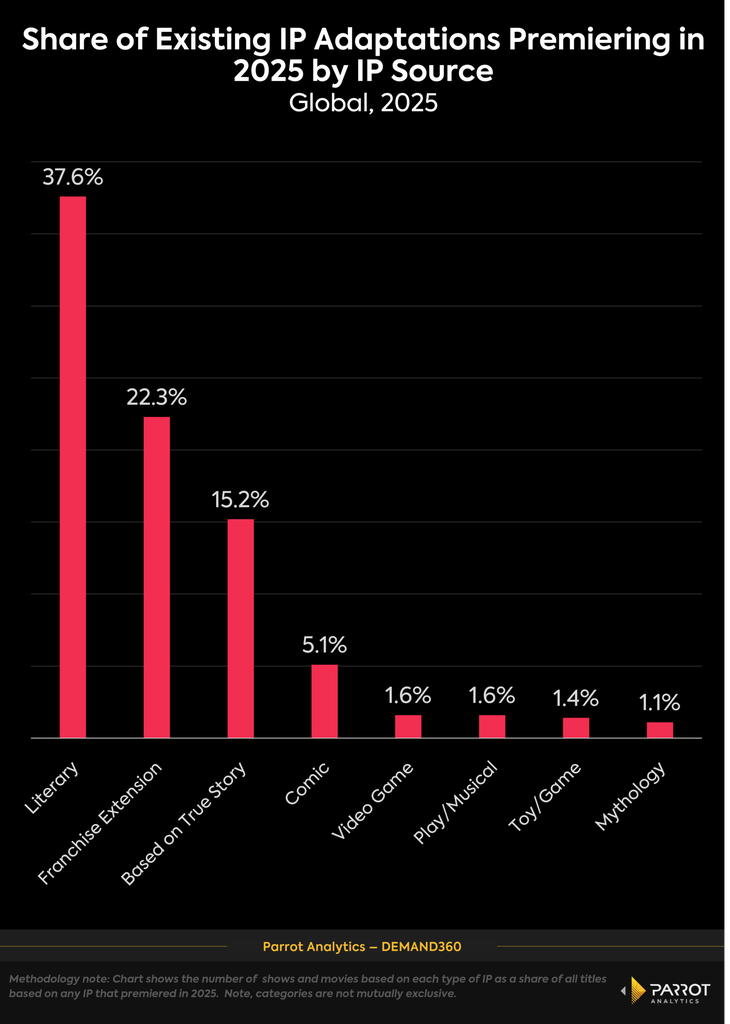
The return on investment for these literary adaptations is undeniable. Shows and movies based on books have generated 3.4 times the global demand of the average title. The reason is clear: books provide tested concepts and built-in, passionate fanbases that give marketing teams a crucial head start. It’s no surprise that platforms continue to heavily stock their slates with recognizable novels, relying on established readership to cut through an increasingly crowded content landscape.
Literary IP has also been successful at appealing to a range of demographics where other adapted formats may have more of a skewed audience. For example, shows and movies that are based on video games are highly concentrated, pulling an audience that is overwhelmingly male (73.6%) and heavily Gen Z (48.5%) – useful for targeting young men but not exactly a broad audience.
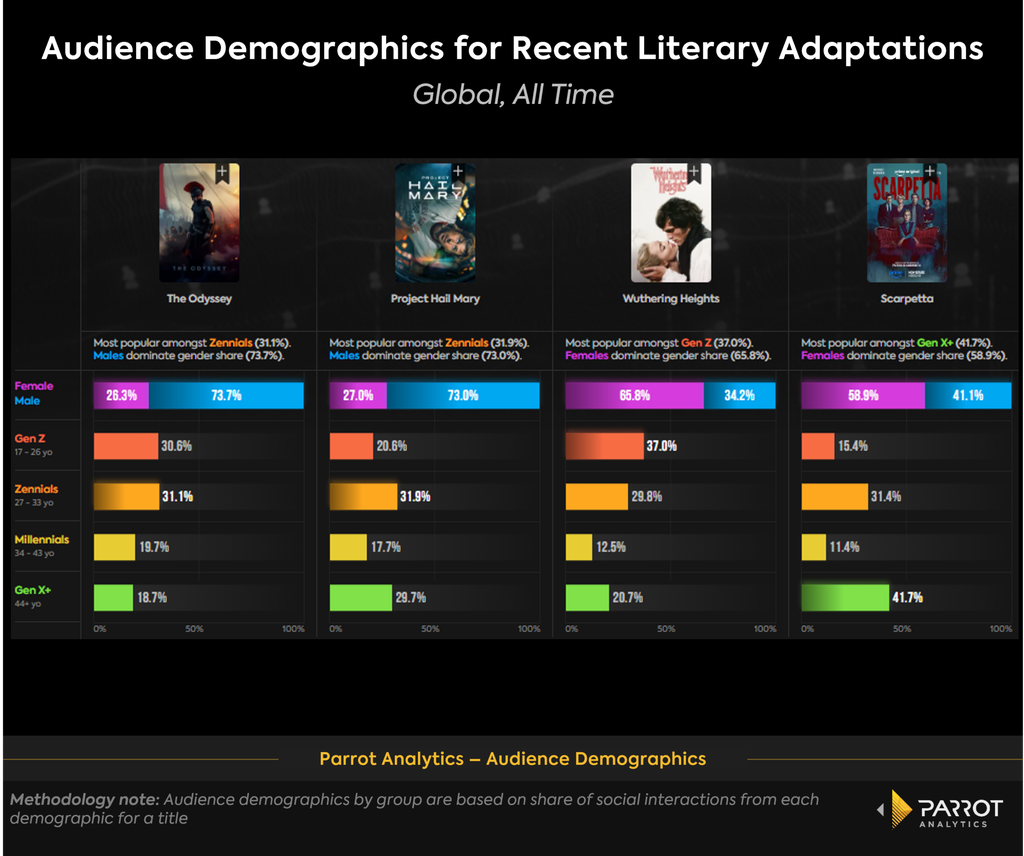
While book adaptations overall have a slightly older tilt to their audiences (30.6% are Gen X or older), a high level look at some of the year’s biggest releases based on books shows literary adaptations can be appealing source material for a range of ages. “The Odyssey” broke through with young men; The latest adaptation of “Wuthering Heights” won over young women. When it comes to building a guaranteed hit, a library card just might be the most valuable asset in town.
