Moving with all the urgency of molasses in winter, Casey Affleck’s “Company” starts out intriguing enough. In the middle of a downpour, a mysterious young woman arrives at a suburban house where a Christmas party is in full swing; she’s uninvited, but received warmly anyway, claiming that she was looking for a previous resident.
By the glow of the fire with a cup of tea in hand, she introduces herself to the other partygoers as Evelyn, and begins to spin a yarn that she explains was told to her recently by a dying relative. From here a tiresome story-within-a-story-within-a-story format unfolds, with three connected stories taking place in 1975, 1953 and 1903 realized one by one like Russian nesting dolls.
Purportedly, this gothic drama is about the limits of human compassion and the inevitable futility of revenge, but in reality, “Company” serves better as a test for the limits of audience patience due to its irritating habit of interrupting its own narrative.
This is Affleck’s third directorial effort, following 2010’s mockumentary “I’m Still Here,” which covered Joaquin Phoenix’s short-lived pivot to a hip-hop career and 2019’s post-apocalyptic weepie “Light of My Life.” Like his elder brother, Affleck obviously has a respect for the craft of filmmaking, and in “Company” he’s clearly taken cues from the directors he’s worked with previously.
This film owes much of its visual style to Andrew Dominik’s “The Assassination of Jesse James,” in which Affleck starred, and he even co-wrote the “Company” script with novelist Ron Hansen, who wrote the book Dominik’s film was based on. There are a few strikingly poetic lines, but overall this screenplay feels labored, bordering on pretentious.

Somewhat bizarrely, “Company” has eight credited cinematographers, many of whom have high profile previous credits: Masanobu Takayanagi (“Silver Linings Playbook”) Lachlan Milne (“Minari”), Adam Arkapaw (“True Detective” and Affleck’s “Light of My Life”), Marcell Rév (“Assassination Nation”), Joaquin Baca Asay (“Paper Tiger”), Holger Jungnickel, Noah Fallis and Affleck himself. It’s unclear why “Company” required such an extensive team of camera talent; while there are three timelines at play, there doesn’t appear to be a conscious decision to shoot each period differently.
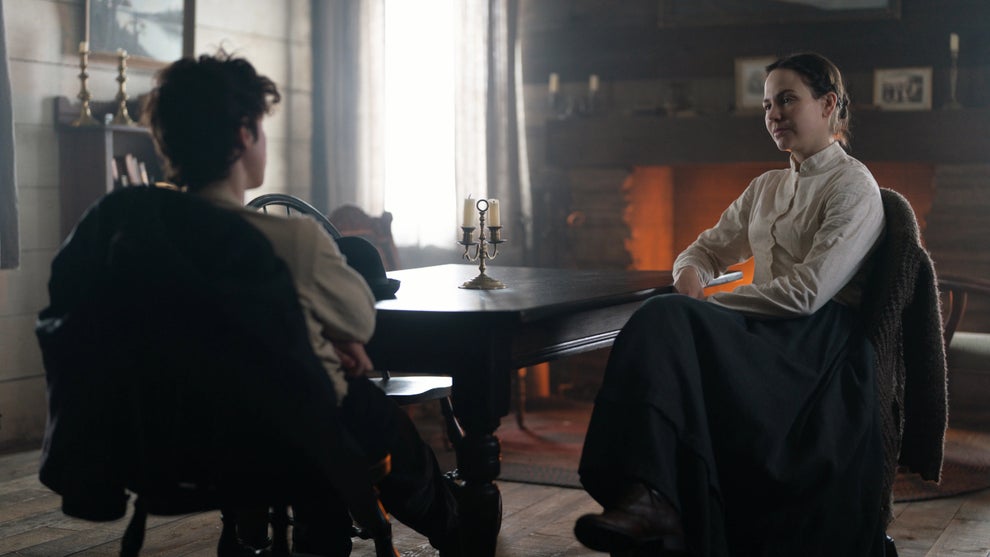
Despite occasionally striking images and an abundance of handsome mountainous landscapes, there’s nothing to separate “Company” from similar period pieces, and the fact that so much talent apparently contributed to the film’s visuals is perplexing.
Sliding back and forth across the three timelines, Affleck utilizes an ensemble cast, including his teenage sons Indiana and Atticus. In Evelyn’s (Emily Alyn Lind) story told at the party, Nick Nolte plays a frail old hermit named Tom who rescues a young woman he finds unconscious in the snow near his isolated cabin. Bob Dylan’s “Shelter From the Storm” proves an on-the-nose opening and closing needle drop; Alice (played by Affleck’s real-life partner Caylee Cowan) offers to tell Tom a story to pass the time until morning, in which the occupants of that same land some 50 years earlier – Rebecca (Adelaide Clemens) and her husband Emmett (Scoot McNairy) – also take in a drifter. He’s a sullen young man named Caleb, who eventually takes a shine to the lady of the house while having plenty to say about how Rebecca and Emmett do things.
At the same time, Rebecca and Emmett’s intense neighbor Kleinschmidt (Ben Mendelsohn) takes matters into his own hands following evidence of a local serial killer preying on livestock and humans alike, ripping their hearts from their chests.
Characters speak in metaphors and sly smiles rather than plainly; they talk about the very themes of the film, chiefly vengeance and forgiveness, leaving little room for ambiguity. These three similar stories eventually coalesce, and we come to understand their connection, but it takes Affleck an awfully long time to get where he’s going, so much so that “Company”’s meagre 100-minute runtime seems to stretch far beyond the reality.
This is particularly frustrating because the grand reveal that “Company” eventually delivers completely shifts the scope of the film, transforming it into something supernatural and altogether more interesting, but the cloying slowness of the 80 minutes prior means that by the time the revelation comes, it feels completely out of left field and there’s no time left to unpack its implications.
The repetitive, rigid storytelling structure convolutes the narrative and hamstrings emotional beats, while the unrelentingly somber and serious dialogue creates a leaden atmosphere that only lifts in the film’s final scene, hinting at a new story that is far more enticing than the one that just came to a close.
By the time Affleck finally shows his hand, it’s too little too late, and you’ll be wishing you were without “Company” entirely.