

In front of the recently refurbished Alex Theatre in Glendale, Calif., flanked by Sen. Adam Schiff and a half-dozen fellow California House Democrats, Rep. Laura Friedman spoke of the urgent need to pass a federal film tax credit to provide a lifeline to hundreds of thousands of film and TV crew members who have struggled as Hollywood production has fled the country.
“Sixty-five countries offer incentives we don’t match, and no single state can outbid a foreign government on its own,” the freshman Congresswoman said earlier this month. “Our bipartisan bill is built on labor costs, which means it only pays off when American workers get hired. These are good paying union jobs with benefits and pensions, and I won’t stop fighting until they come home.”
Though the politicians at Friedman’s event were all deep blue, the Motion Picture, Television and Entertainment Revitalization Act is far from a partisan bill. With Republicans also lining up to support the bill, there is high optimism on Capitol Hill and among Hollywood lobbyists and producers that Congress will pass the federal incentive during the lame duck session set to begin in early November following the Nov. 3 midterm elections.
The highly anticipated bill — which received new life when President Trump endorsed the idea in early September — would provide a much-needed stimulus in American film production, which has been in decline over the last quarter century.
If the federal film tax credit passes – and there’s high confidence among lawmakers that it will – industry insiders anticipate that it will trigger a competition between dozens of states to take advantage of an expected surge in production — and that California shouldn’t assume it will get the lion’s share. In a roundtable hosted by TheWrap, film commissioners and soundstage execs who work in California, New Mexico, Georgia and New York said that plans are in motion in their states and others to hit the ground running in 2027 should the bill be signed by Trump.
Scott Karol, President/COO of SP Media Group, has had the ear of Trump alongside actor Jon Voight, the administration’s Special Ambassador to Hollywood, and SP Media founder Steven Paul. He told TheWrap he’s been amazed by how quickly both parties, despite the turbulence affecting virtually every other political issue in Washington, have gotten onboard.
“People are frustrated that nothing is getting done in politics, but in every discussion I’ve had about the need for a federal tax incentive, the response I’ve gotten has been, ‘This is a good idea. This will help a lot of people. Let’s get it done,’” Karol said.
According to a study commissioned by multiple Hollywood unions, the share of production spending committed by major Hollywood studios to film shoots located within the U.S. has decreased from 74% in 1999 to 42% in 2024. The availability of federal tax incentives in countries like the U.K. and Canada on top of local and provincial incentives has been a driving force in that decline, and Karol said that an American equivalent of that has been long overdue.
“I’ll tell you what I told President Trump: We don’t need to have the best tax credit. We just need a competitive one,” he said. “The U.S. has the best crews. It has the soundstages and the locations and everything else needed for filming in this country to flourish again. What we need is an incentive structure that eliminates the gap between how expensive it is to film here versus filming elsewhere.”
Starting in 2027, that gap may finally be bridged. But while conventional wisdom might suggest that California will be the biggest beneficiary of a federal incentive as Hollywood’s home, it may lose out on much of that anticipated surge to other states that are gearing up with lucrative tax packages and shiny new soundstages to win over studios and indie producers alike. That is, unless it steps up its own incentive game.
A four-week blitz
There’s a tight window for the federal film credit to get passed when Congress returns to session on Nov. 9. It’s also just one of a long list of items that lawmakers will hope to address before the end of the year. Among those is a government funding bill that must pass before Dec. 11 to avoid another shutdown, a bill to fund farm aid programs that expired at the end of September and an annual vote on the National Defense Authorization Act that has stalled in the Senate over the Trump Administration’s war in Iran.
But with bipartisan support and an expected full-scale lobbying push by Hollywood’s studios and unions, confidence is high that the bill can be pushed through both houses and sent to Trump for signature before the targeted Senate adjournment date of Dec. 18.
Meanwhile, the pressure is on from the entertainment workforce for the tax credit to deliver as promised. This past week, SAG-AFTRA President Sean Astin cited the actors guild’s lobbying for the bill and other efforts on the state and local levels to boost production as members have become increasingly frustrated over the difficulty of finding employment and reaching the minimum earnings threshold needed to maintain their union healthcare. That annual threshold is set to increase to over $31,000 by 2030, a total that many working actors are falling well short of.
“Today, the notion of middle-class life is becoming harder and harder to see. There’s downward pressure on everyone and fewer opportunities all around,” he said. “But what we can do, what your union can do and is doing, is to use every bit of leverage we have to make sure working performers have a place in whatever this industry becomes.”
But while the floodgates may be opening for the American film industry, there will be a race between states to collect the productions that pour forth. As several industry insiders told TheWrap, some states may be better positioned to take advantage of the federal credit than others. And as one studio executive noted, the biggest winner of that incentive may not be Hollywood.

A competition between states
Hollywood’s most scrutinized CEO, Skydance’s David Ellison, is on the same page. Speaking to reporters following the close of Paramount Skydance’s acquisition of Warner Bros., Ellison said that following the settlement of the lawsuit seeking to block that merger he told California Attorney General Rob Bonta that more work needed to be done even with a federal incentive to make California competitive.
“Even if you got the federal rebate, California would not be as competitive with some of the other states in the United States,” he said. “Jersey is at 43%. Georgia is at 38%.”
While California has raised the annual cap on its state incentive from $330 million to $750 million, producers and studio execs told TheWrap they believe that it’s the tri-state area that’s most likely to see the biggest American production boom in the years ahead. That’s because New York, which has an $800 million cap on its state incentive with a separate $100 million-capped program for indie productions, allows above-the-line spending to be included towards its 30% baseline tax credit — and up to a 40% limit of all other combined qualified costs.
New Jersey’s tax credit program is more complicated, with allocations for various types of productions including a $250 million program for studios that sign deals to occupy soundstage complexes in the state like Netflix, Lionsgate and Paramount, the latter of which is set to occupy 1888 Studios, a 1.5 million-square-foot complex being constructed in Bayonne. But as Ellison noted, productions enjoy a 30% base rate that includes above-the-line spending and can reach 44% with bonuses.
And then there is Georgia, whose uncapped incentive program and state-of-the-art soundstages like Trilith Studios on the outskirts of Atlanta once made it a mecca for blockbuster filmmaking. But according to state economic data, film and TV output has fallen from a peak of 412 productions with a combined $4.4 billion in direct economic spending in 2022 to 245 productions and $2.3 billion in 2025. Marvel Studios’ “Avengers: Doomsday” was the most high profile move as it was filmed in the U.K. after “Avengers: Endgame” was filmed at Trilith, but it is far from the only one.

“The reasons for moving out of the U.S. can vary from studio to studio depending on what soundstage deals they make, but labor costs are the common denominator,” said one production exec at a major studio who spoke on condition of anonymity. “The gap in costs between hiring union in the U.S. and hiring even union in other countries is getting bigger because of that lack of a federal tax credit.”
Which is why industry insiders believe that should such an incentive be passed, several U.S. states would immediately take advantage, especially considering that, according to Congressional insiders, the tax credit would be handled by the IRS, eliminating the need to create a federal film commission and allowing the incentive to take immediate effect.
But Thomas Laub, producer and EVP of studio strategy for Shadowbox Studios in Georgia, noted how the impacts will be felt state-to-state will depend on several factors, including the aforementioned infrastructure and crew base sizes that Georgia, New York and New Jersey are building.
The other key factor, however, is stability.
“The U.K. tax credit has been stable for 20 years, whereas I think the fear or the worry, perhaps, of a U.S. federal film incentive is, what if it creates two, three golden years of American production, which would be marvelous, and then in three years — due to political pressure, the desire to cut budget, etc. — that is suddenly perhaps taken away,” Laub said. “How does that affect the states who have used state funding to create some film infrastructure, expended millions and millions of dollars on workforce development to train additional local crews?”

Uncapped California?
Stability has also been a question for California, where industry lobbyists and lawmakers scrambled to adjust the state’s incentive to account for a new law that puts a cap on tax breaks for all businesses in the state. Independent productions will be exempt from that cap, while major studio productions will be able to take advantage of accelerated payouts.
While there had been concerns that the abrupt changes would decrease producers’ confidence in the incentive program and push them towards other states when moving projects back to the U.S. from overseas, studio execs tell TheWrap that the biggest thing holding back California from being truly competitive is the inability to include above-the-line salaries as eligible spending.
“The changes they made to what kind of shows can qualify has helped a lot, but as long as that above-the-line rule is there, there’s a big chunk of major productions with large crew sizes that aren’t going to consider California,” said one exec. “And the only way to include above-the-line spending will be to uncap the program, because that’s the only way to satisfy demand, especially with animated features now drawing from that $750 million pool.”
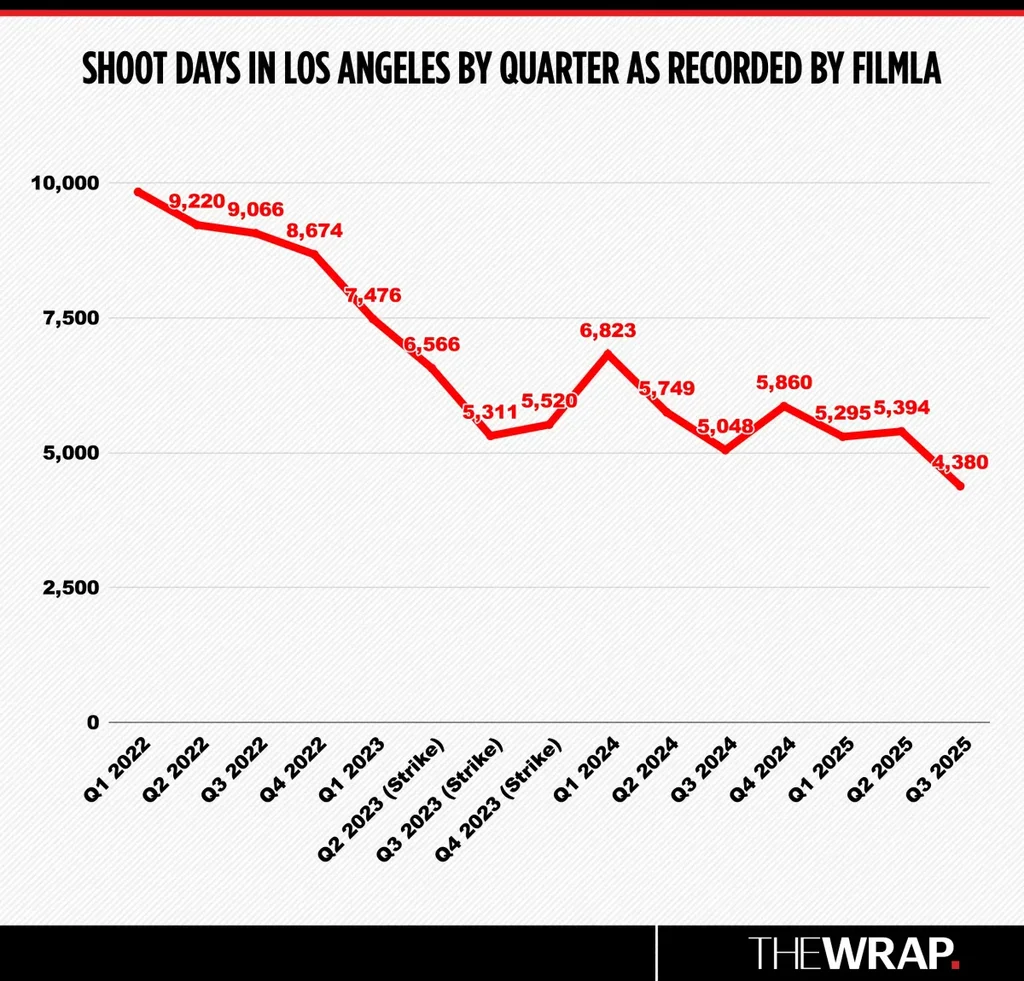
California is in a paradoxical position. With a labor base that is among the largest in the world thanks to decades as the undisputed center of the entertainment world, the recent decline in Golden State productions has sent thousands of crew members either to other states in search of work or into other careers entirely. But the demand for production incentives that remains is still large enough that unlike other states, California’s program has to establish specific windows during which productions can apply to ensure that incentivized projects shoot in the state year-round, and those that do receive credits must begin shooting within 180 days of approval, which can make some producers who are juggling location availability, actor schedules and other logistical issues reluctant to commit to such a time frame.
It is unlikely those rules will change any time soon, as insiders at the California Film Commission say that the 180-day rule is done to ensure that the program fulfills its intended goal as a jobs builder that provides a net boost to the state’s economy. But when California legislators return to Sacramento in 2027, it is expected that there will be a push to uncap the incentive program to avoid getting left behind in the race to capture Hollywood productions moving back to the U.S. Los Angeles Mayor Karen Bass, who is running for re-election Nov. 3, has voiced her support for the uncap along with the federal incentive.
“Right now, California wouldn’t be in my top 5 states to shoot,” the exec said. “New Jersey, New York, Georgia, Illinois … those are in general the prime spots. Ohio and Kentucky are on the way up too. But California’s still too complicated.”
