I have a soft spot for sitcom-style comedies where a comic mix-up or polarized personalities conflict. I remember rewatching the Sinbad comedy “Houseguest” where he cons his way into the life of Phil Hartman’s family and makes them richer for the experience. There’s a similar vibe in Frank Oz’s “What About Bob?” where the neurotic Bob (Bill Murray) provides a constant nusance to beleaguered psychiatrist Dr. Leo Marvin (Richard Dreyfuss).
These are firmly PG hijinks, and the new Netflix movie “Little Brother” tries to find a way to use the soft premise of an unwanted houseguest and inject it with Eric André’s signature edge. But as much as I like André and his co-star John Cena, Matt Spicer’s comedy never reconciles its distinctively different tones. It aims to be a raunchy comedy with a sweet center but always plays as off-balance.
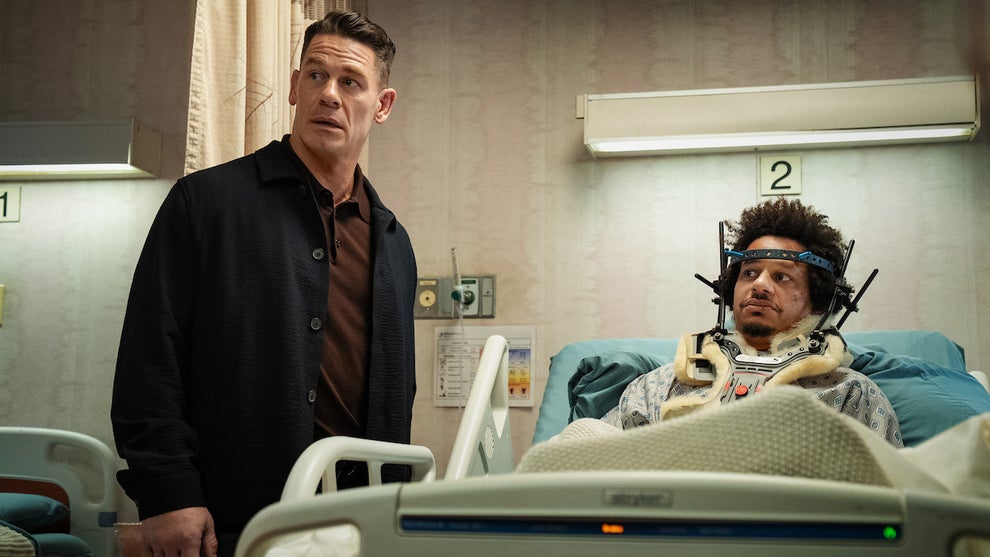
When he was a teenager, Rudd (Cena) signed up for a Big Brother/Little Brother program and paired with Marcus (André), a lonely kid who was constantly moved around foster homes. For Rudd, this relationship was a blip, but it meant the world to Marcus, who continued to idolize Rudd for decades. Thinking he’s staying in touch with Rudd (when it’s actually Rudd’s assistant Mia (Sherry Cola)), Marcus senses that his big brother is in trouble, so he busts out of a psychiatric hospital and rushes to Rudd’s aid only to be t-boned by a truck. Since he has Rudd listed as his emergency contact, Rudd and his big-hearted wife Deirdre (Michelle Monaghan) come rushing to the hospital thinking the call is about Rudd’s actual brother, the grotesquely wealthy and successful Josh (Christopher Meloni). While Rudd, who is trying to land a reality show gig that will boost his real estate business, is reluctant to help Marcus, Deirdre insists that they take him in while he recuperates. Shenanigans ensue.
On the surface, Spicer seems like a good fit for the material given the central relationship in his previous movie, “Ingrid Goes West,” which also focused on a parasocial relationship. But while that film had a consistent tone of menace and obsession, “Little Brother” never seems clear on what it wants to be. The film opens with a charmingly bizarre exchange between Marcus and his roommate at the hospital and the roommate offers Marcus his companion, a rock with googly eyes, as a goodbye present, noting that “she’s a tender lover.” But Rudd is in more of a typical sitcom-style comedy where he’s worried about the big presentation, measuring up to his older brother, and other conflicts that track as fairly relatable. The idea that Marcus is coming to blow up Rudd’s life in an ultimately positive fashion never fully clicks because everyone has to accept that Marcus is a breath of fresh air and Rudd is being unreasonable.

In a PG comedy, these comedies of errors manage to work because the encroachment is big, but never offensive to anyone other than the most uptight person, represented by their co-lead. Here, Rudd is uptight, but Marcus is so chaotic that it’s tough to buy everyone else seeing him as a lovable eccentric.
For example, when Rudd is forced to take Marcus along to the first day of shooting on the reality show, he demands that Marcus stay in Rudd’s fancy Porsche so as not to screw anything up. Marcus, a grown man, needs to use the restroom, but seeking to obey Rudd’s edict, decides that the compromise position is to piss out the window. But then this weirdness gets brushed out of the way when the TV show’s producers love the angle of Rudd teaming up with his former little brother, so Marcus becomes a co-realtor with Rudd. Him urinating into the street out of a parked car never bothers anyone.
“Little Brother” is not consistently weird enough to own that tone in the way of André’s hidden camera comedy “Bad Trip” or a David Wain film like “Wet Hot American Summer,” but neither is it gentle enough to be the “workaholic-learns-the-value-of-family” comedy that Cena represents. This means you get scenes that can be funny in a piecemeal fashion like a shocked Rudd discovering that Marcus is having sex in his study with a nurse from the hospital while her husband watches, but we then have this bizarre world where Rudd is the only one upset by it while his wife just shrugs it off.
There’s no rule that these two tones can’t come together, and there’s certainly a whole genre of raunchy comedy that has a sweet center. It’s more the bizarre, chaotic energy André brings that has trouble finding a place in the staid, sitcom confines of the larger world. When André showed up as a futuristic cop in the madcap “I Love Boosters,” he fit perfectly with the outré approach of writer-director Boots Riley. But here, he’s adrift, a big ball of comic energy that tears through a movie that accommodates him but never fully embraces him. Marcus is supposed to be fun, but the film has to bend over backwards to make his joviality appear socially acceptable. Perhaps with a more confident direction and firmer tone, this would have worked, but here it merely plays as abrasive. Rudd is uptight, but that doesn’t inherently make him wrong. The rest of the film has to do more to show that Marcus is the upheaval that Rudd needs.
In the case of “Little Brother,” the film probably should have followed the weirdness set by André’s character and performance. That’s the brightest color in the film’s palette, and although contrasting it with relative normalcy makes dramatic sense, there comes a point where such a contrast is no longer narratively tenable. Instead, “Little Brother” feels like it’s trying to catch up to André’s whirlwind and ends up getting swept away.
