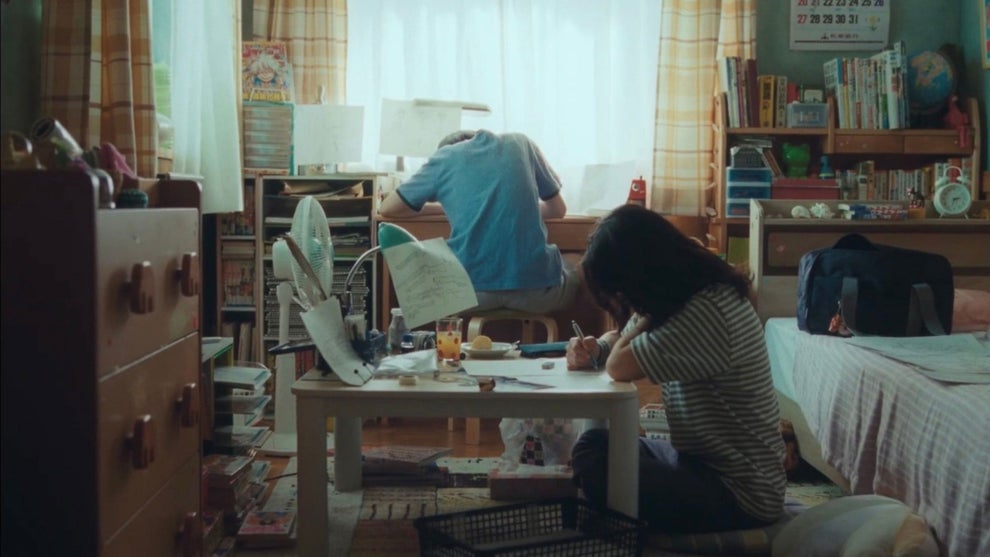
Hirokazu Kore-eda’s “Look Back” follows the unlikely friendship between two young Japanese schoolgirls bound by their love of drawing, until they go their separate ways. In keeping with his recent works (like “Shoplifters” and “Monster”), the director maintains his knack for working with child actors to create a visually detailed drama whose emotions also, on occasion, feel just as thorough.
But lost in Kore-eda’s tender translation is the sense of whimsy and childlike optimism that permeated both the original 2021 manga by Tatsuki Fujimoto and its masterful 2024 hour-long anime film by Kiyotaka Oshiyama. As the second adaptation of the comic in two years, the movie has a lot to live up to, though it only occasionally rises to the challenge.
Playing the sixth grader Fujino, actress Furi Nanase crafts a feisty protagonist, whose four-panel manga makes her a standout in her school’s weekly paper. Boisterous and enthusiastic, her young ego takes a hit when she’s asked to share the page with a reclusive student who attends remotely, and whose lifelike drawings outshine her joking comic strips. After withdrawing into herself and eventually switching hobbies (she has a love of sports), Fujino is asked to hand-deliver a diploma earned by her rival in absentia. This is where she finally comes face to face with the courteous shut-in Kyomoto (Rokka Okada), a robe-sporting girl with messy hair, who, as it turns out, claims to be Fujino’s fan.

Thus begins a beautiful friendship, where the duo collaborates on comic stories and wins local prizes. However, the film struggles to imbue Kyomoto with much by way of character of dimension, beyond her broad otaku reclusiveness. This is likely no fault of the young Okada, who seems just as eager to express herself as her outgoing co-star, from behind Kyomoto’s awkward façade. But the character — as presented — seems to fit more naturally in the context of manga and anime, where broad exaggerations feel in tune with the rhythm and form. Kore-eda’s movie version is much more naturalistic, except for these embellishments.
Still, the director’s use of warm, afternoon glows and gradual movements creates comfort and nostalgic familiarity. This goes a long way towards welcoming viewers into Fujino’s crowded bedroom, which doubles as her workspace with Kyomoto. Their collaboration lands them a deal at a local magazine by the time they turn 17, at which point they’re played by different actresses as young adults. These performers admirably grab the baton from their predecessors to create a sense of emotional continuity — for better and worse. As the older Fujino, Natsuki Deguchi maintains the character’s radiance as the de facto leader of their two-girl collective, dubbed “Kyo Fujino.” But as the older Kyomoto, there’s only so much that Aju Makita can do as a character who feels like she belongs to a different film entirely.
This sense of un-belonging should, in theory, contribute to the girls’ dichotomy, but it often just shows up as Kyomoto’s face being obscured by her scraggly hairdo, or the character retreating within the frame. Kore-eda seldom chases after her. Fujino is popular and well-adjusted, so she grabs the camera’s attention, while Kyomoto can barely hold a conversation — that is, until her friend and mentor drags her out into the world. In fact, this is followed by a present that is neither in the comic nor the anime as Fujino brings the world to Kyomoto through pictures she snaps with a digital camera. Unfortunately, the film doesn’t expand on this minor thread.
In stretching the film to 100 minutes without adding many new flourishes or ideas, Kore-eda either introduces lengthy tangents with little payoff or he packs dialogue scenes with too many silences. These moments linger uncannily and it’s here where “Look Back” feels plain and noncommittal.
Although the live-action movie is decidedly not the anime, it can’t help but fail in comparison to a work that succeeds both narratively and emotionally in just 60 minutes.
Kore-eda loses something vital by hiding Kyomoto to the degree that he does. Without finding a way to adequately externalize her artistry, or dramatize isolation, the character’s creative and personal dynamic with Fujino feels far less inviting than it ought to be.
This version of “Look Back” never fully blossoms.