
Director John Madden returns to TIFF with “Onwards and Sideways,” 16 years after the Oscar-nominated filmmaker behind “Shakespeare in Love” was at the fest with his 2010 thriller “The Debt.”
For “Onwards and Sideways,” which stars Laura Linney and Rhys Ifans as two strangers with Parkinson’s disease, Madden knew exactly what would make the story work: the film’s two leads had to be diagnosed with Parkinson’s disease at the same clinic, on the same day.
“I suggested that the thing we should do is make them both be diagnosed at exactly the same moment, which is kind of an odd idea, but it’s the idea that actually generates the whole story from that moment onwards,” Madden told Steve Pond at TheWrap’s studio at the 2026 Toronto International Film Festival.
Madden directs the film from a script by Paul Mayhew-Archer, who was diagnosed with Parkinson’s in 2011.
“That was his response to the illness, just to fight back and to make jokes about it,” Madden said. “ He’s just got a very, very, very interesting sense of humor that’s very humane.”
Madden got involved with the project in 2018 through the film’s producer Hilary Bevan Jones, who was repped at the same agency as Madden. He worked with Mayhew-Archer and developed the script over nine months.
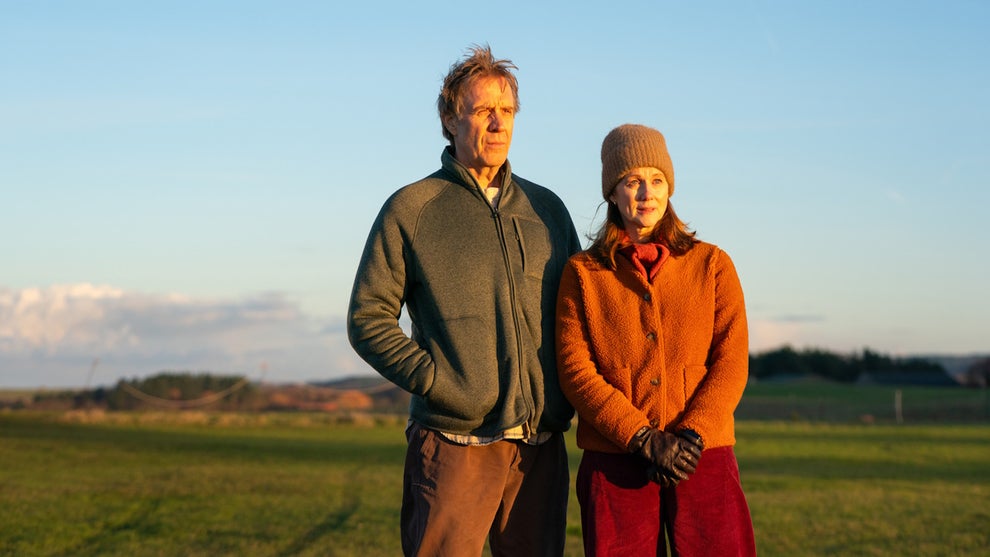
“Onwards and Sideways” follows “Emma Dretzin (Linney), a musician and composer, and single mother of two daughters, and Tony Evans (Ifans), deputy head of a primary school. Neither knows the other. Until a startling encounter changes the course of their lives. On the same morning, these two are simultaneously confronted with a diagnosis of Parkinson’s Disease. This film is the story of Tony and Emma – a friendship which unfolds unexpectedly.”
Ifans has been attached to the project for a decade, and was happy to finally see it come to fruition.
“I just had the instinct and the notion that it had to be a movie. That this was something that needed to be on a big screen. You needed to see a man and a woman in a landscape,” he said. “And I think only in the cinema can you really do landscape justice, to see someone alone with a diagnosis in the elements, to see someone faced with a horizon. It’s a film about horizons. It’s about how our relationship to our horizons shift and change with devastating news, and how our attitude towards sunrise and sunset changes with a diagnosis like this.”
Linney came to the project later, and admitted she approached it with some trepidation before reading the script.
“I was so surprised by how much life was just flying off the page as I read it, and how refreshed I felt afterwards, as opposed to being sort of tired and sad and stagnant, I had the absolute opposite response,” she said. “And then the fact that John, who I’ve been such a fan of for so long, was directing it, and Rhys, who I’d heard of for years but had never met. It was just such a clear thing to do. It took me about two seconds. I think I put it down and went, ‘Yes, please.’”
Madden said the shared diagnosis put the two characters on opposite paths right away.
“What happened to her was a much more intense personality, somebody who doesn’t take things lying down, even though she’s flattened at the moment,” Madden said. “That dynamic comes out against the contrast of Rhys’s character, who was quietly withdrawing into the situation.”
He added: “You never quite understood how each one would react against the other, until it all started to come together. It’s very unexpected. The thing proceeds very unexpectedly, and that becomes more and more involving.”