In April 2025, director Paul Schrader was accused of sexual assault and harassment by a former assistant. By June, he began production on “The Basics of Philosophy,” a mournful admission that feels tethered to these developments, directly or otherwise. The script was written before the allegations were made public, but its tale of an accused college professor in search of absolution feels especially personal (not to mention, especially uncomfortable) in this light.
The result is a film whose text and subtext are undoubtedly riveting, but whose meta-text — the story of its creation, and the fact that it exists at all — is worthy of some inquiry.
Unfolding in his de-facto mode of epistolary confessional, the movie follows philosophy professor John Jorrinson (Jack Huston), yet another of Schrader’s burdened men-in-rooms, scribbling (or in this case, typing) inner thoughts we hear in voiceover. Replacing the diaries in “First Reformed,” “The Card Counter” and “Master Gardener” (and even the documentary camera of “Oh, Canada”) is a more oblique but equally exacting method of self-reflection: a biography of philosopher Baruch Spinoza, which offers Jorrinson the chance to pose broad questions about his place in the world and whether true change is possible.
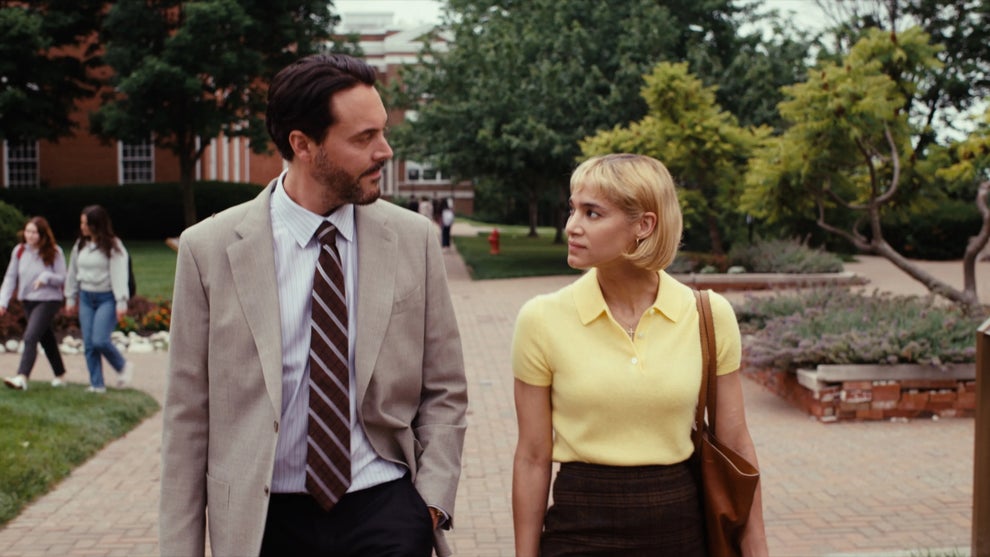
He asks these same questions of his students at a small liberal arts college in scenes that repeat themselves throughout the 94-minute runtime, but seldom yield new dramatic layers. However, the film’s initial point of intrigue is his stilted relationship with his equally attractive peer, psychology professor Rebecca Richards (Sofia Boutella), the single mother of a teenage boy. She wants them to get more serious, but an invisible wall keeps Jorrinson at bay — which he blames on being preoccupied with his dying father. At the funeral, Jorrinson half-recognizes a mysterious mourner in a turquoise tie (Daniel Zovatto), and the man’s piercing gaze sends him down a rabbit hole of remorseful recollections.

In broad strokes: Jorrinson once did something monstrous, which his late father helped cover up while taking care of his teenage victim’s future. In the modern climate, to tell this story from the perspective of a perpetrator is to draw understandable ire, though this expectation is baked into the movie’s telling. Its tale of severe transgression seeks not to garner empathy for Jorrinson, no matter how the resurgent past threatens his relationship or his profession.
Rather, “The Basics of Philosophy” poses piercing questions of absolution and atonement, which Schrader unspools gradually and meticulously. When viewed in this isolated context, it makes for a robust morality play whose most subdued moments feel explosive, and whose sexual explorations (subsequent to its lurid twists and turns) gesture toward thorny psychological dimensions.
However, to separate the art from its artist in this case would be to miss the forest for the trees, not the least because of how publicly Schrader has questioned his own sexuality. Whether the film is a direct confrontation of its author’s feelings, its existence as art is inseparable from its function as a product that was not only bankrolled despite his public accusations, but which placed Schrader in a position of power during its making.
As a film that asks sincere and thoughtful questions about the nature of justice and healing and what these things mean in the context of assault, its admirable on-screen story fits jaggedly with the reality of its creation. That dichotomy is just as worth wading through as the dilemmas in its character arc.
Huston delivers a haunted performance as a man who knows exactly what he’s done, and who believes that even his desire to be forgiven may be a bridge too far. But even as Jorrinson interrogates his own right to live and the story broaches the gut-wrenching question of what’s to stop him from repeating his infraction, this self-reflexive tale of metamorphosis can’t help but turn the camera too explicitly on itself. It pulls back the curtain just a little too far for most viewers’ comfort, particularly if they’re aware of who Schrader is and the things he’s done as far back as when writing Martin Scorsese’s “Taxi Driver” — an admission that bears even more relevance to the story at hand.
Together with the film’s own narrative about what Jorrinson is owed and what he deserves, the very act of watching and digesting “The Basics of Philosophy” becomes its own vital conversation. What do we do in the rare instance when art — worse yet, good art, and effective art — comes from a place of genuine remorse for things we rightly label heinous? It is, in that sense, a deeply challenging work, but only inasmuch as someone might be willing (or able) to give it the time of day.
Based on how its plot unfolds, Schrader seems to know he isn’t even owed that much.
