
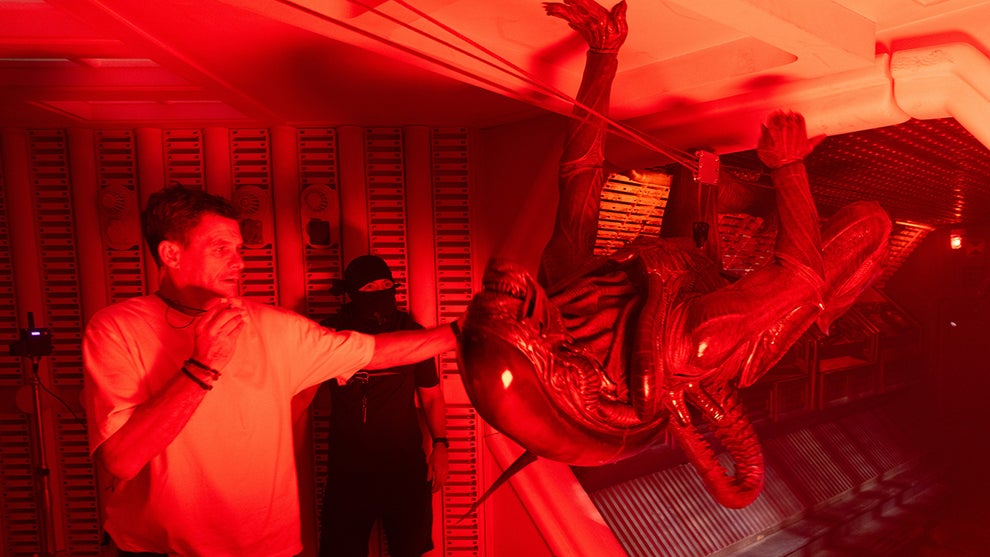
Noah Hawley has brought the sci-fi/horror series to television. Many filmmakers have taken on the “Alien” franchise: James Cameron, David Fincher, Fede Álvarez. Ridley Scott even returned to the well decades after his iconic 1979 creature feature launched the series. Now, with “Alien: Earth,” Noah Hawley has brought the sci-fi/horror franchise to television.
But even if the FX on Hulu series wasn’t made for a 30-foot-tall screen, Hawley and his team wanted it to feel big.

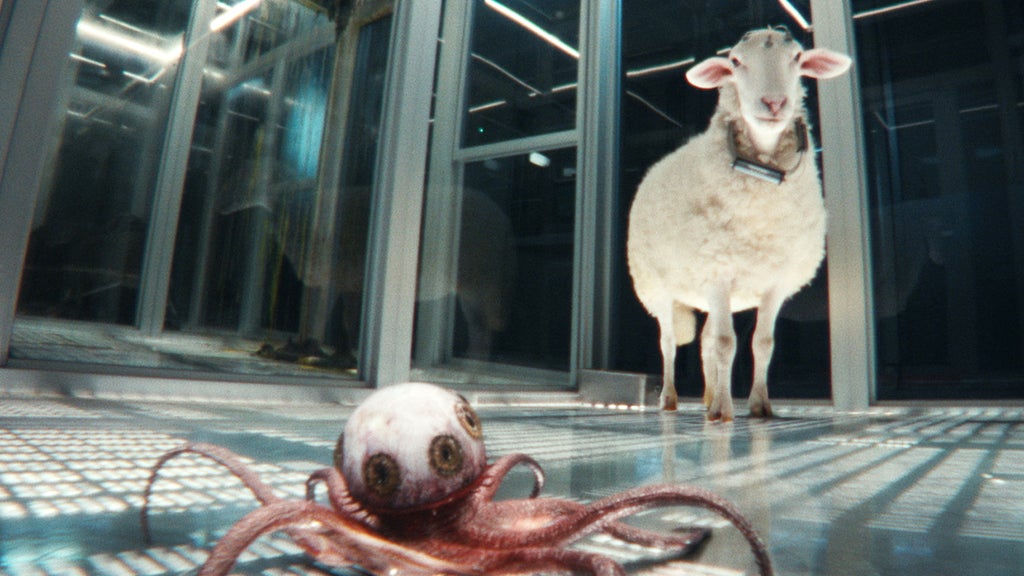
Production designer Andy Nicholson and VFX supervisor Jonathan Rothbart, both lifelong fans of “Alien,” leaped at the opportunity to play in the futuristic sandbox. Rothbart was excited to help introduce new alien creatures, including the tentacled, burrowing parasite known as the “eye midge,” which they rendered using both tangible silicone forms and CGI.
“I put a lot of constraints on our facilities in terms of how they could animate it and how we would shoot it digitally so that it still maintained this feeling of being natural and being practical within the scene,” Rothbart said. “It’s adhering to things, sometimes it’s stretching, sometimes it’s pulling things. It’s a very complex creature.”
Nicholson, meanwhile, helped produce Earth—rarely glimpsed in the “Alien” films—as the team imagined what it would look like in 2120, depicted through the lens of the show’s new central megacorporation, Prodigy. The futuristic Prodigy City adopted “the patina and humidity of Bangkok,” Nicholson said, while Prodigy’s Neverland facility, where synthetics are created, needed to feel like a modernist “haunted house” overrun with air vents and points of entry for alien critters.
All tech owned by the rival Weyland-Yutani Corporation evokes the 4:3 CRT screens used on Weyland-Yutani ships in the 1979 film (and in wide circulation in the real world at the time of “Alien’s” release). Prodigy, in contrast, is meant to be a more advanced corporation, so it uses 16:9 widescreens that are now the norm.
“That’s the difference between Prodigy and Yutani,” Nicholson said. “Prodigy’s got the new s–t.”
All Aboard the “Maginot”
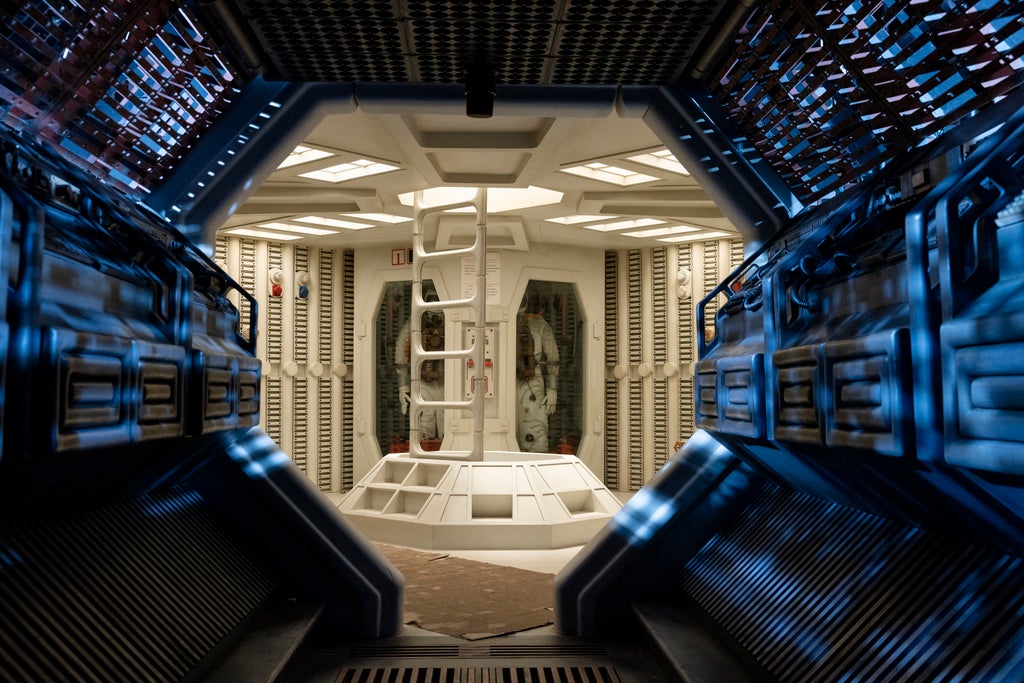
For the fifth episode of “Alien: Earth,” titled “In Space, No One…” (a reference to the classic “Alien” tagline), Nicholson and his crew created the “USCSS Maginot,” a spaceship that looks strikingly similar to the “Nostromo” from Scott’s original film.
“This is a Weyland-Yutani ship,” Nicholson said. “These ships would be designed in a factory that made the same ships, so essentially they’d have the same bridge, the same comms room, so we should respect that.”

He and his team rigorously studied “Alien,” going through the film frame by frame to glean as much information as possible about the design of the “Nostromo.” The production designer rattled off the heights of actors Harry Dean Stanton and Yaphet Kotto from memory, using them as human measuring sticks to gauge the dimensions of various rooms. (“Yaphet never stands up. He’s always leaning over, which means the ceilings were just below six feet high.”)
Nicholson likened the process to building a bomber for a WWII period drama, treating the 1979 sci-fi/horror movie more as history than fiction. It wasn’t until the team was nearly done with the build that Disney shared a collection of blueprints from the first “Alien.”
“I was like, ‘Oh my God, did we do it all right?’” Nicholson said. “It was lovely to see the attention to detail that paid off. There were very few things where we were like, ‘Oh, man, we just couldn’t see that.’”
Xenos and Cyborgs
Hawley “really wanted to stick with not just the look of the original film but also the process of how that look was created,” Rothbart said. That meant he approached the “Alien: Earth” visual effects “through the lens of what they would have done in ’79.”
He poured over archives, including early editions of the defunct visual-effects journal Cinefex, to learn everything he could about how “Alien” came to life. This was especially handy when rendering “Alien: Earth’s” Xenomorphs, which they sought to portray on camera using an actor as often as they could. When practical wasn’t possible, they took a composite approach—“a fully practical Xeno versus a practical Xeno with a CG tail versus a practical Xeno with CG legs or an animatronic head, just switching back and forth between all these various techniques.”
Rothbart takes great pride in one particular digital effect: the cybernetic arm sported by the cyborg Morrow (Babou Ceesay). In total, the team had to render the limb in more than 300 shots for 70 distinct lighting scenarios—which became particularly tricky for the Morrow-heavy fifth episode aboard the “Maginot.”
“He’s walking through the ship and the lighting is constantly changing,” Rothbart said. “For a CG artist, that’s a nightmare, especially when you have this prosthetic that is this translucent synthetic with mechanical interior.”
This story first ran in the Drama Series issue of TheWrap’s awards magazine. Read more from the issue here.


Every Steven Spielberg Movie, Ranked