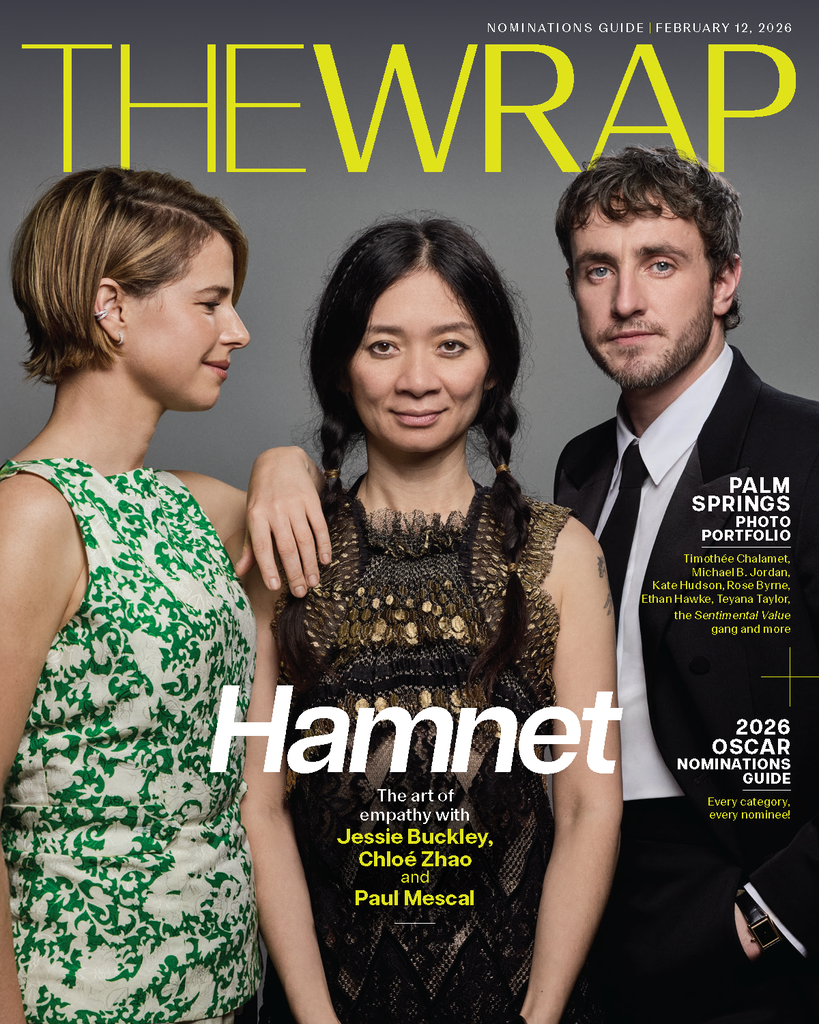
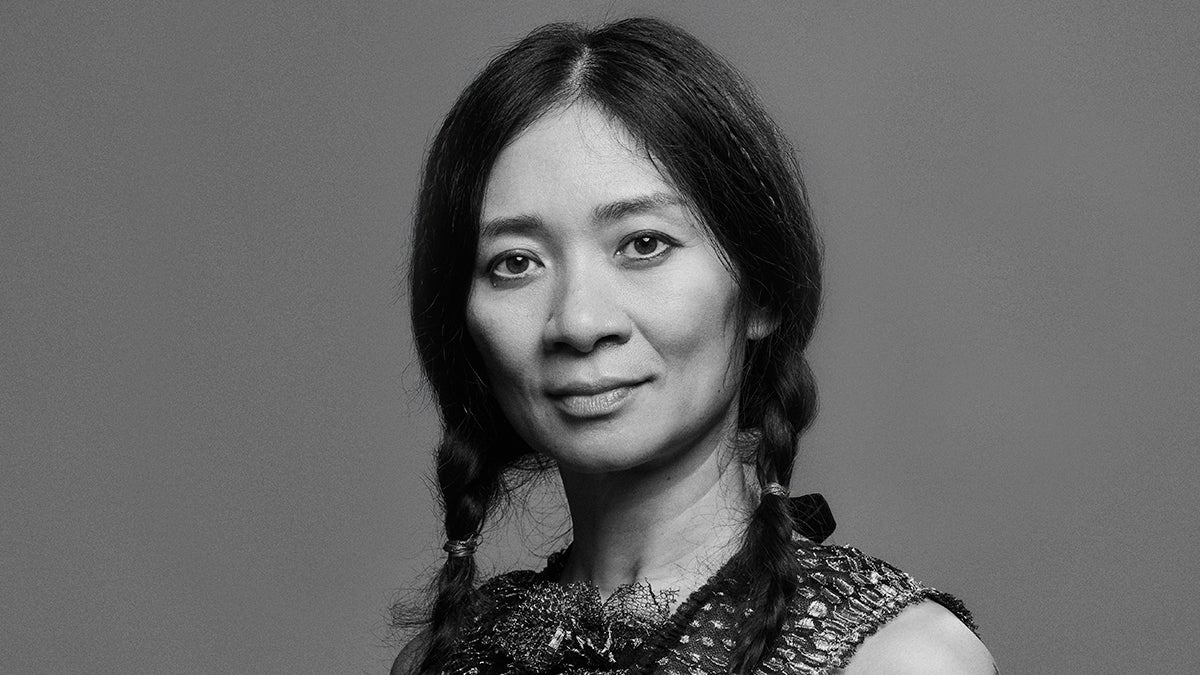
On Oscar nominations morning, Chloé Zhao wrapped a night shoot at 4 a.m., then headed to LAX for a 7 a.m. flight to Sundance, where she received the Trailblazer Award. In her bleary-eyed haze, she learned that “Hamnet,” which she directed and co-wrote with the novel’s author, Maggie O’Farrell, had earned eight noms, including Best Picture, Best Director, Best Adapted Screenplay and Best Actress for Jessie Buckley.
Statements of gratitude from the film’s nominees flooded in — but in lieu of releasing her own written expression of thanks, Zhao shared a video. It was a nod to the one that recently circulated online in which she and the entire “Hamnet” cast, in costume on the Globe Theatre set, dance ecstatically to Rihanna’s “We Found Love.” In the new video, Zhao flashes her iPhone screen to the camera, presses play on the same Rihanna banger and dances around an airport waiting area, hands pumping to the music only she can hear via her purple headphones.
“I just didn’t have words,” Zhao said via Zoom the following week, back in L.A. “I felt so grateful and happy for everyone. And the feeling we had at the Globe Theatre, dancing in that clip — no words can describe it. So when something like this happens… I’m feeling that same kind of village. All I can express is with my body — the most articulate I could be at that time.”
Zhao does not usually struggle to convey her thoughts. (Conversations with her are rich and likely to include references to Carl Jung, the Taoist principle of yin and yang and multiple metaphors relating to the four seasons of one’s creative garden.) But there is something perfect about the director of a movie so primal in its exploration of human emotion communicating wordlessly.
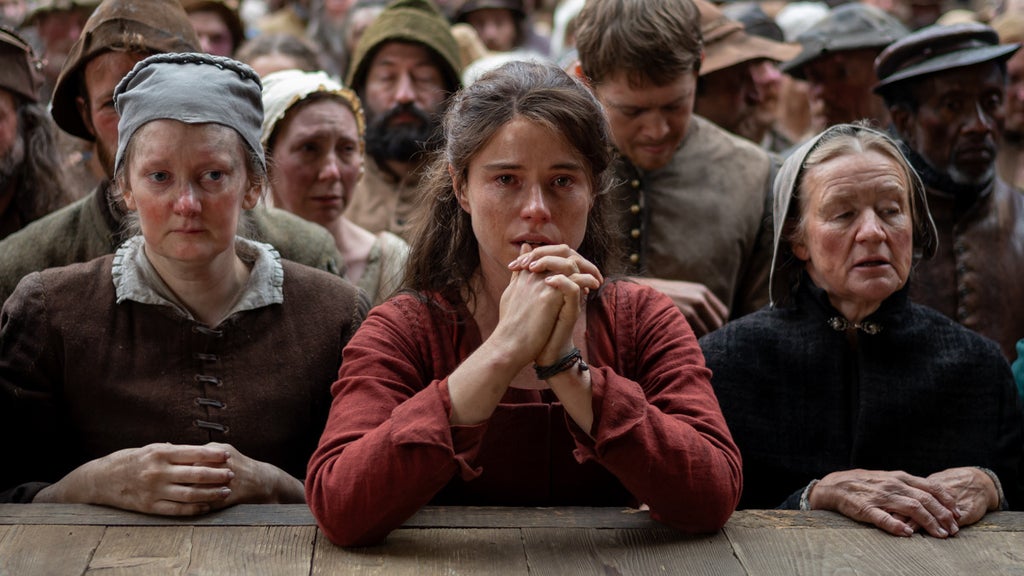
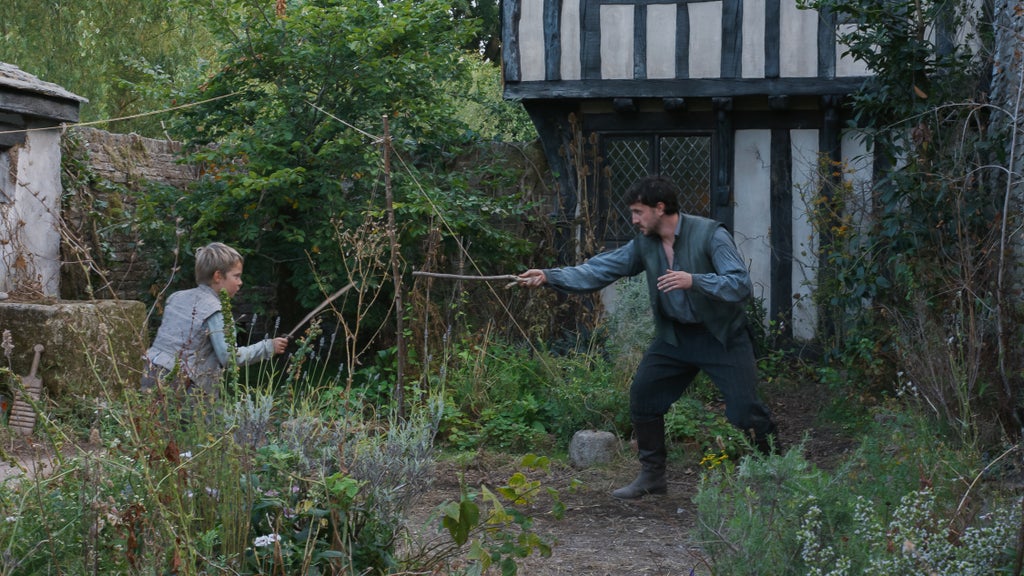
“Hamnet” is the story of how Agnes (Jessie Buckley) and William Shakespeare (Paul Mescal) grieve the death of their 11-year-old son, Hamnet (Jacobi Jupe), in Elizabethan England — she by externalizing her devastation and he by looking inward and turning his pain into one of the greatest plays in the English language, “Hamlet.” The film asks us to consider the power of creative catharsis with deep sincerity, and since its premiere at Telluride last fall, it has left audiences sobbing. Many of us find ourselves nursing a pinch in our heart for days.
For Zhao, who in 2021 became the second woman ever to win the Oscar for Best Director (for “Nomadland”), such reactions are the greatest compliment she can imagine. “I hope all the audiences who leave the theater feeling what you’re feeling realize that it’s a reminder of our immense ability to love,” she said. “It’s actually great. It’s the medicine the world needs — that capacity for empathy and love. Unfortunately, on the other side of that is grief. But one cannot exist without the other.”
You’ve been in this position before, in the awards race with an acclaimed film. But “Nomadland“ came out in 2020, during the pandemic, and awards season was almost all virtual until the scaled-down Oscars at Union Station. This must be a different experience.
It’s completely different. I had never been to any awards shows except the Union Station Oscars. And so every awards show I go to on this trail, everything is for the first time. I’ve never been surrounded by so many people I know; I’ve never been in a room surrounded by that kind of energy. I can’t say it’s easier or less exciting, because I’ve never done it before. It’s all brand-new for me.
The cultural climate is certainly different. “Hamnet“ is out when it feels like the world is falling apart—
Well, “Nomadland”… (Laughs) It’s a different kind of falling apart, because (with the pandemic), in a weird way, we had a natural disaster. So we found some common humanity as we were battling something bigger than us. Now it’s different. There’s the polarity, the divisiveness and the sharpness amongst ourselves. It’s probably more difficult in some ways.
And “Hamnet“ has offered audiences a sense of comfort through the communal experience of art. The moment at the Globe, when Agnes reaches out to the actor playing a version of her dead son on stage, has become a beacon for a lot of people. Do you think this gesture is even more necessary now than when you were making the movie?
For me, it’s never about, “OK, let me see what the world needs.” My spiritual teacher, Carl Jung, truly believed that the work has to be internal first. I feel as an artist, sometimes it’s easier to look outside: “What does the outside world need? Let’s produce that.” Because it’s really hard to look inward. But what we need internally is the medicine the external world needs. So I was guided by this internal, “What do I need? What is the pain in here? What am I feeling? How can I express that and get a connection?”
When the film came out, it’s almost like that desire, that need was transmitted. This coming together at every screening is definitely not something I’ve experienced in the past. And that makes me feel so hopeful as a storyteller. Shared humanity is so undeniable. We just have to throw away all the cynicism and protection and show it.
Making this film doesn’t change the issues I’m dealing with in my life. I still carry the same wound and scars, but it gave me tools and faith in knowing that this discomfort is OK to sit in.”
We have to live like Agnes, whose mother told her, “Keep your heart open.”
Especially right now. Those who can, we’ve got to keep our hearts open.
“Hamnet” has moved so many audiences and helped people cope with grief. I’m wondering if it’s had a similar impact on you, changing how you think about some of the big themes in in the film — life, love, death.
Somebody said to me recently, which helped me articulate this so much better than I did a few months ago, that grief is the placenta that we need for rebirth. When we lose something precious — whether it’s a person, a job or even, like, purpose, faith — if we lose something that defined us, and when that thing is no longer in our lives, the version of ourselves that existed in that life is dead. And then, in order to move forward in life and not be stuck in it, we actually have to be reborn into a version of ourselves and no longer have that thing or person in our lives. And that reverse process requires a placenta, and that placenta is actually grief. The lack of time and space and even right to grieve makes many of us stuck and we never get to be reborn.
What happens in that placenta — or you can call it the chrysalis — is the discomfort of grinding one down into mush to be reborn. How do you sit in that tension? And that’s two things for me, creativity and community, one internal, one external, and both feed each other. So making this film doesn’t change the issues I’m dealing with in my life. I still carry the same wound and scars and challenges, but it gave me tools and faith in knowing that this discomfort is OK to sit in. And I have to sit in it because I don’t want to be stuck.
Agnes got stuck. Her husband’s creativity in his work (gave her) a container for the the massive amount of grief that she’s feeling. And the community of that theater (watching “Hamlet”), that is what it took for her to be reborn.
Steven Spielberg is one of the producers on your film. Did he give you any advice, filmmaker to filmmaker, that was particularly useful?
He gave me two. One was more big-picture advice, the other was a very specific note. When Maggie and I sent him our first draft, he loved the script. He had almost no notes, but he did say, “I think you’re missing a father-and-son moment.” The book didn’t have it; we somehow didn’t think of it. So that’s when we wrote (the scene where Will asks Hamnet, before he leaves for London), “Will you be brave?” Steven was so happy when he saw that scene.
And then in the edit, the film was a lot longer; there were scenes that I just absolutely loved (that were) a big part of the book. He was like, “Chloé, I don’t know how you want to do this, but I promise you, please listen to me on this: You need to get us to the Globe quicker.” Because there was about 15 minutes more in between. Steven was like, “The audience can’t handle that.” He trusts my process, so when he said that, I listened.
There were more scenes of Agnes in mourning?
Yeah. In the book, a big part of the story is her alone in that house with the two (daughters), because she used to be able to sense the ghosts of her loved ones. But for some reason, she can’t find Hamnet. And this is her own journey of trying to understand, “Where is he? Why can’t I find him?” We shot all these scenes with Jessie and the girls and moments with (her mother-in-law) Mary. I hope somebody one day makes a miniseries about just the women of Stratford. The book goes into (Hamnet’s sisters) Judith and Susanna, and Mary, how her relationship with Agnes evolved. It’s the domesticity — I just love that. I tried to include that, but there was just no space for it.
What are you going to do next? You directed the pilot for the new “Buffy the Vampire Slayer“ series, but where does one go as a filmmaker after “Hamnet“?
The four seasons of my creative garden — at the moment, it’s been wintering. I do believe we all need a period of composting, ideally, before we (plant) another seed, because the soil is not healthy. You can grow it, but it’s not going to grow with the energy I felt when I was growing “Hamnet.” I’ve been composting in the last year — some intense compost — so I can see spring around the corner.
I would say there’s a three-and-three going on here. My first three films (“Songs My Brothers Taught Me,” “The Rider” and “Nomadland”) are very much about belonging in the individual sense. “Eternals” and “Hamnet” are very existential. They’re ultimately about this oneness and the yin and yang. So I think there is another one.
So, we are both alumnae of Mount Holyoke College.
No! What class?
I’m a lot older than you, sister! I graduated in ’97. You were the class of 2005 and majored in politics, right?
Yes, American politics.
So when you were an undergraduate, before you went to NYU for film school, did you ever imagine you’d be making movies like “Hamnet,“ which has drawn praise from Bong Joon Ho, Tony Kushner, Jane Fonda and Walter Salles, among others? I also read that Terrence Malick called you directly to say how much he loved it.
(Smiles) I definitely didn’t, because it seemed so unrealistic. I didn’t have any connections in the industry. I was going to go into politics, policy-making, but more for building local communities. It took me four years to be discouraged and disillusioned. I didn’t want to be a screw in a big machine. I could, even back then, intuitively feel that the foundations were not working. So I was very lost for four years after I graduated, wandering New York streets after bartending at 4 in the morning, (asking myself), “What do I need?”
Sleep?
Yeah, I need to sleep! (Laughs) I also need love, I need to feel safe, I need home. I need to feel connection and a sense of purpose. Again, it was about looking inward. I thought, Well, storytelling has always been my way, since I was a little girl, to get some kind of connection. I used to be the storyteller in my kindergarten. I was the one making up stories about everyone: “So you and I and these three friends, we’re gonna be… And the alien comes and…” So I thought, Let’s try that.
That’s when I decided to give it a go, to try film school. Miraculously, I got in. That changed my life, obviously. Otherwise, I would still be bartending, telling stories at the bar, getting extra tips and listening to stories.
A version of this story first ran in the Oscar Nominations Guide issue of TheWrap’s awards magazine. Read more from the issue here.