

A new study from the Geena Davis Institute shows that over the past 72 years, men over 50 have made up a much larger share of Emmy acting nominees and winners than women in the same age bracket. The report found that men age 50 or higher are almost 30% more likely to be nominated than their female counterparts — and nearly 20% more likely to win.
Published on Thursday, “Seventy Years of Fifty-Plus Actors at the Emmys: Gender Gaps in Nominees and Winners” analyzed the Television Academy’s 4,017 nominations in lead and supporting categories in comedy, drama and limited series since 1954. (Guest acting roles did not figure into the research.)

“We’ve been thrilled to see so many women 50-plus leading celebrated series and films in recent years,” Geena Davis Institute President and CEO Madeline Di Nonno told TheWrap, explaining the motivation for the study. “We actually did a similar analysis of gender and age of Oscar nominees and winners last year. But we wanted to know whether what felt like progress was actually borne out in the data. The Emmys give us more than 70 years of history to look at, so we decided to find out.”
Overall, male nominees over 50 dominate by 9 points (42% to 33%). In the 2020s so far, that gap has widened to 12 points. This year, women over 50 make up 41% of the nominee pie — a bigger portion than average (thanks to luminaries including Jean Smart, Lisa Kudrow, Michelle Pfeiffer, Rhea Seehorn, Katherine LaNasa, Constance Zimmer, Sally Field and Youn Yuh-jung). But compared to the male share (60%), the difference is still significant. The only decade in which women nominees over 50 out-represented men was the 1960s: 30% to 23%.
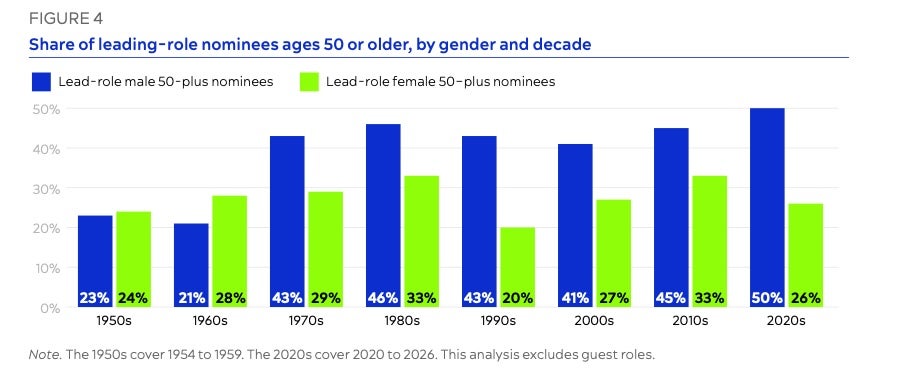
The study found that the gender gap is most persistent in the lead categories, where 41% of male nominees have been 50-plus, versus 28% of female nominees. Among winners, it’s 41% of men versus 27% of women. Between 1954 and 2026, the winners gap has widened from 10 points to 16 points, and to date, it shows no sign of tightening. The TV Academy, it would appear, still prefers celebrating older men who carry series than older women.
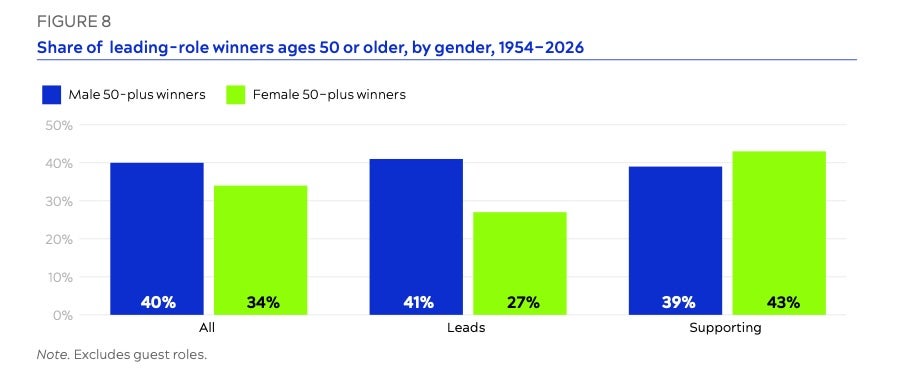
In the supporting categories, on the other hand, the overall 13-point discrepancy favoring male nominees shrinks to 5 points, with 44% to 39%. When it comes to winning, women in supporting roles actually have a 4-point advantage: 43% to 39%, a modest 2-point uptick since 1954.
“Although our research has shown that there is a persistent gap onscreen for women 50-plus, we are pleased to see that gap has nearly closed for women nominated for supporting roles in recent years,” Di Nonno said. “And this year, we’re encouraged to see so many talented women 50-plus recognized across genres and categories, with their share of female nominees well above the historical average. There is still work to do, but this is progress worth celebrating.”
