
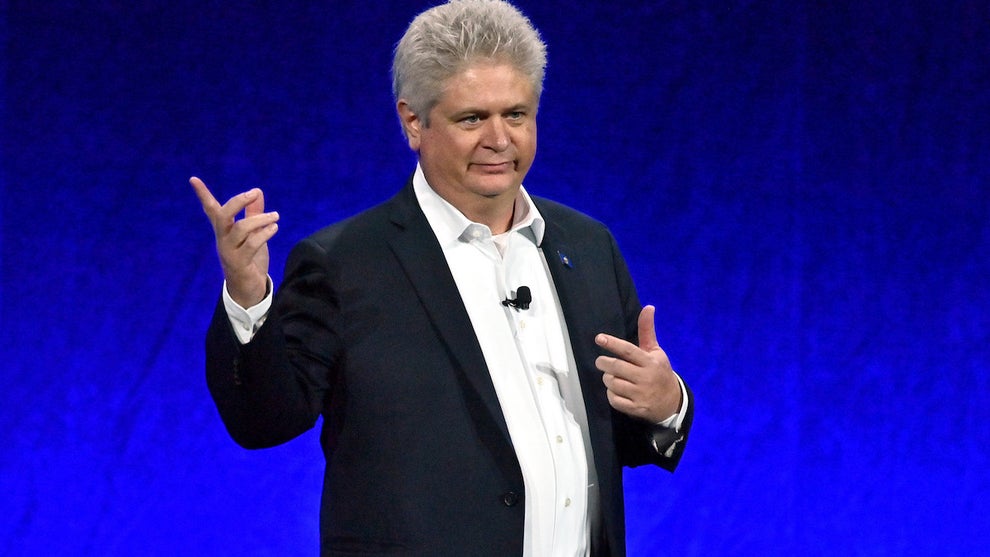
Cinema United president and CEO Michael O’Leary struck a balance between celebrating the positives and issuing grave warnings about the state of the movie theater industry in his keynote speech at CinemaCon on Tuesday, extolling the return of longer theatrical windows while reiterating his industry’s opposition to any acquisition of Warner Bros.
“It is important not to lose sight of the many positives in our industry. Last year can be characterized as a year that had something for everyone at the movies,” he said. “Original films excelled. Moviegoers sent a clear message that they crave stories that expose them to new ideas and new worlds. And in support of these great movies, exhibition stepped up and made the experience of going to the movies even more memorable.”
But along with that optimism, O’Leary also called out studio consolidation as a major threat to the positive trends exhibitors have been enjoying. While he did not mention would-be Warner Bros. owners Paramount Skydance by name — the studio will be presenting its 2026 slate at CinemaCon on Thursday — he did warn that any transaction that results in Warner Bros. being owned by another major Hollywood entity would “be harmful to exhibition, consumers and the entire entertainment eco-system.”

“Further concentrating marketplace power in the hands of a smaller group of distributors that dictate the terms, windows, scheduling, screen-placement of movies, and access to historic film catalogs will have a real and lasting impact on Main Street and millions of movie fans around the world,” he said.
O’Leary has argued as much in letters and committee testimony to Congress, the Department of Justice and state attorneys general going back to December, when it looked like Netflix would be the winner of the bidding war for Warner Bros. Regardless of the potential owner, Cinema United has spoken out against any sale of Warner Bros. and has urged regulators to take action.
“We will continue to press these issues at the state and federal level. And with the help of our friends at UNIC and around the world, the international level as well,” he added.
On a more positive note, O’Leary acknowledged that since the last CinemaCon, where he urged studios to make 45-day theatrical windows an industry standard, Hollywood has moved closer to making that a reality. Last month, Universal announced that it would move to 45-day windows starting in 2027, while Paramount Skydance has also publicly pledged to that length and Disney had an average theatrical window for its 2025 slate of 62 days.

“After six-plus years of theories and experiments devoted to proving that theatrical’s days have passed, there is a growing recognition of something we have always known – theatrical exhibition is the foundation upon which the entire entertainment industry rests, and that will never change,” he said.
O’Leary also noted that exhibitors must meet studios halfway on the windowing front by pledging to “acknowledge and fully support” films and studios that commit to longer windows.
Since the start of the 2026, the U.S. box office has grossed more than $2.1 billion to date, setting the best pace the industry has seen since the COVID-19 pandemic thanks to movies like “Scream 7,” “Project Hail Mary,” “Hoppers” and “The Super Mario Galaxy Movie.” O’Leary hailed that success, along with the rising interest among Gen Z in going to the movies as reasons to be hopeful for theatrical’s future.
“For over a century, movie theatres have been the financial and cultural foundation of communities across America and around the world. That is what makes us a Main Street industry,” he said. “If we work together, if we stay disciplined and focused on the future, I know that someone, fifty years from now, will stand on a stage like this, in an auditorium full of theatre operators to celebrate the wonder of our industry and chart a path for yet another century of movies on the big screen.”
