

After a long, bruising takeover battle and a contentious lawsuit, Skydance is ready to roll with promises of over $30 billion in content spending and the formation of a disruptive player in Hollywood ready to take on Big Tech.
But talk is cheap. Knocking down $80 billion in debt is not. While co-CEOs David Ellison and Ynon Kreiz were busy talking to the press about their plans to reinvigorate the entertainment business, Wall Street was fixated on its extreme leverage and a sordid history of failed media mergers that doesn’t bode well for Skydance.
There’s a reason Skydance shares closed at $9.29 on Thursday, down 8% from its opening day high of $10.
Still, while Skydance will face challenges integrating the sprawling, overlapping businesses of Paramount and Warner Bros. Discovery, its sheer size will force other media companies to re-evaluate if they need to make deals in order to grow.
We talked to money managers and analysts to get their take on what ramifications this merger will have on the industry. We also take a look at Kreiz’s old company Mattel, which is being urged to consider a sale, and the outlook for cable stocks.
Thanks for reading.

THE DEEP DIVE

Skydance vs. History and a Whole Lot of Debt
There’s good reason for Wall Street investors and analysts to be bearish on Skydance even if you take out the debt issue: The track record for M&A in this industry has been dismal.
“The history of media deals has not been great, but that doesn’t necessarily condemn them to the same fate,” Chris Marangi, president and co-CIO of Value at Gabelli Funds, told The Ledger.
One doesn’t have to look much further than the merger that formed Warner Bros. Discovery to see big problems. The dilemma, according to TD Cowan analyst Doug Creutz, is that management needs to invest in content while cutting costs to help service its debt. In the case of WBD, the company was able to cut $4 billion in expenses but saw revenue fall by the same amount — resulting in no gains.
Skydance, which took on significant debt to fund the acquisition of Warner Bros., faces a similar challenge.
“The risks (leverage, integration) of the combination with WBD are high; we remain skeptical that Skydance management will be able to create value from this deal when so many other major media deals have failed,” Creutz said in a research note.
- The company aims to grow revenue while reducing its debt, but Wall Street is skeptical.
- The creation of a new streaming powerhouse will force other media companies to reconsider their strategy in the market.
- The deal could also set off a wave of mergers and acquisitions, as media companies attempt to accelerate growth.
Redbird Capital Partners, the longtime backer of Skydance and one of the driving forces of this deal, increased its investment in the company by $4 billion to a total of $6 billion.

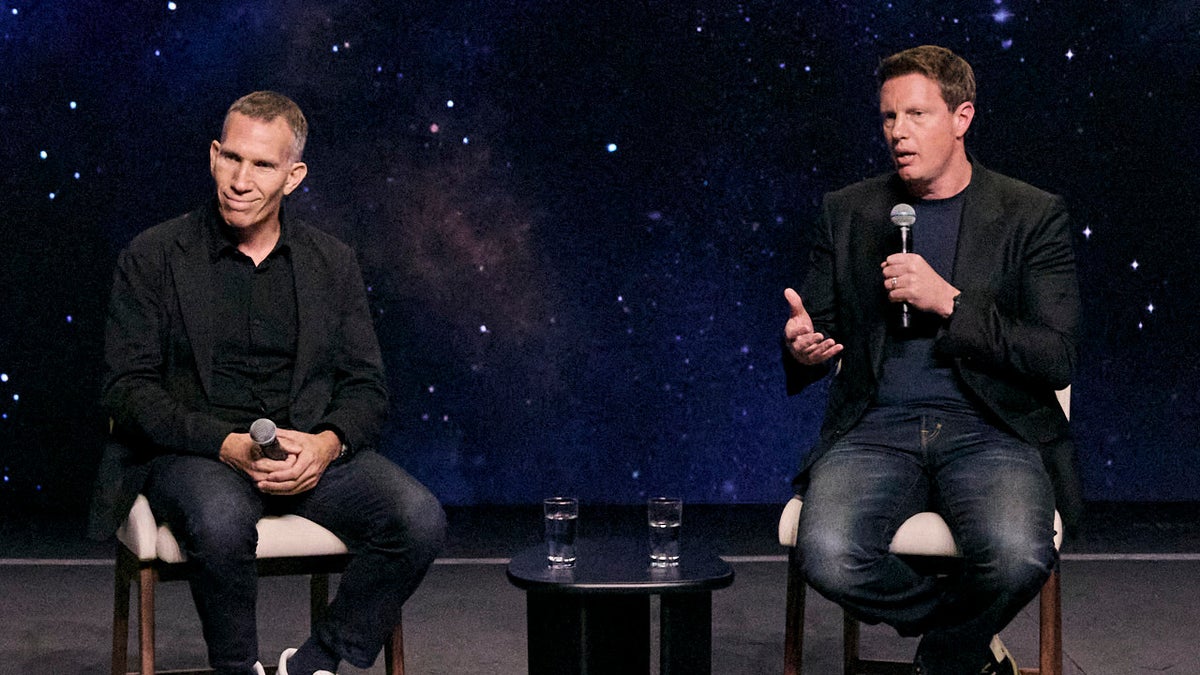
Skydance co-CEOs Ynon Kreiz and David Ellison hold a press conference following the Paramount-Warner Bros. Discovery merger closure on Oct. 6, 2026. (Credit: Nate Jensen for Skydance)
Just before the deal closed, Fitch downgraded its ratings on Paramount and Warner Bros. debt, citing the higher leverage the company would have after completing the deal.
Barclays’ Kannan Venkateshwar reduced his target price for Skydance by $1 to $7 a share. “The company’s commentary around its synergy realization path, its content and streaming plan post-merger, its plans around its news assets and its capital structure plans all need more details,” he said.
Venkateshwar added that boosting revenue was a challenge facing all of the big media companies.
“We expect Disney, Skydance and Netflix to potentially expand on efforts to accelerate streaming growth. The track record of companies being able to convert recent investment cycles into revenue acceleration is at best patchy,” he said.
The Next Deal
One top money manager expects these challenging times will lead to more M&A activity.
Media companies will have to reset their strategies to compete with Skydance.
“The question is what does Lionsgate do? What does Universal do? What does Sony do? Where do I fit now is what these companies need to be asking themselves,” the money manager said. “I think over the next couple of years, you’ll see more deals.”
Gabelli’s Marangi points out that consolidation has left investors with only a handful of players when it comes to publicly owned media companies. The giant tech companies, YouTube owner Alphabet and Amazon appear to be gaining ground, while questions surround other potential buyers and sellers.
Under its new leadership, “Disney is doing many of the same things that Skydance needs to do, sharpening their cost focus. They have the benefit of being heavily weighted towards experiences, which should continue to do well,” he said.
“We eagerly await the spinoff of NBCU next year, but we’re not sure where Peacock goes. There are a limited number of seats at the streaming table and one of them clearly belongs to Skydance at this point,” Marangi said.
He also noted that some investors overlook Sony as a studio owner: “My perception is they are buyers, not sellers, of media assets. But again, it is not clear what’s left to buy.”
Outside of the U.S., Canal has been aggressive in consolidating markets. Another company that looks attractive is TelevisaUnivision. “I think there’d be a number of entities that would love to own the largest Spanish-language content producer in the world,” he said.
Worth Reading:
- Over 30 Movies, a $30 Billion Content Spend and So Much Debt: What We Learned from Skydance’s Kickoff Event
- Skydance Film Chiefs Assure Staff Movie Divisions Will Function Independently
- Skydance CEOs Tease ‘Aggressive’ Content Investment, ‘Difficult Decisions’ to Come in First Employee Town Hall

DEAL SHEET
- Melius, which uses AI to generate ad campaigns and videos for marketers and brands, raised $25 million, including $20 million in Series A led by CRV and a $5 million seed round led by General Catalyst. The company claims to have generated more than $1 million in annualized revenue since exiting a stealth phase in July.
- Authors First, which works with writers to turn books into movies and TV shows using AI, raised $10 million in a seed round led by Brand Foundry and company founder Robert Hamwee. Other participants include Bolt Ventures, Andy Mills, Mike Duggal and John Kline. The company’s first book-to-screen adaptation is “Genghis: Birth of an Empire,” created with author Conn Iggulden.
- Golf media company Pro Shop raised $24 million in a series B funding round led by the family office of Home Depot founder and Atlanta Falcons owner Arthur Black, according to The Hollywood Reporter. Also participating in the fund raising were Causeway Partners, Ares Sports, PGA Tour, Phoenix Capital Ventures and Powerhouse Capital. The company, founded in 2023, acquired the PGA Tour’s digital and social media brand Skratch after raising $20 million in 2024. It also co-produced Netflix’s “Happy Gilmore 2” and produces “Full Swing” for the streamer.
FINANCIAL ROUNDUP
Mattel Gets a Message
After Ynon Kreiz left Mattel to become co-CEO of Skydance, Ariel Investments, which owns 5.4% of the toymaker, urged Mattel to explore strategic alternatives, including a sale of the company.
Ariel had been concerned about Mattel being undervalued for some time, and Kreiz’s departure seemed like a catalyst for change.
“We had lots of conversations with Ynon, and I have a lot of respect for Ynon,” Ariel Chairman and Co-CEO John Rogers told The Ledger. “We’re patient investors at Ariel, but with the CEO leaving, it was a window of opportunity.”
In a statement to The Ledger, Mattel said, “Our Board of Directors and management team are committed to acting in the best interests of all shareholders and will consider the views expressed in Ariel Investments’ letter, as well as the views of Mattel’s other shareholders.”
Rogers said that Mattel has a number of strong brands and IP that could be franchises that generate greater revenue. The “Barbie” movie was a big success, but sequels have been slow in coming. Hot Wheels is another big brand that could be exploited in movies and TV, and Jon M. Chu is developing a film based on the toy line for Warner Bros. “Matchbox: The Movie,” starring John Cena, comes out this weekend on Apple TV.
“I think there’s lots and lots of potential there, but it is clouded by some of the brands that haven’t grown,” said Rogers. He called pre-school brand Fisher-Price a major disappointment. It has become a commodity brand with no product differentiation and weak profits.
“If they didn’t have that albatross, they would have shown a lot more growth overall,” he said.
Mattel is a relatively small business and “in this day and age, scale matters,” he added. Combining with another company would enable it to spread costs over a larger platform.
Rogers noted that there have been rumors that Hasbro has serious interest in buying Mattel. “This might be an opportunity for them to show that,” he said.
Authentic Brands Group, which owns various media, lifestyle and sports assets, has reportedly been considering an offer for Mattel that could value the company at more than $20 a share.
Speaking of Kreiz, Rogers said that he was “good at rationalizing costs and bringing change when necessary. I give him high grades as a CEO.” That’s despite Mattel stock falling from a 52-week high of more than $22 a share in February to a low of $12.66 last month, just before Ariel sent its letter to the company. Since then, Mattel’s stock has jumped to above $16 a share.
Rogers noted that Mattel’s incoming CEO, former Condé Nast boss Roger Lynch, “has a good record for creating value for shareholders. I have high confidence in him.”
The Cable Guy
With earnings around the corner, analyst Gregory Williams of TD Cowan said he expects cable subscriber losses to be near record levels at about 428,000.
Comcast’s bearish remarks in September set the tone, and fiber to the home and fixed wireless access continue to dominate the industry. “Investors desperately seek ARPU (average revenue per subscriber) and subscriber stability,” Williams said.
Since just before the last round of earnings announcements in July, Cable One is down 70%, Charter is down 16%, Comcast is down 9%, while Optimum is up 10%. At the same time, the S&P is up 4%.
A new worry for the cable network is the ability of Meta’s new AI agent Muse to help users find cheaper internet and TV plans. Although Williams doesn’t see it having much impact now, others see it hurting cable’s pricing power and increasing turnover if it makes it easier for subscribers to switch providers and plans.
Williams concluded that the industry is in a rough place and could face further structural changes. “With a Charter/Cox deal now complete, perhaps the next move is Charter/Comcast,” he said.
FROM THEWRAP
Skydance Signals a New Dawn for Hollywood. Will David Ellison Be Up to the Task?
Merzigo Launches $200 Million US Content Push With Wendy McMahon
Fox News Built a Cable Empire. Now It’s Building Around It
HEARD AROUND
Huge in Japan, Setlog’s Hour-by-Hour Video App Is Coming for the US
TikTok Quietly Gutted Its Advertising Rules. Scams Have Exploded Ever Since.
Advanced Stats and $500 Bats: Why Baseball for 6-Year-Olds Is Breaking the Bank
The Internet Is Building an AI Cinematic Universe Out of Sam Altman and Dario Amodei
