



Welcome to The Ledger, TheWrap’s cheat sheet on what investors in media and entertainment are thinking about and where the money is flowing. This weekly guide promises to provide insights that bridge the gap between Hollywood and Wall Street.

It’s a common industry refrain: “It’s called show business for a reason.” That business is rapidly changing and understanding how that disruption creates new opportunities for revenue, cash flow and market value is paramount (no pun intended).
I am Jon Lafayette, and I’ve covered the business of media for Broadcasting+Cable, TVWeek, Advertising Age and the New York Post.
My aim is to use this newsletter to cover public and private investment, who is buying and selling, and what they’re buying and selling. I will also bring insights and opinions from managers and analysts with skin in the game.
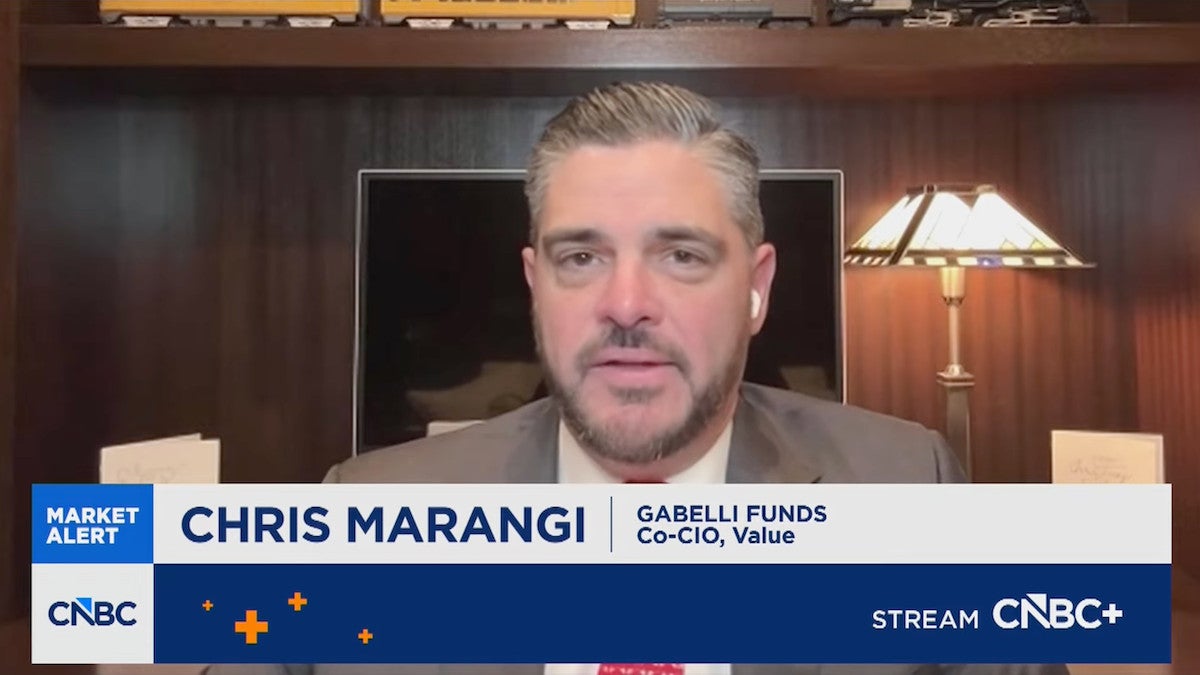
I’m starting off with one of the biggest names in media investing, Chris Marangi, chief investment officer at GAMCO, the investment company started by legendary media maven Mario Gabelli. Gabelli was early to bet on the value of intellectual property, understanding the potential value of sequels and eventually franchises like “Star Wars.”
In a consolidating media industry, Gabelli still has huge stakes in companies including Warner Bros. Discovery and Sony, making its views on the financial futures of this industry invaluable.
Thanks for reading,
Jon Lafayette
P.S.: Send your tips and pitches to jon.lafayette@thewrap.com
THE DEEP DIVE

A Giant in Media Investing Shares His Hot Takes
For decades, the name Gabelli has been synonymous with investing in media and entertainment. Between industry consolidation, the rise of streaming and the spectre of AI, investing in media has become challenging, even for Gabelli.
Chris Marangi has been with the firm for 23 years, starting as a media analyst and now serving as co-chief investment officer of GAMCO (Gabelli Asset Management Co.). Here are some of his key insights:
- In the age of AI, media companies with loads of IP still retain tremendous value.
- Disney should consider spinning off its theme parks and cruise line businesses.
- Keep an eye on Sony (a potential buyer) and TelevisaUnivision (a potential seller).
- He’s bullish on live events, from sports teams and even Live Nation, despite its legal troubles.
While historically, Gabelli has been a big player in media, with consolidation, Marangi declined to say how much of the funds Gabelli manages is currently invested in media.
“The menu of traditional media companies has shrunk, although media on a broadly defined basis has expanded if you include companies like Google/YouTube, Netflix and others,” he said.
He noted that at this point the market cap for Netflix exceeds what is deemed traditional media. One hot take: Broadcasters will have a longer life than some doomsayers expect, but there will continue to be consolidation across the sector.
The AI overhang
In looking at investments today, Marangi said that everything should be considered through the lens of artificial intelligence, which will produce winners and losers.
“I think AI is broadly viewed as negative for traditional media,” Marangi said. “I’m not sure that’s true.”
He said AI could enable media companies to produce content more efficiently and to create more leisure time for consumers to consume more content.
Marangi said there are “still reasons to invest in traditional media, and we are still meaningful investors in the broadcast area and parts of distribution.”
One way to profit from investments in a consolidating media world is to own a company that becomes an acquisition target.
Gabelli was the second-biggest holder of Paramount voting stock when it was acquired by Skydance and was a long-time investor in Discovery. Gabelli kept its Warner Bros. Discovery shares when the stock was at its depths and reaped the potential gains as the Ellisons and Netflix bid the stock up as rival bidders.
To be sure, media companies still have assets that remain valuable in an AI age, particularly their intellectual property.
“It’s the libraries of content, the characters that live in the imaginations of generations of people that are irreplaceable, that AI is largely training and which gave Warner Bros. much of its value.”
The Walt Disney Co. certainly has that type of attractive IP and the purchase prices for Paramount and Warner Bros. to provide data points for valuing their libraries and IP.
“Disney has evolved primarily into an experiences company, which makes it interesting and attractive in our view,” Marangi said. “The Disney studio almost certainly would be worth more than Warner Bros. The question is what will their new CEO do with those assets. Would they consider financial engineering? I think as recently as 10 years ago, the answer was certainly no, but it’s probably something that should be considered.”

Separation anxiety
Marangi said he believes Disney could surface a lot of value by separating their experiences assets — the theme park and cruise line business — from their studio, streaming and linear businesses. He noted that there was some discussion of Disney making ESPN into a separate business.
“ESPN probably would be worth a lot more on a standalone basis. I don’t know that that’s happening any time soon.”
Comcast spun off most of its cable network business, creating Versant, now a publicly traded company. As a separate company, “management can focus on transforming, or pivoting away from traditional linear media. Because there’s more pressure on them to do so,” he said.
Another company with a substantial cache of IP is Sony. Gabelli has a substantial position in the Japanese conglomerate, Marangi said. While it’s big in the music and games businesses, Marangi said he believes the old Columbia Pictures business, now Sony Pictures, is an area that Sony would love to grow.
Under former Sony Picture Entertainment CEO Tony Vinciquerra, the company pursued an “arms dealer” strategy, producing content for platforms it didn’t own. Marangi said Sony’s strategy is now evolving.
“They’re more likely to be a buyer of assets than a seller of assets or a simple provider of arms,” he said. “They’ve been smart, and they’ve been focused. They’ve concentrated on certain niches.”
Another media company worth watching is TelevisaUnivision.
“They’ve cleaned up their balance sheet. It’s under new leadership. And at some point, it will probably be sold,” Marangi said. “It’s a unique platform because it reaches almost 800 million Spanish speakers around the world. It is a diversified business because it includes the traditional broadcast business in the United States, but it’s primarily a content engine for Spanish-language content.”
Who’s buying?
In looking at the value of media assets, the question arises whether there are still deep-pocketed investors interested in a show business that seems to be contracting. One could still be Netflix, which bowed out of the bidding war for WBD.
“So I would think that they would potentially be interested in the right asset at the right price,” he said. “And then the same could be said of a lot of big tech companies who have very, very large balance sheets, very large market capitalization. So it’s not inconceivable that they could be interested in a Disney studio and streaming business.”
Tech giant Amazon snapped up MGM in 2022 for $8.45 billion. “Disney is an asset that would move the needle for most companies,” he said.
While traditional media has largely been downgraded by investors, there are segments of the entertainment sector that remain attractive to Gabelli, particularly sports and live entertainment, Marangi said.
“Obviously, sports franchises don’t necessarily generate a lot of free cash flow, but they have proven to be excellent stores of value, as illustrated by San Diego Padres trading last week for $3.9 billion,” he said.
There are a limited number of sports assets that are publicly traded. Marangi pointed to the Atlanta Braves baseball teams, Madison Square Garden Sports, Manchester United and Rogers Communications, which owns the MLB Blue Jays, NBA Raptors and NHL Maple Leafs as options.
Rogers is talking about spinning off its sports assets, opening the door for investors.
Despite a recent court ruling that it was engaged in anticompetitive practices, Live Nation is also a play in live events.
“Long term, it’s a very valuable flywheel,” Marangi said. “And there’s, there are secular tailwinds for those who wish to pay a lot of money to see artists in person, and that’s not going to change with AI. In fact, it could become more valuable as AI becomes more predominant.”
There have always been those who want to invest in media and entertainment because it is exciting to be part of showbiz and rub elbows with celebrities. That’s not Gabelli’s continuing interest in media and entertainment, Marangi said. “What’s sexy to us is free cash flow, no matter what, no matter its source.”
WRAP 20 INDEX

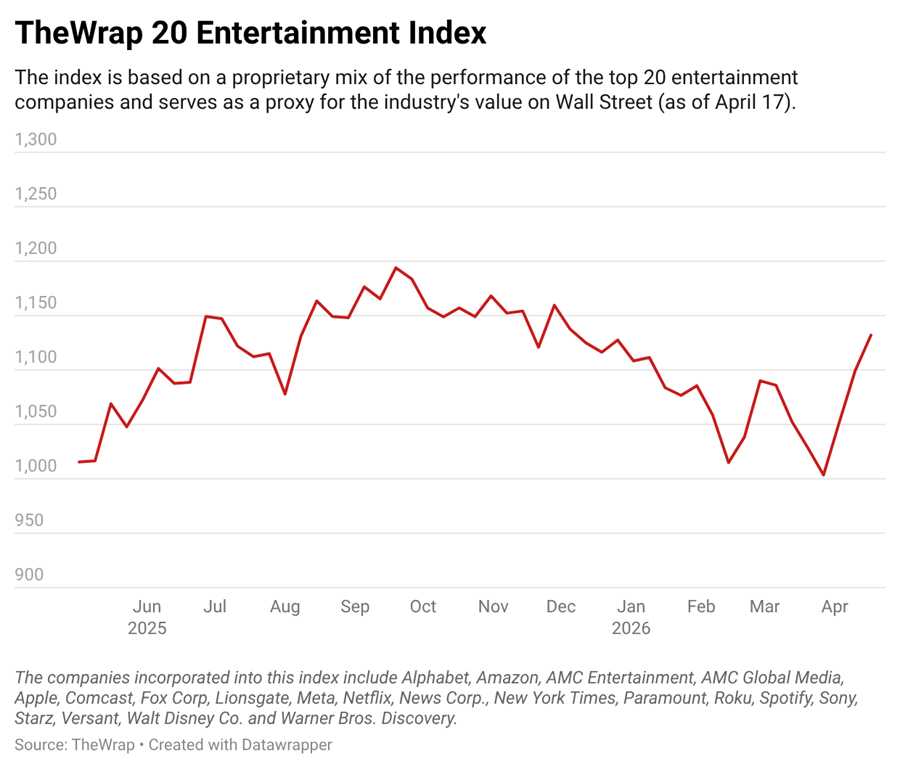
As part of the launch of The Ledger, we’re also introducing TheWrap20 Entertainment Index, made up of the market capitalization of the top 20 companies in the industry and using a proprietary weighting system that gives you a good temperature check on how Wall Street feels about Hollywood.
The companies that make up the index include Alphabet, Amazon, AMC Entertainment, AMC Global Media, Apple, Comcast, Fox Corp., Lionsgate, Meta, Netflix, News Corp., New York Times, Paramount, Roku, Spotify, Sony, Starz, Versant, Walt Disney Co. and Warner Bros. Discovery.
Check back weekly to see how the index is performing.
ANOTHER TAKE

Economic uncertainty and pressure on consumer sentiment will be dogging media companies as they report first-quarter earnings, according to analyst Robert Fishman of MoffettNathanson.
So far, advertising revenues have been steady, but “we cannot ignore some risk to second-quarter numbers if the situation escalates,” Fishman said. “In addition, lower consumer sentiment could begin to show cracks in even this last pillar of support along with willingness to spend on subscription streaming services.”
Fishman said the Olympics have given Comcast’s NBCUniversal most of the upside in the first quarter. In terms of national advertising, Fishman forecasted that cable networks will be down 11.2% while broadcast networks will be up 19.5%. Total national advertising will be up 5.7%. But without NBCU Olympic dollars, broadcast will be down 8.4% and total national ad revenue will drop 9.7% from a year ago.
Streaming ad revenues for Netflix, Roku and the traditional media companies will be up 31% (21.2% ex Olympics).
The TV business’ other sources of revenue are mixed with affiliate fees down 3% and retrans up 7.9%. Taking out Olympic-related revenue, total affiliate fees and retrans will be down 2.1%, Fishman projects.
MoffettNathanson has buy ratings on Netflix, Disney, Live Nation, Cinemark and Comcast.
FINANCIAL ROUNDUP

Paramount Skydance’s $81 billion acquisition of Warner Bros. Discovery hit another wrinkle as Paramount disclosed foreign investors would own 49.5% of Paramount equity.
- The would-be acquirer asked the Federal Communications Commission to permit the deal. The FCC’s rule bars foreign investors from owning more than 25% of companies that own broadcast licenses. Paramount owns CBS, which has 28 owned and operated stations
- The Saudi Arabia Public Investment Fund, Qatar Investment Authority and L’imad Holding Co. of Abu Dhabi have put up about $24 billion to help finance the deal, and would control 38.5% of the shares, although in a non-voting capacity.
- Will the government approve? Paramount, controlled by the Ellison family, has been cozying up to the Trump administration. David Ellison attended a White House state dinner for King Charles III and FCC Chairman Brendan Carr was a guest of CBS at last weekend’s White House Correspondents’ Dinner. That’s not to mention the Ellison-hosted DC dinner honoring Trump in the days before the WHCD. We’ll see if that’s enough to open the Strait of Zaslav.
The debate over whether or not YouTube is or isn’t TV was overshadowed by the first-quarter numbers reported by parent company Alphabet. YouTube ad revenues were up 10.7% to $9.89 billion, so advertisers are clearly liking what they see.
- “We’re in an unmatched position to connect brands with the audiences they care about in the moment they engage in,” said Philipp Schindler, senior VP and chief business officer of Google. AI will widen the margin: “We are applying Gemini to drive better matching and discovery between brands and creators of all sizes.”
- Overall, Alphabet revenues were up 22% to $109.9 billion, and net income increased 81% with earnings per share rising 82% to $5.11.
On Amazon’s call, CEO Andy Jassy called out highlights in the company’s entertainment and advertising businesses.
- “Moviegoers have flocked to ‘Project Hail Mary’ with nearly $615 million in global box office to date. Its opening weekend was the second biggest for any non-sequel, non-franchise film in the last decade,” Jassy said. “We also surpassed 100 million viewers globally for the ‘Culpables’ movie trilogy, with all three films reaching No. 1 in more than 170 countries at launch. In live sports, we offered exclusive coverage of the NBA SoFi Play-In Tournament with total viewership up 18% compared to last year on cable.”
- Jassy noted that Amazon Ads revenue was up 22% to $17.2 billion and he highlighted new deals with Netflix, Comcast and Samsung.
- Amazon net income rose to $2.78 per share from $1.59 a share a year ago as sales rose 17% to $181 billion.
FROM THEWRAP

iHeartMedia in Talks to Merge with SiriusXM
Ted Sarandos Says Warner Bros. Bidding War Built Netflix’s ‘M&A Muscle’
Michael Ovitz Wants Back In. Will Hollywood Have Him?
HEARD AROUND

Goldman Sachs and Bain Lead Investment in AI Marketing Startup
Bertelsmann Merges Firms Behind Kylie Minogue, Miles Davis to Create World’s No. 4 Music Group
Bob Iger Returning to Joshua Kushner’s Thrive in Post-Disney Move
Media & Entertainment CEO Pay Surged 117% in 2025, Report Finds
