
Paramount CEO David Ellison’s higher offer for all of Warner Bros. Discovery couldn’t have come at a better time.
Paramount on Monday raised its offer from its previous $30-a-share, all-cash offer, and while the specific amount of the bid was not revealed, Warner Bros. Discovery said it is reviewing the offer while it continues to recommend the Netflix deal.
The submission comes amid a raft of headlines that seemed to dampen Netflix’s prospects for getting its own $83 billion deal done. President Trump, who has flipped back and forth on his involvement, appeared to put his thumb on the scale over the weekend, calling on Netflix to fire board member and former UN ambassador Susan Rice, a Democrat, or face “consequences.” Adding to the pressure was news that the Department of Justice has opened an anti-trust investigation into the Netflix deal, talking to theater owners, filmmakers and producers across Hollywood to gather their input for its review.
The timing of all those headlines just as Paramount is riding in raises the question of whether momentum is finally shifting in Ellison’s direction. Its latest bid, which presumably will lead to his long-teased “best and final offer,” is Ellison’s attempt to go for the kill.
Experts previously told TheWrap that they expect Ellison’s offer to be somewhere in the range of $32 to $35 per share. While Netflix retains the right to match any offer from Paramount, it is becoming increasingly unclear if co-CEOs Ted Sarandos and Greg Peters are willing to take a potential battle with Trump and the DOJ to court, or if they’ll simply walk away and let Paramount overpay – a move they’ve been willing to do in other high-stakes negotiations with rivals for top talent and content.

“We have always been an incredibly disciplined buyer and we will continue to be one here,” Sarandos told Bloomberg TV in an interview last week when asked about matching an offer from Paramount.
Though Paramount said it’s prepared to engage in “good faith and constructive discussions” with WBD, Ellison and Co. have also made it clear they have no plans to back down from their hostile takeover bid and intend to take their battle to the boardroom with a proxy fight should the outcome not land in their favor. And with their perceived regulatory advantage in the White House and some activist investors showing support for the Ellisons, the fight is long from over.
“It’s pretty clear that Paramount is on the right side of this administration in a way that, certainly after Rice’s statements, Netflix isn’t,” Neama Rahmani, a Los Angeles-based trial lawyer and former federal prosecutor told TheWrap. “That doesn’t mean Netflix is going to roll over, but it’s politically problematic even though legally it should have no effect whatsoever. But we know with this DOJ, the line between law and politics doesn’t seem to exist anymore.”
Paramount and Netflix declined to comment. Warner Bros. didn’t immediately return TheWrap’s request for comment.
Netflix vs. Paramount
Last week, Warner Bros.’ board reopened talks with Paramount for seven days to address the concerns with Ellison’s multiple bids and to submit his long-teased “best and final offer.”
Though Netflix granted the waiver to restart talks, the company and Sarandos haven’t been shy about knocking Paramount’s efforts as an “ongoing distraction” and accusing the company of “flooding the zone with misinformation” about its deal with WBD.
Sarandos made the rounds last week defending the deal, including calling the idea that Warner Bros. pulls all merger talks “some fantasy.”
Over the weekend, reports emerged that the Department of Justice had issued a civil investigative demand (CID) to filmmakers and producers to get their thoughts as part of its review of the $83 billion deal’s potential impact on competition, jobs and the future of the theatrical business. A spokesperson for the DOJ did not immediately return TheWrap’s request for comment.
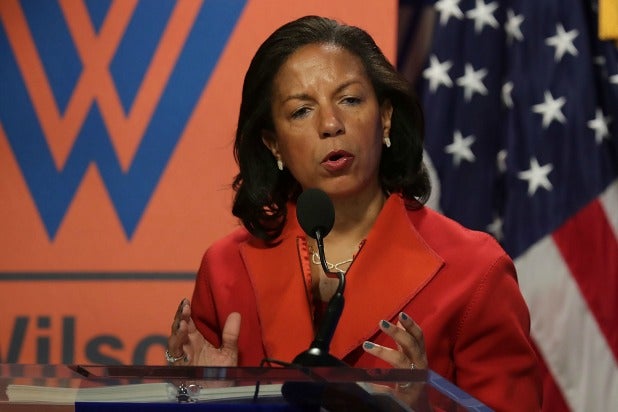
Making matters worse, Trump took aim at Netflix board member and former UN ambassador Susan Rice, calling on the company to fire her or “pay the consequences” after she said that corporations who “bent the knee” to the administration would face consequences of their own if Democrats returned to power.
In an interview with BBC on Monday, Netflix co-CEO Ted Sarandos brushed off concerns about Rice, saying Trump “likes to do a lot of things on social media” and that approval of the deal will be decided by regulators, not the White House.
“This is a business deal. It’s not a political deal,” Sarandos added.

Do the headlines make a difference?
Morningstar Research analyst Matt Dolgin said that the latest developments with Rice and the DOJ are mostly noise for the moment and that Paramount’s success in thwarting Netflix ultimately depends on how high its final offer is and whether Netflix responds.
Though Dolgin told TheWrap that Paramount “already has a more favorable deal for shareholders and an easier path to approval,” he ultimately still sees the fight as a tossup, placing the odds of either being the acquirer at no more than 50% each. On the shareholder front, just 42.3 million of WBD’s 2.48 billion outstanding shares had been validly tendered to Paramount as of Feb. 9, and a vote on the Netflix deal has been set for March 20.
New Street Research analyst and former FCC chief of staff Blair Levin believes that, under a traditional antitrust review, the DOJ would dismiss Rice’s comments as irrelevant. Under an outcome pre-determined by Trump, Levin believes that it would be more focused on news coverage from CNN rather than Rice. He also warned that Trump’s comments could pose a problem in a future review by the courts.
“It is evidence that the DOJ, if it challenges the Netflix deal, did so for non-competition reasons,” Levin said. “We are, however, far from that situation and the Rice comments are likely just one more piece of evidence illustrating motives outside the Sherman and Clayton Acts.”
Rahmani said he would be surprised if Rice stepped down or was ousted, but believes her comments don’t help the case Sarandos is working tirelessly to make to regulators.
“I understand the position that she’s taking,” Rahmani said. “But she’s a pretty high-profile person and her words are going to be attributed to Netflix when they’re trying to get regulatory approval. So it’s certainly adding fuel to the fire.”
As for the DOJ probe, Netflix has repeatedly maintained that it has “not been given any notice or seen any other sign that the DOJ is conducting a monopolization investigation.” It also said that any claim that it is a monopolist, or seeking to monopolize, is “unfounded.”
“Our success stems from innovation and investment that benefit consumers,” Netflix chief legal officer David Hyman said. “We neither hold monopoly power nor engage in exclusionary conduct, and we’ll gladly cooperate, as we always do, with regulators on any concerns they may have.”
Qualia Legacy Advisors managing director Aaron Meyerson said that the DOJ’s probe is a “significant” development, but that it is “more headlines than a fundamental shift” until the agency does something that “translates into a real change in closing probability.” However, he acknowledged it gives Paramount a “narrative tailwind in the short run and another angle through which to negotiate.”

Sticking it out
While experts previously told TheWrap that the reopening of talks between WBD and Paramount gives Netflix an opportunity to bow out amid a declining share price, Rahmani thinks that the streamer is just getting started and gearing up for a high stakes legal battle with the DOJ in court, which could drag the dispute out even longer.
“An asset like this rarely comes along and Netflix has been very, very aggressive when it comes to growth. So I don’t think they’re going to walk away from this,” Rahmani explained. “They’re probably thinking to themselves, ‘Okay, worst case scenario, even if this gets jammed up in court for the next couple of years, let’s see what happens. Let’s see what happens with the midterms. Maybe there’ll be a different environment on Capitol Hill if Democrats take control of the House, and we’ll see what happens with the Senate.’ So from their perspective, they’d rather ride this out in litigation than to just walk away.”
Both Levin and Rahmani don’t see Netflix simply folding to the DOJ’s decision, noting that there’s so much at stake and that the Trump administration has previously lost in court before on issues like tariffs and immigration.
“[Monopolization investigations] are very difficult. Most people would agree that Meta, Alphabet and Apple have stronger market positions in their relevant markets than Netflix,” Levin said. “Investigations of the tech companies started long ago and still have not achieved any material change. So I doubt that rumors of such an investigation will, or should, scare Netflix (or WBD shareholders) away.”
