
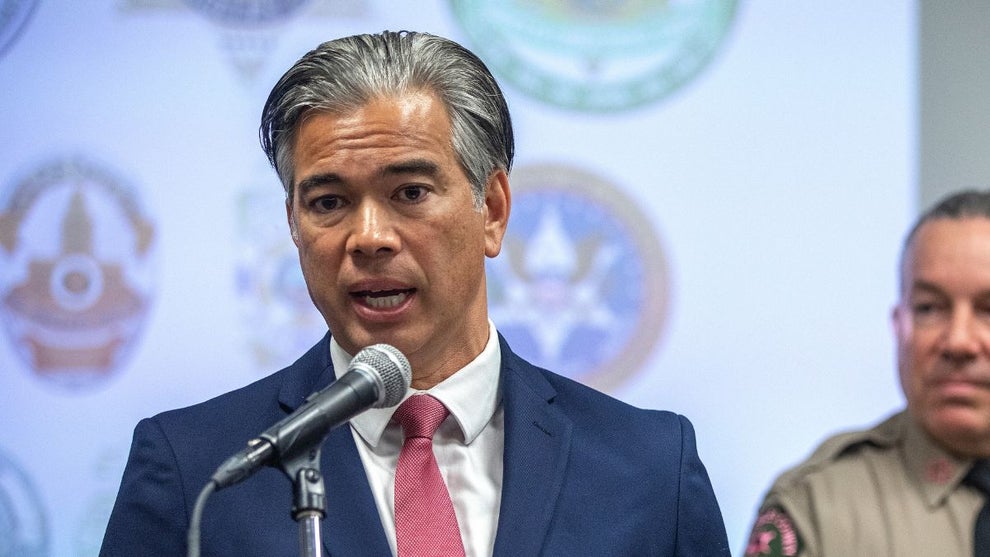
A dozen state attorneys general have sued to block Paramount’s “unlawful” pending $110 billion merger with Warner Bros. Discovery, California AG Rob Bonta announced on Monday.
“Today, I am leading 12 states in challenging the proposed merger of Warner Bros. and Paramount and asking the court to block the deal,” he said in a statement. “California’s film and entertainment industry touches the lives of Americans daily. We’re going to court to fight for a free and fair market and protect this iconic industry.”
Arizona, Colorado, Connecticut, Massachusetts, Minnesota, Nevada, New Jersey, New Mexico, New York, Oregon and Washington are also included in the lawsuit. A Paramount spokesperson did return TheWrap’s prior request for comment.
The coalition of states argue that the merger would create an entertainment giant with increased leverage over movie theaters, along with cable and streaming platforms, seemingly allowing Paramount to raise prices, reduce content output and make it more difficult for other studios and production companies to reach audiences. The states contend that consumers would ultimately face fewer viewing options and less competition across film, TV and streaming.
“The unlawful merger of these two entertainment behemoths would lead to higher prices, lower quality and less content for film and television, harming movie theaters, basic cable distributors and, ultimately, audiences on every sofa and movie theater seat in the U.S.,” Bonta added. “Consolidation here not only leads to higher prices — it also leads to fewer opportunities for important stories to come to life, and fewer ways for audiences to encounter stories, ideas, and perspectives beyond their own experiences.”
“In this country, no one is above the law,” he continued. “With this lawsuit, California and our sister states are fighting for free and fair markets, not rigged markets. America has no kings in government or our economy.”

In response, Paramount said the lawsuit would help Netflix avoid competition and threw cold water on the antitrust arguments.
“We will vigorously defend the transaction and demonstrate that this challenge is inconsistent with sound competition policy and the competitive realities of the media marketplace. Delaying this transaction will only harm entertainment workers who have already suffered over recent years as technology has disrupted their livelihood and cost California tens of thousands of entertainment jobs,” a Paramount spokesperson said in a statement.
And Cinema United — the lobbying group for theatrical exhibition — threw its weight behind the attorneys general in another statement released Monday.
“We welcome the decision of the Attorneys General of multiple states to challenge the proposed acquisition of Warner Bros. Studios. The ramifications of further movie studio consolidation will be significant and lasting, not just in Hollywood, but on Main Streets across this nation where local movie theaters serve as cultural and financial cornerstones for communities of all sizes,” said Michael O’Leary, President and CEO of Cinema United.
The legal effort comes after AG Bonta told TheWrap in April that “red flags are everywhere” in this type of merger.
In May, Paramount said it was cooperating with various state AGs who sent them subpoenas, or civil investigative demands, focusing on the competitive effects of the merger and the DOJ’s investigation. At the time, it did not disclose which or how many state AGs sent subpoenas.
In addition to the lawsuit, Oregon AG Dan Rayfield separately requested a court order that would delay the deal from closing for 60 days after it substantially complied with the state’s request for the media giant’s records. However, Rayfield later withdrew that request and motion to consider next steps after “Paramount made it clear that they weren’t going to comply with the investigative demand, and that they think they’re above the law.”

The lawsuit comes after the merger was cleared by the Justice Department and Warner Bros. shareholders. State attorneys general were able to participate in the DOJ’s eight-month investigation, which allowed them to share information with the agency and vice versa and to attend related depositions.
Other countries where the deal has received clearance or where relevant waiting periods have expired include Australia, Austria, Canada, China, Kuwait, Saudi Arabia, Serbia, South Africa, Ukraine, Montenegro, New Zealand, and North Macedonia. Foreign direct investment authorities in Spain, Germany, Slovenia, Belgium, Czechia, Italy, France and Romania have also signed off.
The Paramount-WBD merger is on track to close by the end of the third quarter. The company has agreed not to close the merger prior to July 22, when the European Commission will decide whether to clear the merger or or refer it for a more in-depth Phase 2 investigation.
The EU’s Phase 1 investigation was extended from July 7 after Paramount submitted concessions in an effort to address the regulator’s concerns about the merger’s potential impact on competition. Remedies discussed during a meeting with EU officials last month included withdrawing from United International Pictures, an international film distribution joint venture with Universal.
The EC and the U.S. Federal Communications Commission are also reviewing the foreign investment in the deal, with those investors set to account for 49.5% equity of the combined company. The EC has set an initial deadline for that review for July 14, while the FCC has not offered a specific timeline.
In addition, U.K. Secretary of Culture, Media and Sport Lisa Nandy informed Paramount and WBD that she’s “minded to intervene” in the deal. The U.K. Competition Markets Authority will decide whether to clear the merger or launch a Phase 2 investigation by Aug. 7.
In the event the transaction does not close by Sept. 30, WBD shareholders will receive a 25 cent per share “ticking fee” for each quarter until closing. In the event that the deal does not close at all due to regulatory matters, Paramount will pay WBD a $7 billion termination fee.
