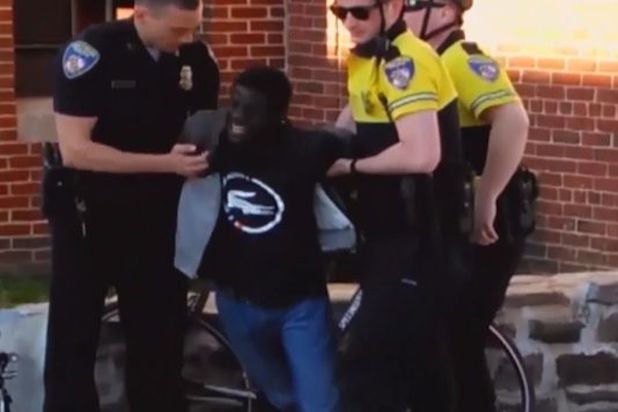
CNN Boss Jeff Zucker Apologizes for Controversial Freddie Gray Story (Exclusive)
Article on network’s website called man who died in Baltimore police custody “the son of an illiterate heroin addict”
Jordan Chariton | December 1, 2015 @ 11:00 AM
Last Updated: December 1, 2015 @ 2:20 PM
CNN president Jeff Zucker on Tuesday admitted it was a “mistake” to publish a controversial story on the network’s website Monday calling slain Baltimore resident Freddie Gray “the son of an illiterate heroin addict.”
“This was a mistake,” Zucker said at a town hall event for staffers, according to a transcript the network provided to TheWrap. “The digital team removed it last night and inserted an editors note to be completely transparent. The editorial intent as the digital team has laid it out to me was to make clear he had a difficult upbringing. But clearly it did not come across that way when it was written and published. We recognize that. It did not work and we removed it. And were transparent about that. That was a mistake.”
Though a network insider who observed the town hall event described Zucker’s comments as an apology and his behavior as conciliatory, a CNN spokesperson disputed that characterization: “He never used the word ‘apology,’ nor any word that evokes apology.”
The story, about the first day of jury selection in the trial of one of the Baltimore officer’s charged with the late Gray’s killing, drew the ire of many on social media for reporting: “The April 19 death of Freddie Gray, the son of an illiterate heroin addict, made him a symbol of the black community’s distrust of police.”
CNN was ripped by many for what appeared to be an insensitive depiction of Gray. “Here we go. Freddie Gray on trial in the murder of Freddie Gray,” one Twitter user wrote.
Another took the network to task for its selective policy on suspending reporters after reporter Elise Labott was suspended for a tweet that criticized Congress’ bill restricting Syrian refugees entering the U.S.
Gray, of course, was the center of a media firestorm and widespread protests in Baltimore in April after he died as a result of not being properly belted into a police van after his arrest for carrying what officers determined to be an illegal switchblade.
The 25-year-old African American succumbed to life-ending spinal cord injuries suffered during the arrest. Six officers involved with his death were charged in May.
Outside the jury selection of the trial of officer William Porter on Monday stood a small group chanting, “All night, all day, we will fight for Freddie Gray” in support of Gray.
Gray’s family received a $6.4 million civil settlement from the city of Baltimore in September.
For the record: This story has been updated with a response from a CNN spokesperson.
The Scene in Baltimore Following Freddie Gray's Death (Photos)
Freddie Gray suffered catastrophic injuries after he was arrested on Apr. 12 for running from Baltimore police. He slipped into a coma and died on Apr. 19.
CNN
Protesters marched toward the Baltimore Police Western District station in a stand against police brutality and the death of Freddie Gray
Getty Images
Protesters clashed with police during a march through Baltimore in honor of Freddie Gray on Apr. 25
Getty Images
Gray's casket was unloaded for his funeral on Apr. 27, drawing thousands of people from all over the country
Getty Images
Following Gray's funeral, at least 15 Baltimore police officers were injured on Apr. 27 when riots broke out in response to Gray's death
Getty Images
Protesters set fires in the streets of Baltimore on Apr. 27 following Gray's funeral
Getty Images
Cars were burned as rioters threw rocks and bricks at the police on Apr. 27
Getty Images
Several police cars were destroyed by the crowds on Apr. 27
Getty Images
A CVS pharmacy in Western Baltimore became symbolic of the riot when it was looted and burned on Apr. 27
Getty Images
Riots continued throughout the night on Apr. 27
Getty Images
By the end of the night on Apr. 27, nearly 200 people had been arrested
Getty Images
Baltimore Mayor Stephanie Rawlings-Blake and Maryland Gov. Larry Hogan walked out of an interview with Don Lemon on Apr. 27, after the CNN anchor questioned their decision making
Getty Images
A National Guardsman kept watch over a deserted Baltimore street on Apr. 28
Getty Images
Burned out cars and wreckage smoldered as Baltimore prepared for an enforced curfew on Apr. 28
Getty Images
One protestor laid down in the street in front of riot police on Apr. 28 rather than abide by the city-wide curfew
Getty Images
Police fired tear gas into the crowd as residents resisted a city-wide 10 p.m. curfew on Apr. 28
Getty Images
Fearful of large crowds and the safety of fans, the Baltimore Orioles played the Chicago White Sox on Apr. 29 in an empty stadium, the first time such a game has occurred
Getty Images
Baltimore Orioles players beat the Chicago White Sox in an empty stadium on Apr. 29, with some pretending to sign autographs for invisible fans
Getty Images
Protests spread on Apr. 29 to New York City as around 140 people were arrested in Union Square
Getty Images
The outbound Holland Tunnel in New York was shut down on Apr. 29 as protestors flooded the streets
Getty Images
New York Knicks star Carmelo Anthony joined protesters in Baltimore on Apr. 30, the NBA All-Star grew up in Charm City
Instagram/Aaron Maybin
Demonstrators clashed with police in Philadelphia during a march dubbed "Philly is Baltimore" on Apr. 30
Getty Images
1 of 22
Violent protests took over the city as thousands demonstrated after the 25-year-old man died in police custody on Apr. 19
Freddie Gray suffered catastrophic injuries after he was arrested on Apr. 12 for running from Baltimore police. He slipped into a coma and died on Apr. 19.