

During an hourlong staff meeting last month, McClatchy’s vice president of local news Eric Nelson pitched what he called “a powerful addition to our toolbox.”
Nelson was promoting the company’s new “content scaling agent,” an AI summarization tool powered by Anthropic’s Claude, which he said can help reporters find “new audiences, angles and entry points.”
“Journalists who embrace and experiment with this tool are going to win,” Nelson told the group, according to multiple people familiar with the meeting. “Journalists who are defiant will fall behind. Bottom line: We need more stories and we need more inventory.”
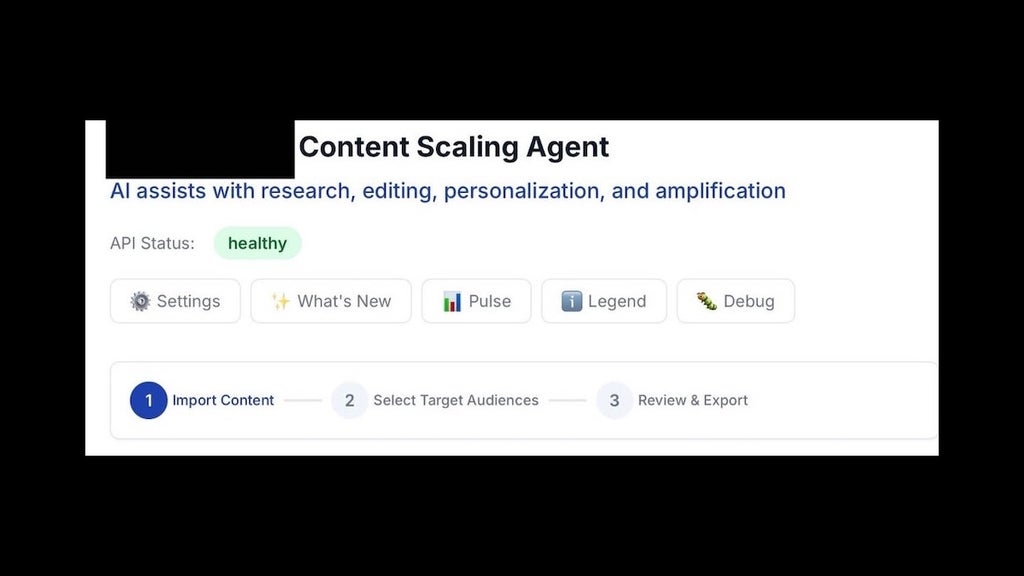
Since reporting earlier this month how McClatchy’s new AI tool has angered staffers across several of its Pulitzer Prize-winning newsrooms, TheWrap has obtained new details about how the tool works from the March 17 company meeting, including screenshots of the tool, and insight into how management is pitching it to employees and responding to reporters’ concerns about adding their bylines to AI-assisted articles.

Executives have framed the tool as “Grammarly on steroids,” a way to extend a story’s reach beyond its initial audience. But some journalists at McClatchy, a 168-year-old newspaper chain serving nearly 30 U.S. markets, fear it could undermine their work and are pushing back.
At least three unions representing McClatchy newsrooms — the Miami Herald, the Sacramento Bee and the Kansas City Star — filed grievances against the company last week for allegedly violating contract provisions requiring advanced notice for any “major technological change,” according to two people familiar with the matter. The move followed information requests from some of those unions expressing concern over “limited information and mixed messaging” about the product.
The contrast between executives’ enthusiasm for the tool and employees’ reluctance to use it reflects how generative AI tools have splintered newsrooms across the country. Outlets such as Cleveland’s Plain Dealer have used the technology to let reporters prioritize reporting over writing, while unionized staffers at Pulitzer-winning outlets such as ProPublica and the New York Times have sought AI guardrails in negotiations, even prompting a daylong walkout at ProPublica.

A McClatchy spokesperson did not respond to TheWrap’s detailed questions about the company’s AI strategy, its internal guidelines and executives’ comments at the March meeting.
How it works
The content scaling agent, or CSA, allows newsroom editors to generate short- and long-form summaries of reporters’ stories; versions targeted at specific audiences; and video scripts for reporters to produce short-form content from their stories.
The CSA landing page for a McClatchy newsroom — the first page one sees when they open the tool – touts it as able to “assist with research, editing, personalization and amplification.”
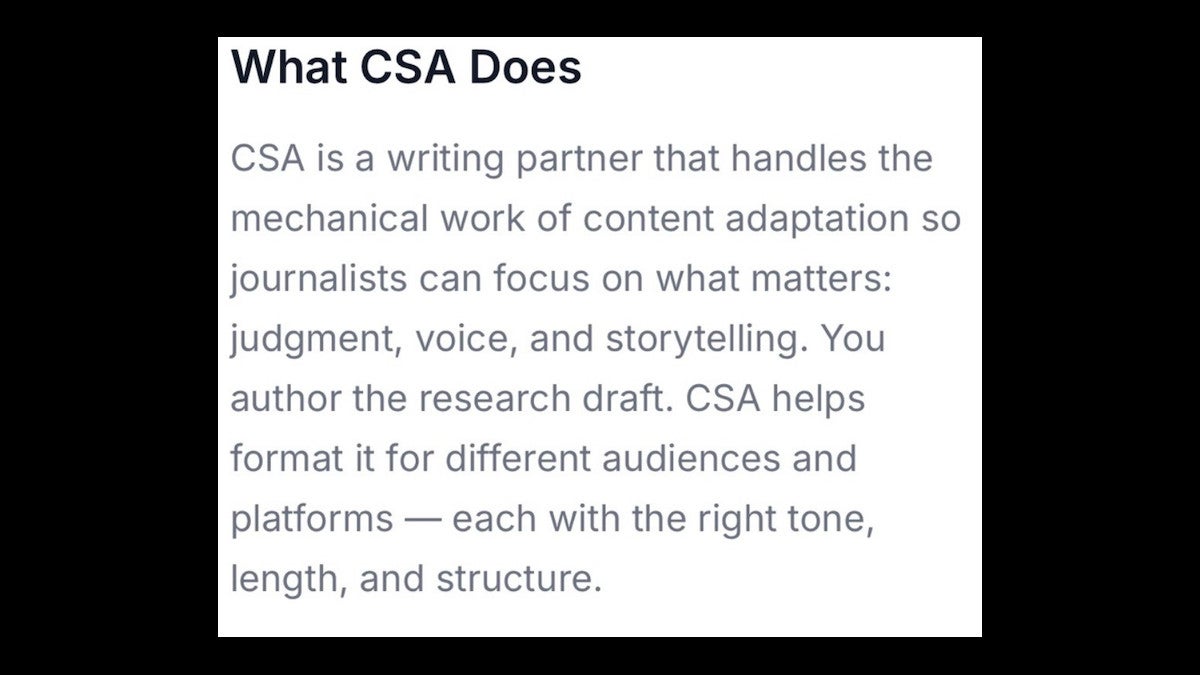
The tool, according to one page outlining its work, is “a writing partner that handles the mechanical work of content adaptation so journalists can focus on what matters: judgment, voice and storytelling.”
“You author the research draft,” the tool reads. “CSA helps format it for different audiences and platforms — each with the right tone, length and structure.”
Once a journalist imports one or multiple URLs from a McClatchy website (examples on the tool include articles from the Herald or the Centre Daily Times in Pennsylvania), they then choose up to five “target audiences” for the new version of the story to appeal to specific community members. A story’s length can be as short as 200 words or as long as 1,500, and each story comports with the newsroom’s style guide.
The CSA can then generate a “What to Know” summary, with bullet-pointed highlights of the original work now optimized for “newsletters, social media or time-constrained readers”; a video script to adapt an article for short-form video; or a “discover explainer,” a 400- to 800-word explainer version that uses phrases optimized for Google.
Here’s an example: The Herald published a nearly 1,100-word story on April 9 by reporter Howard Cohen about Florida’s leading grocery chain, Publix, potentially retiring its stores’ weight scales, where customers have weighed themselves for decades. A “What to Know” version of the story, published on April 17, broke Cohen’s story into bullets and linked back to his original piece. Its word count, with an AI disclaimer at the bottom, totaled 212 words.
By picking target audiences, the tool provides a novel way for journalists to “think about how you should approach a story where sometimes reporters have blinders on,” Nelson said during the March 17 meeting.
“Maybe there is something there that you didn’t think about,” Nelson said, according to multiple sources familiar with the meeting. “We’ve had stories that have done better versions than even the original versions.”
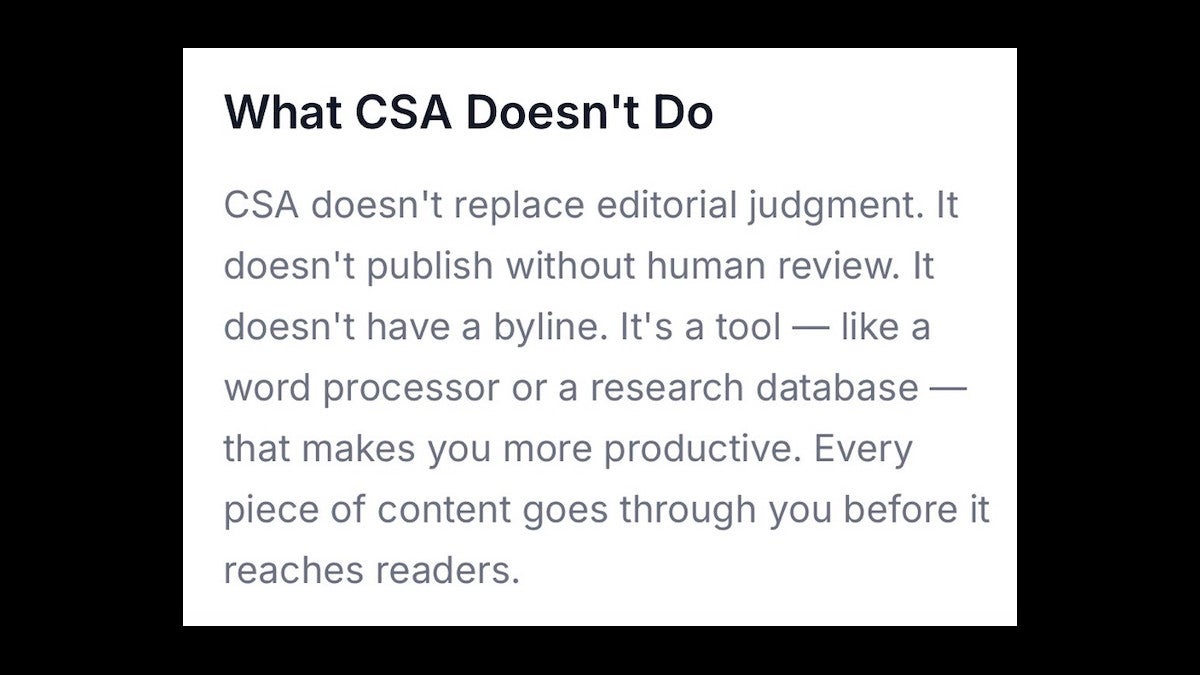
The CSA doesn’t replace editorial judgment, according to the tool’s page outlining its abilities, which emphasizes that humans must review what it produces before publication.
“It doesn’t have a byline,” the page reads. “It’s a tool — like a word processor or a research database — that makes you more productive.”
Yet bylines have become a flashpoint.
Byline battle
Whether a McClatchy newspaper discloses the tool’s usage depends on the newspaper’s union, or lack thereof.
Pennsylvania’s Centre Daily Times, which is not unionized, publishes stories citing “reporting by” the reporters of the original story, though the story itself was “produced with AI assistance.”
Unionized staffers at the Miami Herald have a CSA byline that reads “produced using AI based on original work by” the reporter whose story was summarized, while stories at the Sacramento Bee, whose unionized staffers last month invoked a contract provision to withhold their bylines in advance from stories to protest the CSA, note they’re “edited by” a top editor and “produced with AI assistance.” The stories also note at the bottom how “a proprietary tool powered by artificial intelligence” was used.
But McClatchy executives initially indicated they’d like more control over how they label reporters’ work.
Kathy Vetter, McClatchy’s chief of staff for local news, said during the March 17 meeting that the company’s general policy was that reporters who cannot revoke the use of their bylines must keep them attached to CSA-produced stories. For those who can revoke their byline, she said, McClatchy will still use their work anyway.
“We have every right to use their work,” she said, according to multiple sources familiar with the meeting. “It belongs to us, and if an editor wants to go … in there and repurpose a reporter’s content, they can put their name on it.”
“If they don’t have the ability in their contract to remove their byline, we’re going to use their name,” Vetter added in response to a question. “Now, I’m not asking y’all to get in fist fights with all of them, but in the cases where we have to, they get to decide. If they decide not to, again, they don’t get credit. They don’t. We’re going to do it anyway, but they’re not going to get credit for it.”

For CSA-produced stories that reporters “substantially” rework, Vetter said, the company may not even need to label the use of AI. Vetter said reporters at the Wichita Eagle and Raleigh’s News & Observer opted to just put their bylines on CSA-produced stories because of their work on the final product.
“They’re substantially reworking the draft, and they don’t think they need AI assistance at all,” Vetter said, according to multiple sources familiar with the meeting.
“Just putting AI-produced or AI summarization or some of those catch-alls that we have been using very much downplays the blood, sweat and tears we have put into this work,” Vetter said. “I’m not going to give the AI credit for all the reporting that we went out and did, the original story that we wrote. All this is doing is reformatting it for us because it’s faster and more accurate than doing it manually.”
Nelson said the company needed to use reporters’ names to show “authority” with Google, whose changing algorithms have induced massive traffic plunges for news publishers, as it was “very important to say that this is from our reported stories.”
It appears the company has already taken steps to pull back its public disclosure of AI, both privately and publicly. An April 7 update to the CSA said that the “discover explainer” drafts optimized for Google would no longer automatically include an AI disclaimer and that reporters must manually include them. It came as McClatchy this month took down its public AI guidelines posted on the Herald’s website, with the landing page now leading to an error page.
The inside pitch
While the company appears less inclined to publicly promote its use of AI, privately it remains bullish.
Staffers clicking around on the CSA’s landing page can produce a Star Wars-esque credits reel that highlights those who’ve worked on the product with sci-fi labels and the tools used to build it, including Claude Code, Anthropic API and other AI agent framework software.
One video seen by TheWrap, labeling the CSA “A McClatchy Production,” cites people such as McClatchy’s senior vice president of marketing Jason Smith as “Bending the Spoon”; its vice president of product and experiences, Kat Sheplavy, as “system override”; various developers and designers; and “Dr. Opus Claude & The Anthropic Agents.” The product’s “director” is Rajiv Pant, a former chief technology officer at the Wall Street Journal and the New York Times, who spearheaded the tool. Pant is labeled “The Architect (Augmented).”
Pant was one of the presenters during the March 17 meeting, explaining through AI-generated presentation slides how the CSA functioned as a “Grammarly on steroids” designed to produce content that kept humans at the core. Nelson then followed up Pant’s comments with a demo of the tool, but before it could generate anything, it appeared to hit a snag.
Pant found the culprit on Anthropic’s status page: Claude was down.
