
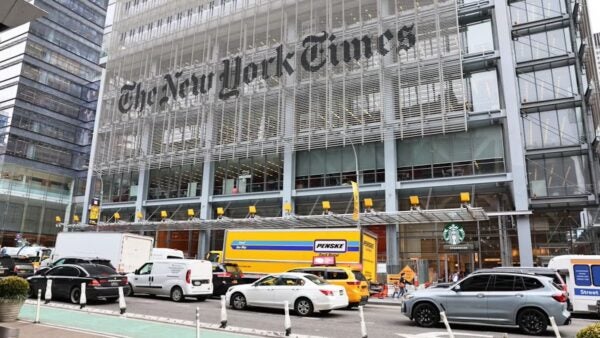
Investigative outlet Hunterbrook accused The New York Times on Sunday of using elements of its earlier reporting without proper credit in a front-page investigation into President Donald Trump’s environmental rollbacks, pointing to similarities in pollution modeling, photographs and sources.
The allegations followed the Times’ Saturday investigation into how Trump exempted more than 200 industrial facilities from stricter clean-air regulations. Hunterbrook claims portions of the report closely resemble two investigations it published months earlier into chemical pollution at plants in Texas and Virginia. The Times denied the allegations Monday and confirmed to TheWrap that it added an acknowledgment of Hunterbrook shortly after publication.
In a series of posts on X, Hunterbrook pointed to its May investigation into an April accident at Sterilization Services of Virginia, where a faulty valve released 580 pounds of ethylene oxide, a cancer-causing gas. Both newsrooms used the National Oceanic and Atmospheric Administration’s HYSPLIT modeling system to illustrate how the chemical spread into nearby communities.
Hunterbrook also highlighted similarities between the Times’ reporting and its February investigation into Indorama Ventures’ chemical plant in Port Neches, Texas, which received an exemption from federal pollution rules despite a history of chemical releases.
The outlet shared side-by-side photographs appearing to show the same Texas home overlooking the Indorama plant, taken from similar vantage points. Both images feature the house in the foreground and industrial smokestacks in the background, though they were taken by different photographers.
Hunterbrook further pointed to interviews with Joseph Goffman, a former senior Environmental Protection Agency official quoted by both newsrooms, although the quotations published by each differed.
Hunterbrook publisher Sam Koppelman said publicly that his newsroom raised concerns with the Times before going public and questioned the newspaper’s explanation for the similarities.
“We gave the Times the chance to do the right thing yesterday,” he wrote on X, arguing that the similarities were too specific to dismiss as coincidence.
“They wrote a great story,” Koppelman added. “Obviously, we care about the subject deeply. It’s just a huge bummer for our team and the reporters who worked relentlessly on these stories.”
Charlie Stadtlander, a Times spokesperson, told TheWrap that the newspaper’s journalists spent months independently investigating the Trump administration’s pollution exemptions, reviewing thousands of pages of government documents obtained through public records requests.
Stadtlander said the Times worked with outside researchers from Johns Hopkins who used NOAA’s modeling system to independently produce its Virginia plume graphic. He said the newspaper photographed the facilities because the Environmental Protection Agency had identified them as among the country’s worst polluters.
“The collective work published — including photography, graphics and writing — was entirely ours, and we stand behind its originality and service to audiences,” Stadtlander said.
The Times’ acknowledgment of Hunterbrook, added shortly after publication, noted that pollution concerns surrounding the facilities had previously been covered by organizations including ProPublica and Hunterbrook, which it described as an investigative outlet affiliated with an investment firm.
“But these past publications had no bearing whatsoever on The Times’s article,” Stadtlander said. “Allegations to the contrary are simply untrue.”
