
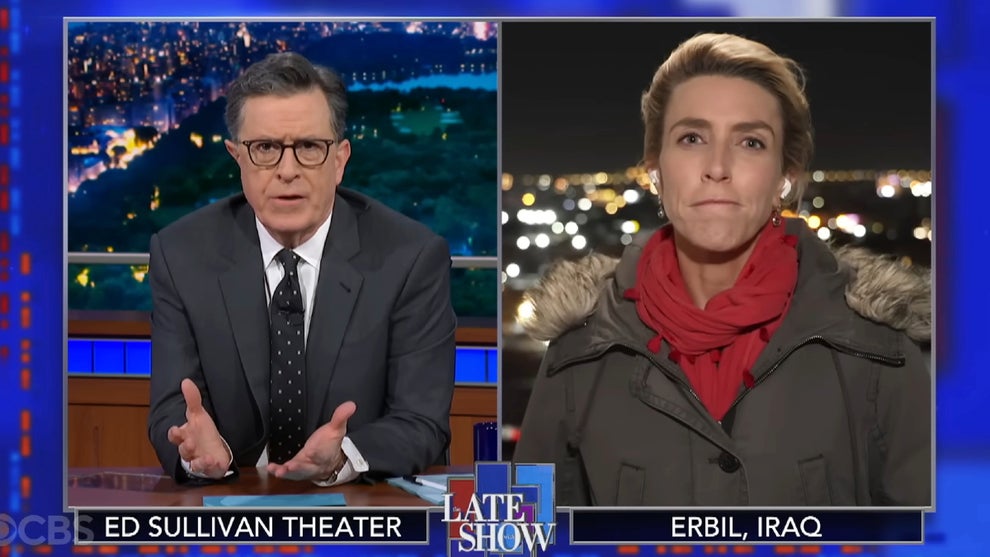
CNN correspondent Clarissa Ward joined “The Late Show with Stephen Colbert” on Wednesday night live from Iraq, where she accused the White House of demonstrating a “staggering lack of humility” with its handling of the war in Iran so far.
Colbert asked Ward directly how she, as an on-the-ground journalist, felt about the White House’s use of action movie clips and “Call of Duty” gameplay in a recent social media video covering the war in Iran. “As a journalist, I’m really not supposed to say this, but I feel deeply ashamed, and I think it belies a staggering lack of humility,” she responded. “I think it just plays into the worst stereotypes about America and how America wields its power, what America cares about.”
“My good friend, journalist Hala Gorani, today quoted Machiavelli, who wrote, ‘Wars will begin when you will, but they do not end when you please,’” Ward noted earlier in her interview with Colbert. “I think this war is particularly disconcerting in the sense that it is so difficult to prognosticate or predict when it will end, how far it will unravel, how far the repercussions will reach.”
“We’re talking about 13 or 14 countries [that] have now become embroiled in one way or another with this conflict,” the CNN correspondent added. “I’m not sure that that was part of the calculus going into this.” You can watch a portion of Ward’s “Late Show” interview, below.
Ward additionally pushed back against Trump, members of his administration and Israeli Prime Minister Benjamin Netanyahu for their calls for the Iranian people to take their country back themselves. “The few Iranians that we’ve been able to get in touch with … are mostly hiding. They’re hiding from relentless bombardment,” she explained. “They’re hiding from a brutal regime that has made very clear that they will shoot to kill if anyone dares to take to the streets.”
“For those ordinary Iranian people, I can only imagine how horrifying it is right now to have just so little sense of where this is going and what the metric is for victory for the United States,” the journalist said. She went on to tell Colbert and his CBS viewers that reporting on the growing conflict from the ground has felt like “looking through a keyhole” the last two weeks.
“What we are missing right now so clearly is the humanity of this. We’re not seeing the mothers of those 168 children who were killed, almost certainly by a U.S. tomahawk,” Ward noted. “We’re not seeing people who were cheering when the Ayatollah, when the Supreme Leader was killed, but who have now been told that if there are more reports coming from that apartment block that anyone’s cheering or booing that they will be raided.”
“The fear that they live with, the trauma that they went through in January, more than 7,000 people massacred for taking to the streets and demanding freedom and a better future, we are not getting that texture,” she concluded. “That layer of complexity and humanity, which, frankly, as a war correspondent, to be trying to cover this, it feels like you are looking through a keyhole. It’s incredibly frustrating and humbling.”
