
With his hit "Midnight in Paris," Woody Allen wrote a humorous piece of fiction in which the protagonist hung out with the likes of Ernest Hemingway, Gertrude Stein, Pablo Picasso, Man Ray, F. Scott and Zelda Fitzgerald and Salvador Dali.
It wasn't the first time he'd done that.
 "They were easy for me to capture in the writing," Allen said in a recent interview with TheWrap. "I could write them off the top of my head. Because after all, who was I dealing with? Salvador Dali, Gertrude Stein, Picasso, the Fitzgeralds … These are people we know from high school."
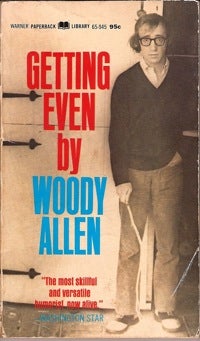
He also knew them, fictionally at least, in "A Twenties Memory," a short story that appeared in his 1971 book "Getting Even" after originally running under the title "How I Became a Comedian" in the Chicago Daily News.
I pulled out my old copy of the book over the weekend, looking for its one-act play "Death Knocks," a spin on Bergman's "The Seventh Seal" in which a dress manufacturer from Queens plays gin rummy with Death to buy himself more time.
And when I started leafing through the rest of the book, I was surprised to rediscover that the slim volume (which sported a 95-cent price tag) also contained "A Twenties Memory." In that four-page, first-person story, the narrator hangs out with Hemingway and Stein; visits Picasso's studio with Stein; goes to Man Ray's Paris home and meets Dali; and spends time with F. Scott Fitzgerald, who's troubled over his relationship with Zelda.
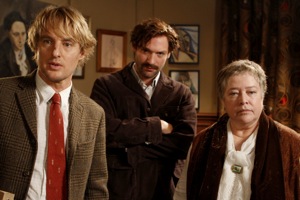 All of those characters (and some of the settings) resurfaced 40 years later in "Midnight in Paris" — though fortunately for Owen Wilson, the film doesn't include a running motif in the short story, in which "we laughed a lot and had fun and then we put on some boxing gloves and [Hemingway] broke my nose."
(On the other hand, Owen Wilson famously broke his nose as a teenager, so maybe that helped him get the part.)
The story also includes a cast of characters who don't appear in "Midnight in Paris," the artist Juan Gris and the bullfighter Manolete among them. And its events certainly differ from the film. For instance:
"Both Gertrude Stein and I examined Picasso's newest works very carefully, and Gertrude Stein was of the opinion that 'art, all art, is merely an expression of something.' Picasso disagreed and said, 'Leave me alone. I was eating.' My own feelings were that Picasso was right. He had been eating."
Later:
"That year I went to Paris a second time to talk with a thin, nervous European composer with aquiline profile and remarkably quick eyes who would someday be Igor Stravinsky and then, later, his best friend. I stayed at the home of Man and Sting Ray and Salvador Dali joined us for dinner several times and Dali decided to have a one-man show which he did and it was a huge success, as one man showed up and it was a gay and fine French winter."
On the Fitzgeralds:
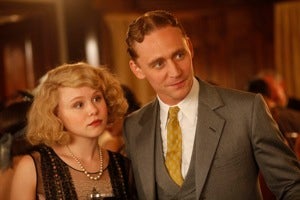 "Scott was having a big discipline problem and, while we all adored Zelda, we agreed that she had an adverse affect on his work, reducing his output from one novel a year to an occasional seafood recipe and a series of commas."
So "A Twenties Memory" is not "Midnight in Paris." But it was a treat to stumble across it and find Allen, then just beginning his career as a director, riffing on many of the same characters he would later use to such good effect in what has become his top-grossing film ever, with a remarkable theatrical run that began on May 20 and continued until the movie's home-video release last week.
And in a way, with its repeated scenes of broken noses, the story also touches on the same thing the film does: that while nostalgia for a past time is undeniably alluring, it's also a bit misleading.
 "Once in a while, when I'm sitting at my typewriter and looking out the window and can't think of a joke, you think, Gee, it would be great to be having lunch at Maxim's, and then taking a walk on the Champs Elysees, going over to Cezanne's or Renoir's and having all that incredible beauty around me in Belle Epoque Paris," Allen told TheWrap.
"But you know, it would have been a situation with no antibiotics, no Novocain, a lot of anti-Semitism. It was not a paradise for everybody, and maybe not for anybody."
"We have one conception of things from the past. And certainly in my movie, that's what I wanted to trade on. But I'm sure if you were sitting in a restaurant with Salvador Dali and Luis Bunuel, they spoke very differently from what you'd imagine."
("Midnight in Paris" photos by Roger Arpajou/courtesy of Sony Pictures Classics)