Beach-goers this summer may have noticed that their favorite magazines — from Time to Vanity Fair to Esquire — have shiny new tablet editions.
Magazine publishers are betting heavily on the tablet platform, aggressively enticing new customers and existing subscribers to embrace their digital versions.
Hearst and Conde Nast both struck deals with Apple in May, permitting consumers to subscribe through the iTunes Store — deals that closely followed redesigned apps from the likes of GQ and Vanity Fair.
Also read: Time Inc. Will Launch Tablet Editions for Every Magazine by Year's End
Two months later, Time made its biggest tablet-related news to date, announcing it would release tablet editions for the remaining 17 of its 21 titles. Time had already released editions for its four most popular titles, Sports Illustrated, Time, Fortune and People.
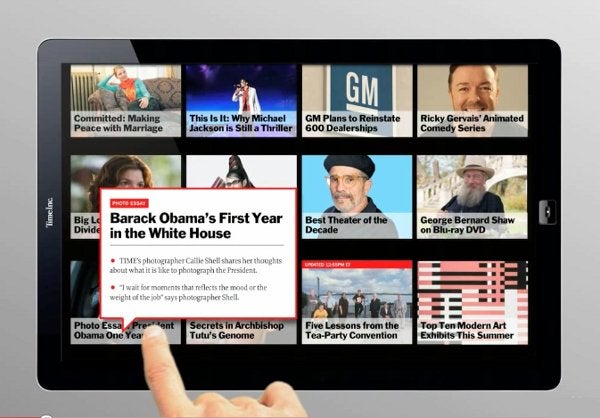
“Conde Nast and the others are looking at the tablet market as the promised land that will deliver them from the plight that they are going through in print and online,” said Roger Entner, founder of Recon Analytics, a research and consulting firm.
But the revenue for iPad apps has yet to materialize. Neither Conde Nast, nor Time nor Hearst has provided figures for what they're making off their iPad apps.
They have released subscription numbers, which, while growing, remain miniscule. For example, Conde Nast reported 242,000 digital customers in the six weeks since introducing iPad subscriptions, but that still makes up just 1.3 percent of its total print circulation.
Still, while publishers refuse to give up on the slumping print editions, they clearly see the tablet as the future.
Also read: Condé Nast: Every Magazine Will Have a Digital Edition by End of 2011
“While nascent, it’s clear that tablet editions will play an increasingly important role in our overall business moving forward,” a Conde Nast spokesperson said.
Each of the major publishers continues to push more tablet editions into the market and make deals with various tablet makers.
Apple remains the king of the tablet market, and much of the enthusiasm stems from its decision in February to allow direct subscriptions through the iPad rather than limiting purchases to individual issues.
Even with Apple’s new rules, the publishers had previously been wary of striking a deal with Apple because it demands a 30 percent take on all apps sold in its iTunes store.
Conde Nast and Hearst eventually relented — hence those subscription agreements in May — but Time has maintained a more limited relationship so as to control more of its revenue and subscriber information.
“What we know is that the No. 1 complaint — at least as far as magazines inside the Apple Store — is that they couldn’t get the magazines they love,” said Avi Zimak, advertising director for Hearst Tablet Media. “They had to pay cover price on every single issue. To resolve that, we have offered it as a subscription.”
These slightly different approaches are but one sign that while publishers and industry analysts may agree on the significance of the tablet, they disagree on a whole lot when it comes to monetizing the digital content.

Print magazines rely on revenue through three streams — advertising, subscriptions and single copy purchases.
That is unlikely to change for the print editions, but when it comes to tablet editions — their digital doppelganger — how will publishers like Time or Hearst turn them into profitable enterprises?
“I’d like to believe we’re moving towards this world where publishers are getting closer to understanding the tipping point on monetizing their content,” said Donnie Williams, chief digital officer at Horizon Media said.
However, he believes that “there is a lot of work that needs to be done to continue to succeed in the space.”
The most basic question to be answered is whether tablet advertising can generate enough revenue.
Ruth Reichl, former editor of Conde Nast’s now-closed Gourmet magazine and current editorial adviser to Gilt Taste, does not think so.
She points out that Gourmet fell victim to ad cutbacks, not circulation woes.
“What killed the magazine was the recession,” and the fact that “none of our advertisers had any advertising budgets anymore," Reichl said. "I feel strongly that going forward, the advertising model for magazines is not a viable model.”

That is one reason she decided to take the helm of Gilt Taste, an online marketplace cum-magazine that draws most of its revenue from e-commerce.
Yet if Reichl is confident that e-commerce is the best model — and some industry analysts share her point of view – most magazine publishers are not sold. At least not yet.
Rather than pursue an unproven form of revenue generation, the major publishers are still betting on the traditional avenues — advertising and subscriptions.
But not only do ad revenues remain low, but subscription models also differ widely.
Time, for example, offers an all-access plan geared to print subscribers, while Hearst offers one plan for its print magazine and another for its digital edition, and Conde Nast fits in the middle. Its print subscribers can access the digital editions for free, but it also offers annual subscriptions for digital editions.
The diverging plans reflect different philosophies about tablet and print subscribers.
Time’s goal is launch a model that gives existing subscribers more value, while Hearst considers tablet subscribers additive. Zimak argues that an all-access approach is too limiting, saying that the company wants to give readers the content they need — as long as they get paid for it.
“We look at it as an additive,” Zimak said of tablet subscriptions. “We know through research we’ve conducted that the overlap from print onto this medium has been minimal.”
Figuring out which of these models is most effective will become increasingly important given the investment publishers are making in tablets.
“A lot of it is just figuring out what makes sense financially,” Reichl said. “You can make everything sing and dance, but it costs a lot of money.”
With Apple unveiling its newsstand in September, each publisher will be put to the test. Though each one will have a different presence — they offer differing amounts of titles for the iPad — the next few months are shaping up to be very revealing, especially with Amazon rumored to be launching a tablet soon.
“We’re all in the sandbox,” Entner said. “We’re in the process of stepping out of the sandbox. Hopefully we don’t stumble over the rim in the box.”