Rupert Murdoch, Big Man on Campus?
Just seven months after his surprising expansion into reading, writing and arithmetic with the $360-million acquisition of Wireless Generation, News Corp.'s chairman and CEO seems intent on making the grade in what could be the future of education — economized, customized, data-driven digitized instruction.
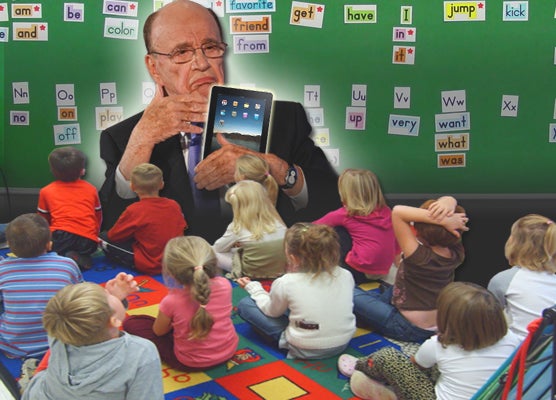
Potentially at stake: hundreds of billions of dollars.
“We have the resources to play and do what we need,” said Joel Klein, the innovative former New York City schools chief now on News Corp.'s board and CEO of Murdoch’s Education Division.
And Klein (below) is seriously scouting more acquisitions, though he is stingy with details. “We’ll make strategic investments," he said. "And the [News Corp.] board has said if these make sense, we can move forward on them.”
In plunging into the education last November, Murdoch moved in typical fashion — big, splashy and disruptive.
First, he wooed Klein — one of public education’s most high-profile administrators, reformists and technology-advocates. Soon after, he purchased Wireless Generation, a leading-edge ed-tech company based in Brooklyn.

Kindergarten-through-12th grade “is waiting desperately to be transformed by big breakthroughs that extend the reach of great teaching,” Murdoch said at the time.
The media mogul's ambitions may well be the clearest and most optimistic bellwether yet of a coming paradigm-shift in education.
The nation’s failing schools, eroded competitiveness and fiscal crisis form a perfect storm of factors that true believers hope will usher in an age of digitally enabled individualized learning.
They envision public school classes where slow, fast and average students are each digitally tracked, measured, categorized and fitted for a customized curriculum. Gone will be the paper notebooks, replaced by digital tablets and laptops.
Teachers, untethered from the blackboard, test-grading and lesson-planning, would be empowered to interact strategically with the class, his or her own performance subject to digital assessment.
“We are convinced that in the next years we can build platforms with digital content and learning profiles,” Tom Vander Ark, CEO of Open Education Solutions and a partner of ed-venture fund Learn Capital, told TheWrap. “These platforms can be customized to learning, and put in teachers’ hands, really powerful new tools.”
Investors’ growing interest in education is another indication of the dawning era. Vander Ark, who was the Bill & Melinda Gates Foundation’s first executive director for education, launched the first fund dedicated to education three years ago. Now, he told TheWrap, private equity dealmakers and venture capitalists are pouring into the field.
This week, for example, the first ever Goldman Sachs-Stanford University Global Education Conference is convening worldwide education leaders. The purpose, says the invitation: “to discuss how innovation, globalization, regulation and technology are impacting education, and how the public and private sectors can work together … Education appears to be at a fundamental inflection point.”
And another big player also recently has joined the tech-ed fray. Pearson Plc, owner of Financial Times and Penguin trade books, is in an on-going $1-billion-plus acquisition spree, selling assets from the Financial Times Group to pay for its purchases.
Among Pearson’s recent acquisitions: America's Choice and Schoolnet. It also forged an agreement with the Gates foundation to create digital learning programs.
Enter Murdoch, whose arrival in the business “is a real sign that the learning innovation space is maturing rapidly,” Vander Ark said.
It's not without controversy, either, which is not surprising for media mogul frequently suspected of mixing business and politics. A former Idaho legislator, Laird Noh, has worried that Murdoch is part of an emerging “educational industrial complex” that will use campaign contributions to sway public policy in favor of its education businesses.
Indeed, with the non-profit College Board, News Corp. is co-hosting "The Future of American Education: A Presidential Primary Forum" in October, limiting the event, however, to Republican candidates vying for the White House.
Undaunted, Murdoch is taking the message to the world’s most powerful national leadership. “Our schools remain the last holdout from the digital revolution,” he told the G8 Summit of wealthy nations in Paris last month. “The person who woke up from that 50-year nap would find that today's classroom looks almost exactly the same as it did in the Victorian age: a teacher standing in front of a roomful of kids with only a textbook, a blackboard, and a piece of chalk.”
He added: “The same digital technologies that transformed every other aspect of modern life can transform education … My company is determined to try — in a big way.”
Murdoch’s point man, Klein, made innovation a pet project as New York City School Chancellor. “I saw a real receptivity in the field for effective, interactive, data-driven analytics,” Joel Klein told TheWrap. “I’m confident this is going to happen in the next several years.”
Klein financed some of his New York schools initiatives by tapping private sources, including, according to a former top aide, at least $1 million from Murdoch’s wife, Wendi.
Since coming aboard, Klein has been escorting the media mogul to visit innovative education efforts around the country — and even to Sweden to study the groundbreaking Kunskapsskolan school.
In addition to tutoring his boss, Klein is continuing to build his staff. On Tuesday, he hired a top strategist, veteran educator and digital-education expert Diana Rhoten. Two other recent hires included the division’s chief operating officer, Kristen Kane, Klein’s former No. 2 in the New York city schools. The other is senior vice president Dr. Peter Gorman, former superintendent of Charlotte-Mecklenburg Schools.
Klein, who also joined News Corp.'s board, declined to detail the size of the investment Murdoch intends, saying only, “I don’t feel constrained.”
Then there's Pearson, a familiar rival of News Corp., which owns the Wall Street Journal and book publisher HarperCollins.
Pearson “is now envisioning leading a transformation of U.S. education, aimed at both raising student performance and lowering spending,” analyst Claudio Aspesi of the Wall Street research firm Sanford Bernstein wrote earlier this month.
Pearson’s goal is nothing short of “personalizing education in US schools through technology and best practices,” Aspesi said.
A Pearson spokeswoman declined comment.
Undaunted, Klein says of potential rivals, “We are going to do our thing.” And taking a swipe at Pearson, he added, “Obviously, we’re looking to develop what we think is a disruptive strategy — one that isn’t build around the textbook model.”