From "Iron Man 2" to "Shrek Forever After," Paramount has released some of the biggest films of the year. So where's the respect?
After years as a box-office also-run, the studio has finally climbed to the top of the heap. But while it commands an impressive share of the market — second only to Warner Bros. domestically — it doesn't actually own its biggest blockbusters.

The studio’s three highest grossing films this year are the result of distribution deals with Marvel and DreamWorks Animation, on which the studio makes an 8 percent distribution fee.
Marvel already has left the lot for Disney.
But the bigger danger looms with Paramount's deal to distribute DreamWorks Animation movies ending in 2012 — which CEO Jeffrey Katzenberg is not inclined to renew, TheWrap has learned.
According to multiple individuals with knowledge of Katzenberg's thinking, the executive believes that his films get insufficient attention for bringing in nearly half of Paramount's box office in 2010.
What's more, his relationship has become frazzled with COO Rob Moore, even as his compatriots at DreamWorks have decamped for Disney, and his former deputy Steve Bertram in the home-entertainment division has left Paramount to be COO at Relativity.
"He's sick of how they've treated him," said one person close to the situation.
On the surface, Paramount appears to be doing well, fielding recent high-profit margin hits "Paranormal Activity 2" and "Jackass 3D." And cash registers will keep ringing through 2011 with “Thor,” “Transformers 3,” “Kung Fu Panda 2" and “Captain America” all hitting theaters under the studio’s banner.
 “Their summer of 2011 looks unbelievable. Nobody’s going to match them,” Jeff Bock, a box-office analyst with Exhibitor Relations, told TheWrap.com.
Yet the same problem remains. With the exception of "Transformers 3," it's other people's content who will be driving that release schedule, namely films belonging to Marvel and DreamWorks.
Last month, Paramount sold its worldwide rights to “Iron Man 3” and “The Avengers” to Disney for $115 million, a short-term move that helps the company’s income recognition and guarantees high executive bonuses. But it leaves the studio without those reliable titles in two to three years.
Paramount executives maintain that this was a brilliant deal, since they were paid regardless of whether Disney makes those titles. On the other hand, it robs the studio of two potentially lucrative releases down the line.
Meanwhile, part of the tension with DreamWorks Animation stems from the hard-nosed re-negotiating of the deal. Paramount wants to increase its fees, but Katzenberg feels his company already accounts for a huge slice of the studio’s no-risk profits.
DreamWorks Animation and Paramount declined to comment for this article.
All of this while Paramount has climbed to slim profitability of late, after years of moribund to nonexistent profit margins.
But Paramount’s bottom line hasn’t improved as much as Wall Street would like.
In its Thursday quarterly report, Viacom beat analysts expectations, but its film division once again lagged behind.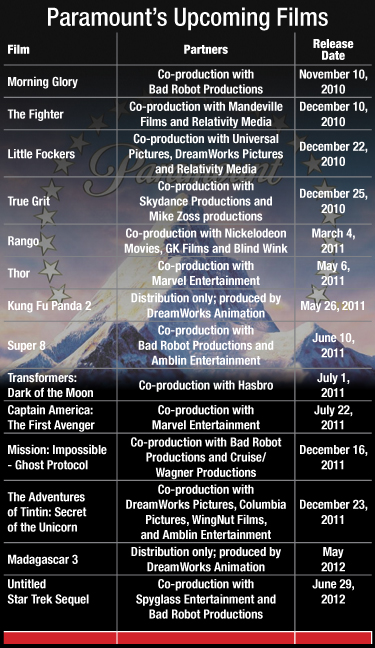
Revenues for the media company increased 5 percent to $3.33 billion, but operating profit for the film unit fell 29 percent to $52 million. Paramount made $219.3 million in revenue, driven primarily by “The Last Airbender.”
“For the past few years they’ve been a distribution house, but they’re going to start moving their own intellectual property, so it will be a challenge,” Tony Wible, an analyst with Janney Montgomery Scott, told TheWrap. “Paramount is a marginally profitable studio, but they need to improve their magins so they no longer lag behind their peers.”
Over the long run the move toward wholly owned tentpoles could be good for the studio if it can pull it off. “Star Trek” was a huge success and gave the studio greater confidence that it can reboot played-out titles from its library for younger generations.
It also will try to dust off “Footloose” and “Top Gun,” and attempt to recapture “Mission Impossible”s’ magic by pairing Tom Cruise with Jeremy Renner and Josh Holloway (both of whom lack couch-jumping baggage).
These are positive steps, but it’s taken a while for the studio to reach this place.
When current CEO Brad Grey took over following the departure of Chariman Jonathen Dolgen and studio head Sherry Lansing, the cupboard had been left bare. The partnerships with Marvel and DreamWorks Animation were billed as a stopgap measure, while the studio worked on reinvigorating its production slate.
Grey’s stamp may be affixed to the upcoming slate, but analysts wonder if Paramount is overly concerned with the immediate future and not worried enough about its long-term strategy.
“They tend to be very oriented on their stock price and risk averse, and that can be a zero sum game over the long term. They’re very concentrated on a few franchises, and it sometimes feels as though they’re not as innovative as Sony or that they’re playing catch up with Warner Bros.,” said Matthew Harrigan of Wunderlich Securitie.
In negotiations, COO Moore has often played the heavy, while Grey has succeeded in maintaining more distance, while staying close to Viacom chief Philippe Daumann, who is reportedly a supporter of the executive.
Paramount has to hope that the good cop/bad cop routine works on Katzenberg, because Marvel’s exit will strengthen DreamWorks’ hand.
“I would say it’s a critically important franchise for Paramount, especially with Disney getting Marvel. There are nice economics and it’s a great model to distribute branded entertainment, because your risk is pretty minimal,” Marla Backer, media analyst with Hudson Square Research, told TheWrap.
Sharon Waxman contributed reporting to this article.