(Editor’s note: This post first appeared on Jenka’s blog, social-creature.com, and was posted to Twitter by "Iron Man 2" director Jon Favreau early Tuesday.)
In 1938, on the eve of the Second World War, a relatively new medium called the comic book unleashed a new kind of character into the consciousness of American youth. Created by writer Jerry Siegel and illustrator Joe Shuster, this character possessed superhuman powers and a dedication to using those powers for the benefit of humanity. Often battling and defeating evil as hyperbolic as his own goodness, his iconic name would become the source of the term for this all-American archetype, the “superhero.” In the decades since Superman’s arrival, innumerable variations on this theme have emerged, but always these characters have struggled under the weight of a concept about who they must be that was invented before television. For the past 70 years we have been living with a 20th century version of the superhero.
Until now.
Though the Iron Man character was originally created in the early 60s, his most recent incarnation, as played by Robert Downey Jr., and directed by Jon Favreau in the just released Iron Man 2, is really the first Millennial superhero.
The original Superman prototype possessed a key characteristic, one that his creators, first generation American sons of Eastern European Jewish immigrants, would have known something about, one that this “Man of Tomorrow” would pass on as part of his legacy to future generations of masked heroes: a secret identity. This trait would become an intractable part of the very definition of a superhero, as much a prerequisite for his mythology as extraordinary powers, or at least a flamboyant getup. And yet, in a press conference at the end of 2008’s first installment of the Iron Man franchise, Tony Stark announces to the world that he is Iron Man. This is where sequel starts off. The need for a secret identity is gone. The entire world knows — and not because some tabloid uncovered the mystery man behind the mask, but because he just straight up told everyone. In the comic books, it took Stark 40 years to make this move. For Superman or Spiderman or Batman or virtually any other superhero from the prior century (save some like the X-Men) their secret identities were their most sacred possessions, the keys to their undoings, and they fought as hard to protect them as to save humanity itself. But in the 21st century, Tony Stark’s approach to privacy reflects how Millennials now think of the concept.
These days, the kind of stuff kids choose to reveal about themselves online is almost beyond comprehension. The latest social platform eroding the boundary between what was once strictly private and is now exposed to the world is Formspring.me, which the New York Times calls, “the online version of the bathroom wall in school“:
"While Formspring is still under the radar of many parents and guidance counselors, over the last two months it has become an obsession for thousands of teenagers nationwide, a place to trade comments and questions like: Are you still friends with julia? Why wasn’t sam invited to lauren’s party? You’re not as hot as u think u are. Do you wear a d cup? You talk too much. You look stupid when you laugh."
Comments and questions go into a private mailbox, where the user can ignore, delete or answer them. Only the answered ones are posted publicly — leading parents and guidance counselors to wonder why so many young people make public so many nasty comments about their looks, friends and sexual habits."
Social media researcher danah boyd asked a similar question a couple of weeks ago:
"This [behavior] has become so pervasive on Formspring so as to define what participation there means. More startlingly, teens are answering self-humiliating questions and posting their answers to a publicly visible page that is commonly associated with their real name. Why? What’s going on?"
While this particular trend is definitely a bit baffling, those of us that have grown up in the digital age have pretty much come to expect that the privacy arc of the internet is perpetually bending more and more towards greater disclosure. Privacy, as Facebook’s Millennial founder Mark Zuckerberg insists, is dead:
"People have really gotten comfortable not only sharing more information and different kinds, but more openly and with more people. That social norm is just something that has evolved over time… But we viewed that as a really important thing, to always keep a beginner’s mind and what would we do if we were starting [Facebook] now and we decided that these would be the social norms now and we just went for it."
Here’s an interesting visualization of the Evolution of Privacy on Facebook, indicating how the website has let ever more of our information become increasingly public over the years:
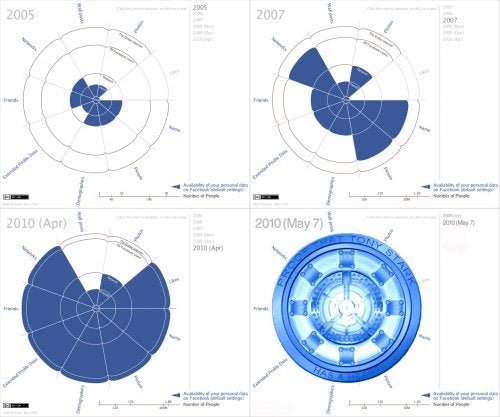 Oh… wait a second, no, that last one is actually the arc reactor implant that’s keeping Tony Stark alive. But, no doubt, Skynet… err.. Facebook is intent on catching up to the full-pie version of the chart soon. Anyway, Bruce Wayne, Clark Kent, Peter Parker, they were never prepared for this brave new networked world. Their entire way of being simply doesn’t fit anymore. Neither with Facebook and its social network platform ilk, nor the (*cough* relative) sensibilities of the Millennial youth who use it. For Tony Stark, transparency isn’t just relegated to the subject of his super-powered “alter ego,” it’s a pervasive part of his total personality, his way of being in the world. Stark is as blatant as his id, his mobile touch-screen device is actually, literally, transparent, allowing others to see everything he’s doing on it, every surface in his house seems to be equipped with touch-screen capabilities, his browsing activities public to anyone sitting nearby who cares to look. Zuckerberg himself likely couldn’t have dreamed up a more post-Privacy kind of superhero, one less conflicted about the disparate parts of his identity. With the death of privacy, you cannot be one thing in one context, and something different in another. You cannot be Clark Kent at the Daily Planet desk job, and then Superman on the night shift. You are exactly who you are to everyone at all times. Like no other superhero, Tony Stark’s identity isn’t conflicted. It’s absolute.
In her book Generation Me: Why Today’s Young Americans Are More Confident, Assertive, Entitled–and More Miserable Than Ever Before, psychology professor Jean Twenge writes:
"It has always been normal for kids to have big dreams, but the dreams of kids today are bigger than ever. By the time kids figure out they’re not going to be celebrities or sports figures, they’re well into adolescence, or even their twenties.
High expectations can be the stuff of inspiration, but more often they set GenMe up for bitter disappointment. [The book] Quarterlife Crisis concludes that twenty-somethings often take a while to realize that the ‘be whatever you want to be, do whatever you want to do,’ mantra of their childhoods is not attainable."
In the late 90’s, Tyler Durden, himself a sort of Gen X superhero — a transitional alpha version precursor to the Gen Y model, if you will — says it like:
"We have no Great War. No Great Depression. Our Great War’s a spiritual war… our Great Depression is our lives. We’ve all been raised on television to believe that one day we’d all be millionaires, and movie gods, and rock stars. But we won’t. And we’re slowly learning that fact. And we’re very, very pissed off.”
Even in the throes of the economic crisis, my generation hasn’t really had a Great Depression either — though we did come this close. And even after 9/11 my generation hasn’t had a Great War. The world is now far too mind-numbingly complicated and complex to even have a clear concept of a single, monolithic Evil to fight. The “heroes” of my generation, the ideals that kids look up to and wish to be like, haven’t been men of steel battling evil for a long time, they are now, like Durden says, millionaires and rock stars. And that is precisely what 21st Century Tony Stark is. After he comes out of the closet (or, more accurately, the basement science lab) as Iron Man, he becomes a worldwide celebrity, a household name. Even the migrant worker he stops to buy strawberries from on the Pacific Coast Highway asks, “Are you Iron Man?” like he’s recognized a movie star.
And unlike Superman or SpiderMan or Batman or any other major superhero before him whose truth the world was not yet ready to handle, Tony Stark answers casually, “Sometimes.”
 Perhaps that’s the other side of what allows a 21st century superhero to be transparent. The modern world can accept him as such. Gen Y is a lot more tolerant of lifestyle differences than prior generations, after all. The X-Men didn’t hide that they were different, either, but then again, they COULDN’T hide it — looking like Beast or Nightcrawler, or having Rogue or Cycolps’ particular mutations, you couldn’t just “pass” in normal society — and the humans the X-Men fought to protect could never accept them for being what they are. Not so in the world of Tony Stark. He’s no mutant. No outcast. He’s the most popular kid in school. The late DJ AM even spins at his birthday bash. The 21st century Tony Stark reveals to the world he is Iron Man, and the 21st century world says…. Awesome!
In the past, being a tech entrepreneur-slash-engineer, as Tony Stark is, would have made him a nerd, or otherwise Bruce Wayne, still stuck in the previous millennium, putting on a show of irresponsible playboy-ness to deflect attention from both his morbidly serious crime-fighting alter ego and his humorless tech geek underbelly. Like, remember when no one would have wanted to sit at the lunch table with kids who talked about stuff like “augmented reality”?
Yeah, not so much, anymore. In the 21st century, being a tech geek no longer detracts from the image of a bad-ass or a dilettante. James Bond and Q have combined into one seamless character. It’s 2010, and geeks are cool! Hell, we’ve even got one as President.
While both Wayne and Stark are surrounded by high tech everything, for the 20th century hero all the gadgetry is just a means to an end. Even the Batmobile is ultimately just a flashy tool. Same could technically be said about the iPhone, but who would? In the post-iPod era we have a very different relationship with our technology. Our favorite tech objects aren’t just for utilitarian application, they’re obsessed over, fetishized, loved. It’s why Gizmodo would pay $10,000 for an exclusive scoop on an in-production, “lost” 4g iPhone, and why an enormous global audience would give a crap. When Stark says in the movie that the Iron Man suit is a part of him, that he and it are one, we all intimately understand exactly what he means even if the rest of us don’t actually literally plug our gadgets into our chest cavities.
After a raucous birthday party in which we see Stark, in full Iron Man gear, getting shitfaced and acting the fool, (he’s dying at the time, and feeling a bit of the nothing-really-matters mortality blues — being dissolute and apathetic, itself, unusually postmodern behavior for a superhero), S.H.I.E.L.D. agency director Nick Fury (played by Samuel L. Jackson) “grounds” the hungover superhero by sequestering him in his house with all access to communication with the outside world cut off until he solves a theoretical physics problem. This superhero’s punishment is having his phone and internet privileges revoked and being sent up to his room to finish his math homework. There isn’t a single one of the 60 million American Millennialsthat doesn’t relate to this.
When Favreau was looking for a 21st century industrialist corporate executive to use as a model for his and Robert Downey Jr’s interpretation of Tony Stark, he sought out Elon Musk, co-founder of paypal. Musk even has a cameo in the movie, chatting Tony up about an electric rocket, a concept referencing Musk’s current endeavors, Tesla Motors, which produces fully electric sports cars that rival Porsche in performance, and SpaceX, a private aerospace company working to invent the first reusable rockets, which would dramatically reduce costs and eventually lead to affordable space-travel. This dude is the inspiration for the 21st century version of Stark.
So what’s Tony Stak’s inspiration? Why does he do what he does? There was no childhood trauma that drove him to caped crusading. He wasn’t raised by adoptive Earth parents who imbued him with a strong moral compass during his formative years on a farm in the American Heartland. Sure, ok, he underwent a certain crisis of conscience in his 40s after escaping from a terrorist hostage situation in Afghanistan, shutting down the weapons manufacturing division of Stark Industries and all, but still, why does he take it so much further, going so far as to “privatize world peace.” …. For the thrill of it! As he himself says, he keeps up the good fight at his own pleasure, adding, “and I like to pleasure myself often.” Unlike the prior century’s superhero, this new version saves the world not out of any overwhelming sense of obligation or indentured servitude to duty, but because he can do what he wants, when he wants, because he wants to, and most importantly, he GETS what he wants. Sure he has to work for it, but unlike with, say, Peter Parker and Mary Jane or Clark Kent and Lois Lane or even Buffy and Angel, what he wants isn’t perpetually out of his grasp just because he is who he is. Being Iron Man isn’t a burden, it’s an epic thrill-ride.
The first 21st century superhero is a hedonistic, narcissistic, even nihilistic, adrenaline junkie, billionaire entrepreneur do-gooder. If Peter Parker’s life lesson is that “with great power comes great responsibility,” Tony Stark’s is that with great power comes a shit-ton of fun.
You can’t get any more Gen Y than that.
Welcome, 21st Century superhero, my generation has been waiting for you.