
After enduring “Antichrist” a few years ago and then listening to Lars von Trier shoot off his mouth with an ill-advised “joke” about Nazis this spring at the Cannes Film Festival, I wasn’t exactly rushing into “Melancholia” with hopes raised. Von Trier’s recent films feel like the work of a man who uses the camera as a magnifying glass — the way that a sadistic six-year-old would use that same implement to torture and destroy helpless ants.

As a non-fan, then, it is with utter surprise that I can report that “Melancholia” is the Lars von Trier movie for people who hate Lars von Trier movies. (Or for this person, at any rate.)
Visually stunning — cinematographer Manuel Alberto Claro's work here is jaw-dropping — and intensely moving, “Melancholia” earns its perfectly-chosen soundtrack of Wagner, unfurling its tale with the heft of grand opera and the immediacy of the best contemporary storytellers.
Kirsten Dunst stars as Justine, whom we first see as a positively glowing bride, riding in the back of a stretch limo with her new husband Michael (Alexander Skarsgård). The fact that the limousine can’t make it through a tight turn in the woods, leaving the newlyweds to arrive at their reception hours late and on foot, serves as an omen that not everything is as picture-perfect as we might immediately think.
As the evening wears on, with Justine’s sister Claire (Charlotte Gainsbourg) managing the proceedings with the assistance of a high-strung wedding planner (Udo Kier, of all people), it becomes more and more clear both to the wedding guests and to viewers that Justine has issues — namely, a crippling depression that sends her off to take a long bath in the middle of her own wedding-night party.
While various scenes are made by Justine’s divorced parents (John Hurt and Charlotte Rampling), her demanding boss (Stellan Skarsgård), and Claire’s harrumphing millionaire husband John (Kiefer Sutherland), both the party and Justine’s new marriage fall irrevocably to pieces.
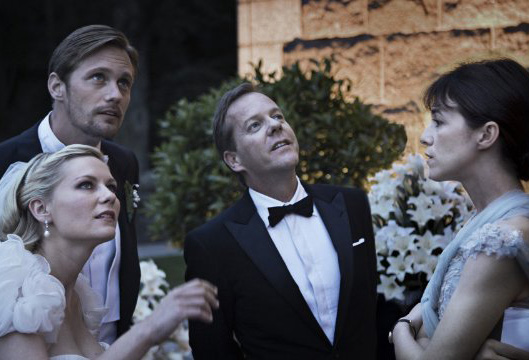 But all that turns out to be prologue, as the rest of the film deals with a rogue planet called Melancholia that’s on a collision course with Earth. Amateur astronomer John assures Claire that there won’t be an impact, but as the two worlds come closer to colliding, it’s surprisingly Justine — perhaps due to her familiarity with a more terrestrial brand of melancholia — who emerges from a near-catatonic state to swap roles with her sister and become the family’s pillar of strength.
“Melancholia” is one of those movies that defies easy description by merely recounting what happens in the plot — love him or hate him, von Trier is a master of making the silences count. His films demand a level of attention, in that it’s the little moments, the miniscule gestures, that tell us so much about the characters.
And this time, for a change, it feels like the director doesn’t despise his creations. He threatens them with doom, yes, but his characters don’t feel like cogs in a giant everyone-is-awful machine, and that feels like a radical switch from the man who gave us such exercises in S&M as “Breaking the Waves,” “Dancer in the Dark” and “Dogville.”
The blonde Dunst and the dark Gainsbourg make a perfect yin and yang, and while I never bought that these two were sisters (much less the results of a Hurt-Rampling coupling), they’re both utterly riveting, to the extent where you can hardly picture anyone else in either role. But the whole cast is great, from the Skarsgårds père et fils to Rampling to Brady Corbet (as Justine’s boss’s nephew, whom the bride uses to set a land speed record for adultery) to young Cameron Spurr as Justine’s loving nephew.
Admirers of von Trier’s filmography will no doubt find much to admire in this soaring, moving work of art, but film lovers who might have written off the erratic auteur (and can forgive him for his Cannes Film Festival shenanigans) should open themselves to the apocalyptic possibilities of “Melancholia.” There’s no discussing the major films of 2011 without seeing this first.