
In 1993 and 1994, a comic book arc played out in the pages of “Batman” that absolutely riveted comic book readers and casual superhero fans alike — one that brought the Caped Crusader to his knees and reset the established continuity of the character (for a little while, at least). It was a comic book “event,” meant to capture the imagination of die-hard fans and casual readers alike through a bold shake-up of the status quo. And boy, did it ever.
“Knightfall,” like “The Death of Superman” (which was published around the same time), left a lasting impression not only on readers from the period — who can still remember the cover featuring Batman getting his back broken and, later, the foil, almost holographic cover that peeled back to reveal Bruce Wayne’s replacement and his new suit — but on much of the Bat-media that followed. Countless stories across the Batman mythos have drawn inspiration from or cribbed directly from “Knightfall.” But it’s never been adapted one-to-one until now.

The clunkily titled “Batman: Knightfall Part I: Knightfall” (yes, that’s its actual title) is Warner Bros. Animation’s latest ambitious direct-to-video animated feature. It just debuted at the Annecy International Animation Film Festival. And it seeks to faithfully adapt the comic book arc that captivated countless readers in the early 1990s while also modernizing the story for contemporary audiences and giving it an even harder edge.
And on all counts, it succeeds. Mostly.
The movie starts, after some ill-advised static images of Gotham at night that almost make you question whether this will be fully animated, in medias res. We’re at the Gotham docks, where much criminal activity takes place, and there are two competing vigilantes on the scene — Batman (voiced by Anson Mount) and Azrael (Pablo Schreiber), aka Jean-Paul Valley Jr. Azrael is a religious fundamentalist and schizophrenic whose violent approach to crime makes Batman look like a teddy bear.
These early scenes are bracing and, honestly, somewhat shocking, as Azrael cuts through bad guys quite literally — limbs go flying in splashes of bright red blood and hoods are dispatched indiscriminately. Even Batman is taken aback. But he’s also not one to turn his back on someone he thinks he can help, so he brings Jean-Paul into the Bat-family (as it’s more commonly known now). Dick Grayson immediately takes to Jean-Paul and thinks he could become a strong backup for Batman and the gang, should things get really hairy.
And wouldn’t you know it? Things do get really hairy.
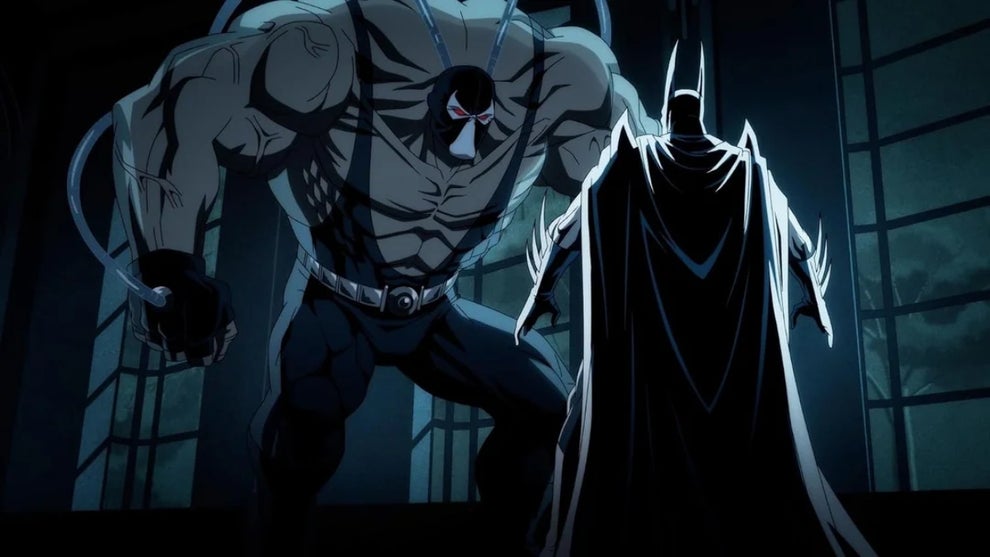
Much of “Knightfall’s” runtime is devoted to the story of Bane (voiced by Michael Mando) — the hulking behemoth who has become one of Batman’s most iconic foes. We see him born and raised in a South American prison and watch as he grows up under truly miserable conditions. When he’s old enough, he undergoes a medical procedure — an experiment, really — that transforms him into the brute comic book readers know and love (or love to hate). The transformation sequence borders on body horror, again pushing the limits of just how extreme this “Batman” story can be. (As it turns out, pretty extreme.)
Batman and Bane’s paths cross when Bane travels to Gotham and attacks Arkham Asylum, essentially allowing some of the most dangerous villains in Batman’s rogues’ gallery to escape. This leaves Batman beleaguered and worn down; Robin suggests that Azrael could help contain some of the chaos, but Batman refuses. He’s not ready yet. Maybe he’ll never be ready.
But there’s only so much Batman can control. This leads to the inevitable climax of the first movie, which recaptures the dread and visceral anxiety of reading those pages of the comic book. Batman isn’t destroyed — hell, even when he “died” years later, Grant Morrison instead sent his consciousness on an existential journey through time and space — but he is incapacitated in a way that still feels powerful and dangerous.

Don’t Underestimate Netflix’s ‘Steps’
This isn’t a spoiler, of course. Not only is the comic book arc decades old at this point, but director Christopher Nolan staged a version of this confrontation in “The Dark Knight Rises,” the third film in his Dark Knight trilogy, which condensed and reworked many elements of the “Knightfall” arc into a single, breathless narrative. (Bane, in that film, was portrayed by Tom Hardy; much of the more sci-fi gobbledygook was stripped away, and Hardy gave him a distinctive, heavily modulated accent that proved memorable.)
“Knightfall” is meant to be the first part of a trilogy of animated features, with the second and third parts coming soon.
But how does it stand as a single film?
“Batman: Knightfall” is actually very solid. Director Jeff Wamester and writer Jeremy Adams do a strong job adapting the comic book arc, paying close attention to what made it so compulsively readable and so influential on subsequent projects. Wamester stages the action gamely, with a strong sense of choreography and spatial clarity — something often missing in films today and essential in sequences like the movie’s opening confrontation between Batman and Azrael. Adams, meanwhile, distills the sprawling narrative of the original arc into something that reads cleanly and is easy to follow, which is quite a feat given the film’s compact runtime.
Best of all is the work done by Studio Mir, the South Korean animation studio that has become one of the most exciting international outfits working today, contributing to everything from “X-Men ’97” to “Devil May Cry” to the upcoming “Avatar: The Last Airbender” film. The studio has both a distinct, dynamic style and a chameleonic ability to adapt to the specific look and tone of each property or era. “X-Men ’97” is perhaps the best example of this, as it mimics the heavy linework and stylized action of the original animated series.
What makes “Knightfall” such a thrill to watch is that it captures a very 1990s story in a very 1990s style. The moody aesthetic, defined by deep, inky shadows and brooding characterizations, not only evokes the original comic book run but also other 1990s animated series that pushed the medium into more mature and ambitious territory.
More specifically, it’s easy to see the point at which Eastern influences began filtering into Western animation, and when Korean studios in particular started taking on Western properties and incorporating anime flourishes into what might otherwise have been more traditional animation.
Watching “Knightfall,” you may think of series like “Spawn,” the HBO animated show based on Todd McFarlane’s comic, which had a similarly dark tone and stylized approach. It was also animated by a South Korean studio (Koko Enterprises), which feels telling in hindsight. The connections are many, if you choose to see them.
If you love Batman, love the “Knightfall” comic book arc or just love Batman animated films, you’ll undoubtedly appreciate the new movie. And it will be fascinating to watch as the second film (“Knightquest”) and third film (“KnightsEnd”) come together, unspooling the full narrative across the trilogy.
Your mileage may vary, but “Knightfall” is about as much fun as biking down to the corner comic book shop and picking up the latest issue of “Batman.” It leaves you with the same level of excitement and anticipation for the next installment — or, in this case, the next animated feature.
