A love letter not just to film music, but to the complicated and passionate musicians who bring it to life, Tony Gilroy’s film “Behemoth!” is difficult to overstate in its unique structure and sonic register. It serves as the film’s narrative spine, the foundation from which the drama unfolds, rather than an enhancement or embellishment. Working with nine different composers – credited as the “Behemoth!” Collective – Gilroy has crafted a film where image and sound are so inextricably linked that to try and watch without one of them would be nothing less than an act of violence. This is not quite a project that you just “watch” and “hear,” but experience in unblemished totality. Even when, narratively, it may spend too much time in minor keys, the craft around it is undeniably transformative and ambitious.
The delight of experiencing “Behemoth!” is seeing how Gilroy transitions from scene to scene; mise-en-scène acts as springboards to various different eras in time while Damián García’s camera can be remarkably patient for scenes that one might expect to vibrate with spasmodic motion. Gilroy teases out the film’s serpentine movements when we first meet Alex (Pedro Pascal), a celebrated cellist who has moved from Chicago to LA to be a part of the score for a franchise film going under the working title “Behemoth!” Alex barely has time to string his bow before he’s being greeted by various band members who wonder where he has been and how he’s back. This social barrage of competing voices and disparate lines of questioning that Alex will have to distill into something coherent is all table-setting for when it happens again on a larger canvas, once Alex and the orchestra begin scoring the film.
At any given moment, the film jumps back in time to his days in Boston and Chicago, to when he begins to fall for his colleague, Nadia (Eva Victor). This jump between the present and past, bolstered by the movement of the film score, is what gives “Behemoth!” most of its electrifying structure. It’s not just non-linear, but fractured storytelling. We as the audience never know what might trigger a flashback, and the score of the film offers no cues either. It is a fascinating subversion of a chamber piece, showcasing the lives that can be lived within one bar of music, or how memories can coalesce into stanzas that we cannot help but play over in our heads. What is striking is when the music goes from diegetic to non-diegetic, and you do not realize that the film within the film’s score and the movie’s actual score are all the same. It is a clever way to showcase audibly how fiction and real life bleed into each other.
This manifests in a thrilling sequence in which Alex recalls a moment when, after finishing a rehearsal, his ex, Carol (Olivia Wilde), went on the prowl for him in the building where he was practicing. As he tries to escape from her, the score that present-day Alex is scoring for “Behemoth!” is transposed over his past self’s escape attempt. All of a sudden, a simple walk down a hallway becomes tinged with a thriller-esque intensity; if the film had any other score in this moment, it would have changed the ambience completely, but by blending these elements together, Gilroy and his collaborators are able to imbue spectacle into life’s everyday beats.
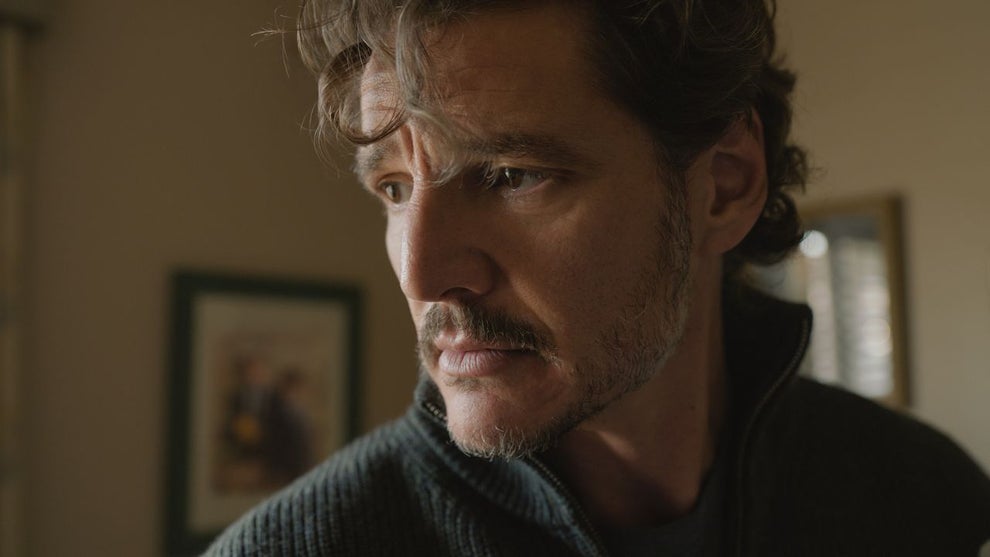
For a film of such scale and sonic ambition to work requires a performer like Pascal to be its north star, and the actor sells drama and emotion just by drawing his cello bow or tapping his foot. We feel him moved by the music he hears and plays, and García’s willingness to keep the camera trained on him reflects a trust that Pascal’s range of expressions fully honors. There are many moments where, as he listens to a piece of music from Nadia’s daughter, Viviana, we simply watch him get shattered. It is a testament to Pascal’s willingness to be present, to use so few words to communicate the enormity of emotion, that sells the film’s premise about the transformative power of music.
As a character, Alex is passive though, and while that is endemic, it can occasionally create dissonance when other actors enter the frame, who do not always buttress him and more so bulldoze over him. Take Wilde, whose Carol is very much a portmanteau of her roles from this year, channeling the relational anxieties of Angela in “The Invite” and the ferocity of a woman scorned of Erika in “I Want Your Sex,” into a tornado of a performance that shines in its histrionic brevity. Victor is sadly underused, but in her interactions with Pascal, she brings the same witty, self-awareness and soulful interiority that makes it clear why anyone would fall for Nadia. All of the characters in “Behemoth!” struggle to take the craggy formations of emotion and chisel them into palatable spaces to walk on, and the beauty comes from witnessing their attempts to put words to the storms that brew within them.
Then again, part of how “Behemoth!” strikes a chord is in how music is its own language whose beauty perhaps lies in being wordless. One night, Alex goes to visit a grown-up (meaning: fifteen years old) Viviana, who is performing a concert of her experimental, alternative EDM tracks. She plays the song “Your God Is Sleeping” (brainchild of composer Lukas Frank), and Alex is swept up not only in the power of its rhythms, but in witnessing the people around him get lost in it just like him. With “Behemoth!,” Gilroy understands that there are moments in our lives where words seem insufficient to articulate what we feel or experience; sometimes the pains and regret we replay can be the only song we hear. Grace notes, though, are never far away, and maybe new music can be born from the chaos of our lives.