Once upon a time, Werner Herzog became a meme.
He never exactly sought out web stardom — Herzog is nothing if not analog — but the German filmmaker has cultivated a public persona that’s proved remarkably durable across two decades of online riffing: the unflappable adventurer, a deadpan Don Quixote who meets gunshot wounds, bear attacks and life’s general chaos with the same bemused fatalism. Manna from heaven for Internet geeks and improv comics, who promptly seized on that persona and made it their own.
That history would seem relevant to “Bucking Fastard,” a two-for-the-price-of-one oddball drama about sisters whose peculiarities turn them into digital-media curios — if only the director cared enough to do anything with it. Instead, it’s just one of many threads dropped in a movie that amounts to little more than an eccentric showcase for Kate and Rooney Mara at peak weird.
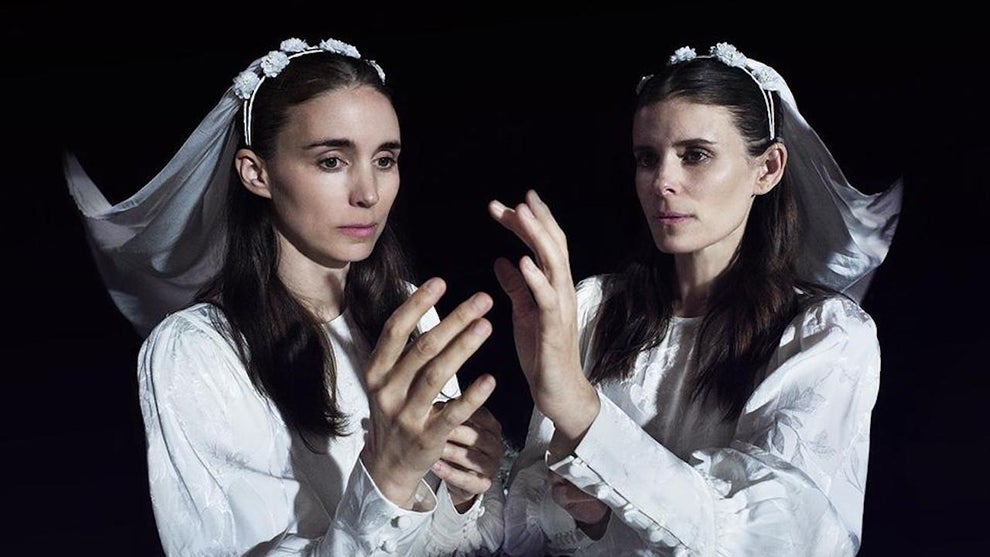
And hey, there’s nothing wrong with weird… least of all the kind the Maras deliver as the Holbrookes. Jean (Kate) and Joan (Rooney) speak in unison and move in lockstep, turning every frame they share — which is to say, all of them — into a delightful in-camera special effect. But whether intended or not, “Bucking Fastard” also seems destined for a second life as scattered web clips once its fall-festival run ends. The initial thrill of watching something this strange curdles quickly, though, because there’s little underneath.

At first, the film gets plenty of mileage out of oddity alone. We open with the sisters on trial — or, more precisely, brought before a judge to receive a court-mandated restraining order keeping them a safe distance from the lothario next door. Turns out Joan and Jean still have the hots for their erstwhile flame Gareth (Orlando Bloom, made up to look and sound uncannily like Colin Farrell in another bizarre, beguiling analog effect). The relationship flamed out, but their passions — and retaliations — still burn.
They take the stand together, in what the presiding judge makes a big show of stressing is a first in Irish law, and we’re instantly hooked. First, it’s the American accents — an intriguing choice for a tale set entirely in Ireland, and one that makes these odd ducks stand out even more. Then, it’s their features — similar, if hardly overlapping, adding a new layer of uncanniness to the sisters’ synchronized routine. And then again, well, we can’t help but laugh, taking in the Maras’ commitment to the bit with sheer delight.
That delight doesn’t last. With the trial rather open and shut, the plot needs a change of scenery, especially once the sisters land in the media spotlight. That thread runs thin, too, prompting another jump in supporting cast and location, and then another still. The result is a disconnected narrative that resembles nothing so much as a recurring “SNL” bit. You know the drill: introduce a memorable character — two, in this case — give them a killer hook, then drop them into a new scenario alongside whichever guest star shows up that week, Orlando Bloom one, Domhnall Gleeson the next. Rinse and repeat until the bit runs dry.
To his credit, the director never tries to explain the central duo — we don’t know how or why they ended up this way, and that’s perfectly fine. But we also never really learn anything about the otherwise “normal” foils they interact with. Drama, conflict, catharsis, stakes — none of it comes from oddity itself, but from the response to oddity; that’s the dialectic. With no countervailing force, the film stays fundamentally incurious, as disinterested in the sisters themselves as in the world around them.
A closing turn toward more overt magical realism offers little lift. We pick up with them two years into a mad mining project meant to unearth a better, more accepting world. There, isolated from everything and everyone else, the sisters ever so briefly fall out of sync — speaking to each other for the very first time at around the 90-minute mark. This too proves illusory, another short, spiky promise of a more interesting — and interesting-in-itself — take on the material than what we finally end up with.
Instead, we get a punchline that doubles as a mission statement for the filmmaker’s own Quixotic public image: “Everybody should dig a tunnel through a mountain.”
Easy to quote, easy to share. Don’t forget to hit that subscribe button.
