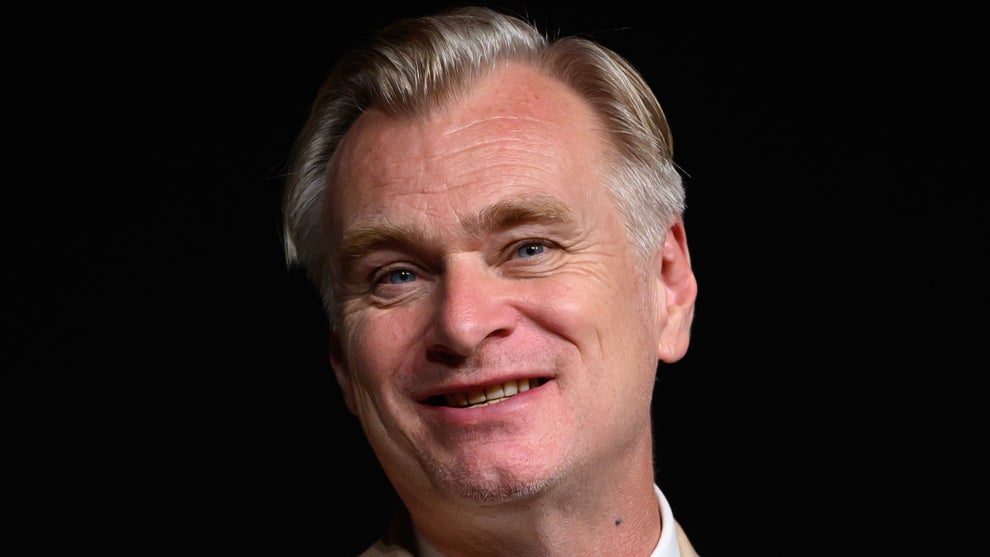
Christopher Nolan dug into what he believes is a “real problem in criticism today” during a promotional interview for “The Odyssey,” arguing that some audiences wish to “invalidate” a storytelling mechanism just because it is “identifiable.”
Speaking with political philosophy lecturer and podcast host Zhong Shu in an interview originally posted to the Chinese video sharing platform Bilibili on Friday, Nolan was pressed about how his adaptation of “The Odyssey” portrays the military genius of Odysseus (Matt Damon) as something he must repent for and reflect on — a more contemporary interpretation of the character compared to what is evidenced by studies of ancient Greek culture.
Nolan used his answer to elaborate on how he conceived his film as something that must be “in conversation with the expectations of the audience” and feature storytelling mechanisms that are “identifiable” within the modern context of his adaptation.
“The criticism that’s often leveled at movies in general is, ‘Oh the character has to be made sympathetic, so the character is manipulated in different ways or changed in different ways.’ And that’s a fundamental flaw of film criticism in a way,” Nolan said. “Because to be able to identify the mechanism does not invalidate the mechanism. And that’s a real problem in criticism today.”
“People have this idea that, ‘Because I can understand why the story affects me the way it is, therefore, it didn’t work.’ That’s not how storytelling works,” the filmmaker continued. “So, when we create a heroic figure in a story, as storytellers, we have to be mindful of the energy that the audience brings to that story and the interaction between our intention and the way the audience receives that. The fact that that mechanism is identifiable to people doesn’t invalidate it.”
Nolan went on to clarify that this is an issue he’s observed in “amateur film criticism” and that “professional film criticism tends to understand the necessity for the mechanisms.”

“We’re looking at a lingua franca of storytelling created by Hollywood for the last hundred years that is effectively universal. … It is a very, very accessible modern language of storytelling, and it has certain rules (and) conventions. You can break those conventions. You can bend them. You can move them. But you have to be aware of them,” Nolan added. “I’m thinking more of amateur criticism when I say that people who — because they feel they’ve identified the mechanism, they feel that it invalidates it. That can be true of certain elements, and film grammar (and) film language evolves with that. So when a trope becomes too familiar to an audience, then it has to be changed. But we do, as filmmakers, avail ourselves of that common language. We build on that understanding (that) our audience has seen many films and they understand that language.”
Although the interviewer does not cite any particular responses to Nolan’s “Odyssey” in the interview, she does playfully accuse the filmmaker of drawing skeptical readings from “classicists” and “academics.” In that way, the full 17-minute conversation represents Nolan’s most comprehensive response yet to criticisms of his adaptation. On Monday, classicist Emily Wilson, whose translation of Homer’s epic poem was published in 2017, panned the film in a review, writing that the themes are “filtered through contemporary American ideas about the importance of philanthropic charity” which is “not in itself a problem, but it is a problem if the film’s own values and vision don’t hang together.”
Nolan was in Beijing as one of the final stops for his global rollout of “The Odyssey.” The film opens in China on August 14, though special preview screenings began in the country on Saturday.

All 13 Christopher Nolan Movies Ranked