
Exit the sweltering Underground trains of Waterloo Station, make your way through the crowds to the exit, and take a left under a train overpass towards the River Thames. As you go up an incline along a narrow sidewalk, a cylindrical cinema comes into view with an enormous banner featuring Matt Damon as Odysseus.
This is the BFI Imax, a theater that has played sold out Imax 70mm screenings of Christopher Nolan’s “The Odyssey” around the clock and has continued to sell out screenings scheduled into mid-September as the director’s legions of fans turn out to see the first film ever shot entirely with Imax cameras as he intended.
It was also at this theater 20 years ago that Nolan began a friendship with two collaborators that would lead him to this moment with “The Odyssey”: David and Patricia Keighley, the veteran Imax execs who oversaw the development of a new camera that Nolan and DP Hoyte van Hoytema could use in both quiet dialogue scenes and roaring battle sequences. The result: Imax screenings of “The Odyssey” being one of the hottest tickets in theaters around the world.
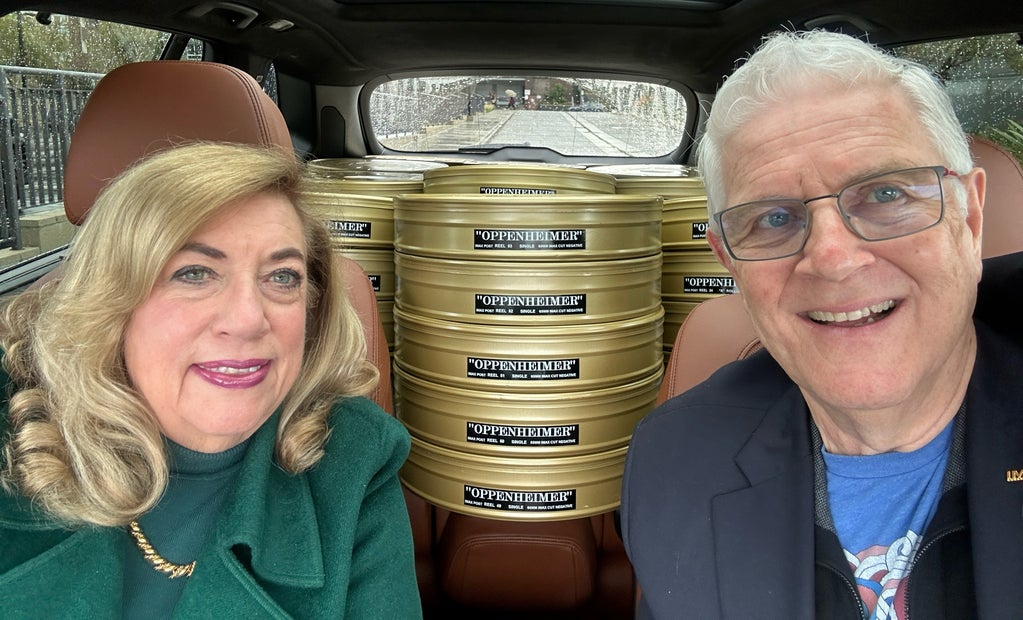
It is a friendship that, in David’s case, came to a tragic end after the Imax chief quality officer died in August 2025 from cancer. At the premiere of “The Odyssey” at the BFI Imax, Nolan dedicated the film to his memory.
“David passed sadly right after we finished principal photography on this film, and after we finished his very important work of printing all our days and approving all of the photography. So I’m thrilled that he was able to finish that,” he said.
In a conversation with TheWrap, Patricia Keighley said that her late husband and Nolan met while the director was working on his psychological thriller “The Prestige.” At the time, Imax was in the beginning stages of its transformation from a science museum staple to the movie theater titan it is today, releasing films like Nolan’s “Batman Begins” that were converted in post-production to fit the company’s extra-large screens.
But Nolan wanted to go further, telling Keighley that he had wanted to try using Imax cameras since seeing a nature documentary filmed with them at the age of 16. So to show Imax’s capabilities, the pair filmed a grisly scene in “The Prestige” in which Christian Bale’s character amputates two of his own fingers with Imax cameras and scanned it to a 6K resolution.

“David was able to prove to Chris, as they had hoped, that that scene looked better at higher resolution, and not only that, but it also held up well within the 35mm workflow. So those two things could be blended together,” said Patricia, who still works at Imax as the company’s chief quality guru. “That was the beginning of the relationship, and then by the time ‘The Dark Knight’ came along after ‘The Prestige’ incident, we spent about a year testing with Chris back and forth with footage that he shot all over the place in his garage and all sorts of other tests that we did for a full year before he decided that this was worthwhile.”
Imax’s growing role in Nolan films
Thus began a two-decade partnership between Nolan and the Keighleys through which Imax was challenged to knock down every filmmaking obstacle the director had in front of him. Imax cameras were used to shoot several of the “Dark Knight” fight scenes, including the dramatic chase sequence where Batman pursues Joker through Gotham City on his Batpod motorcycle. They were also used in select scenes in “Interstellar” as Nolan mounted Imax cameras onto a Learjet to film aerial sequences that captured the scale of the alien planet that the spaceship Endurance lands on without relying on CGI.
And with “Oppenheimer,” Nolan worked with the Keighleys and Kodak to develop the first ever black-and-white film for Imax cameras, used during sequences filmed outside of J. Robert Oppenheimer’s perspective.
It was after that partnership that Nolan told the Keighleys he wanted to reach for the brass ring and do something he always wanted to do: shoot a movie entirely with Imax cameras. But all three of them knew that in order to do this, they would have to deal with the major reason why Imax film cameras have only been used in specific sequences: they sound like lawnmowers when they are running.
That means that in the past, dialogue-heavy sequences shot with Imax cameras were unable to also capture usable live sound from the actors. That’s always why Imax cameras have traditionally been used for action sequences, where dialogue and sounds can be added in during post-production.
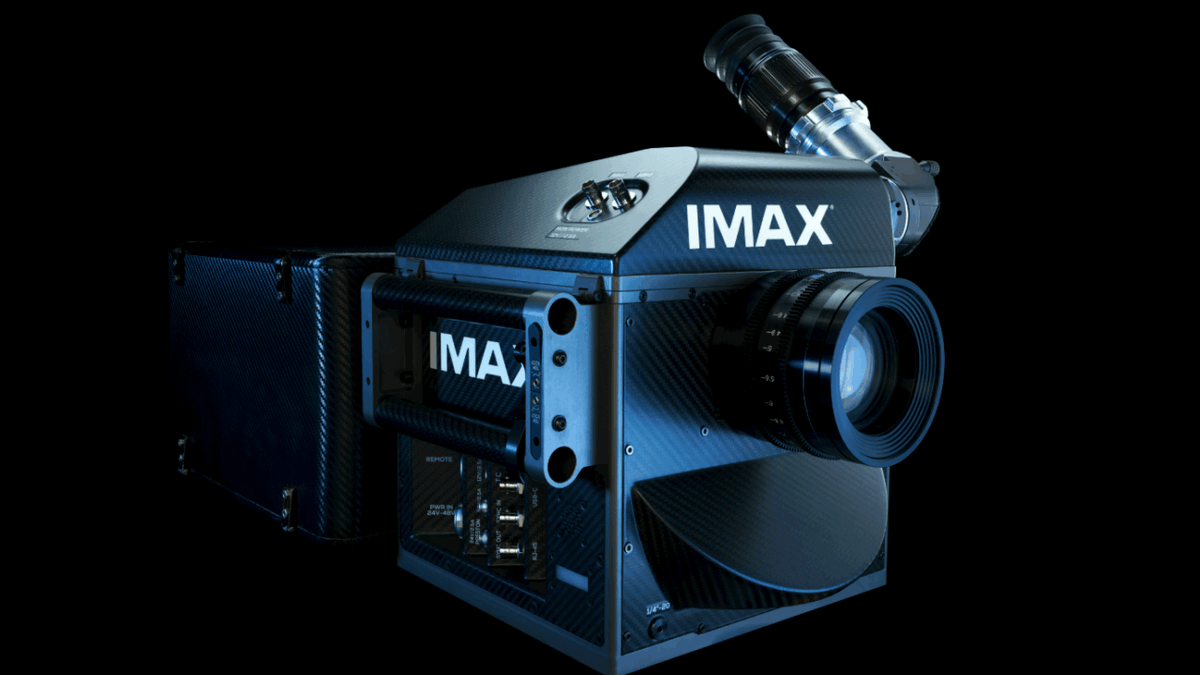
“The work on the new cameras started right after ‘Oppenheimer’ came out. There was about two years between that release and when shooting on ‘The Odyssey’ started, and that’s about how long we spent at Imax designing the Keighley camera,” Keighley said. “At the same time, we wanted to put this film in more theaters on Imax 70mm, which meant we needed Kodak to provide more film.”
That was a difficult task given the Hollywood studio-driven push to phase out celluloid for digital to cut costs and provide a more consistent image quality. With only one photochemical lab in operation with the capacity to create Imax 70mm film reels, the Keighleys and Imax had to not only develop a new camera but also get the logistics needed to generate the 800-lb. reels that would be sent out to 41 select theaters that would screen “The Odyssey” in the ultra-premium format.
“We had to work together with lots of different parties in the workflow process to make sure that everybody would be ready,” Keighley said.
But the primary focus was on the blimp, the component of every camera that muffles the sound of the motors that move the film inside. While Imax had improved on its blimps over the decades, Imax 70mm cameras require much larger motors to move the 15/70 film inside, making it unsuitable for scenes that involve dialogue in quieter surroundings. It was a reason why Nolan had decided not to use Imax cameras on his 2010 film “Inception.”
The most cost-efficient solution would have been to just use the old Imax 70mm cameras and use AI technology to eliminate the camera sound and amplify the dialogue. But Nolan, ever the practical filmmaker, did not want his actors trying to do their work through that noise. Instead, the Keighleys designed a camera box large enough that it could muffle the camera motors enough for actors’ dialogue to be heard.
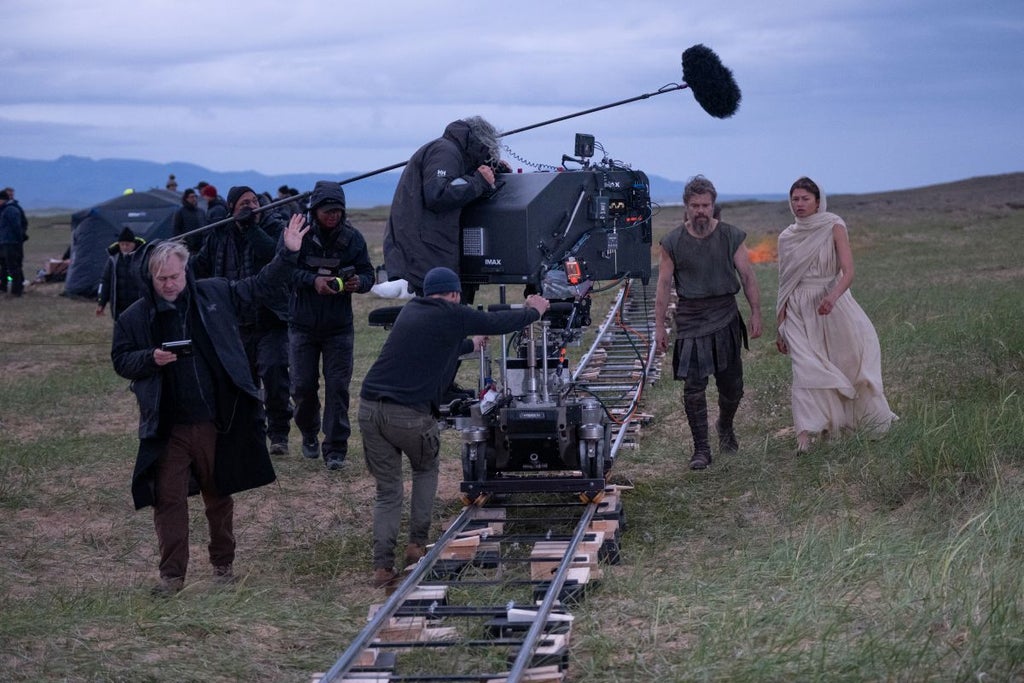
There was just one problem: the blimp was so large on the camera that when the actors faced each other for over-the-shoulder dialogue shots, it got into their line of vision. Cinematographer Hoyte van Hoytema came up with a solution: mounting mirrors on the sides of the camera that, when properly aligned, would allow the actors to look at each other through them. The mirror system was shown in an image shared on social media during a scene between Tom Holland and Jon Bernthal where Odysseus’ son, Telemachus, asks about his father to the Spartan king Menelaus.
“That hadn’t been foreseen by the engineers by the camera department because they’re not the end users of the equipment, but Hoyte told us that his team could figure it out once the sound from the blimp was acceptable,” Keighley said.
Fulfilling a dream
With the Keighley Camera complete, Nolan and Hoytema took it across six countries during the three-month shoot of “The Odyssey,” sending back two million feet of dailies to be converted into 35mm footage for the Keighleys to look at for sound and picture quality and then send back to Nolan with notes.
“I think that what comes across the most, even in dailies, with Chris’ work is just the epic scale of it all, with hundreds of actors coming out of the screen at you in a way you don’t see with a lot of other films,” Keighley noted. “And the system that he and Hoyte came up with … it’s not for his camera crew. It’s not for them to be comfortable. It’s not for them to be to have convenient equipment to be using. Their job is to capture the best image to put on the screen for the audience to make the audience feel like they were there to engage them in the story as it unfolds.”
But the work unfolding between Nolan and the Keighleys took an emotional turn in January 2026, when David Keighley was diagnosed with terminal cancer. In an Instagram post published after the premiere of “The Odyssey,” Keighley’s son, Geoff, who produces and hosts The Game Awards, talked about how the Imax veteran was determined to see his work through before he passed.
“‘The Odyssey’ is the fulfillment of his lifelong dream. Imax began in the 1970s making documentaries about space, animals and the wonders of the world, but my Mom and Dad always dreamed that one day, a major Hollywood epic would be made entirely with Imax cameras — our ‘Lawrence of Arabia,’ as he liked to say,” Geoff wrote. “When we, as a family, met with his doctors, my Dad was clear on the goal that would define the rest of his life: ‘Please keep me alive long enough to finish production of “The Odyssey” for Chris.’”
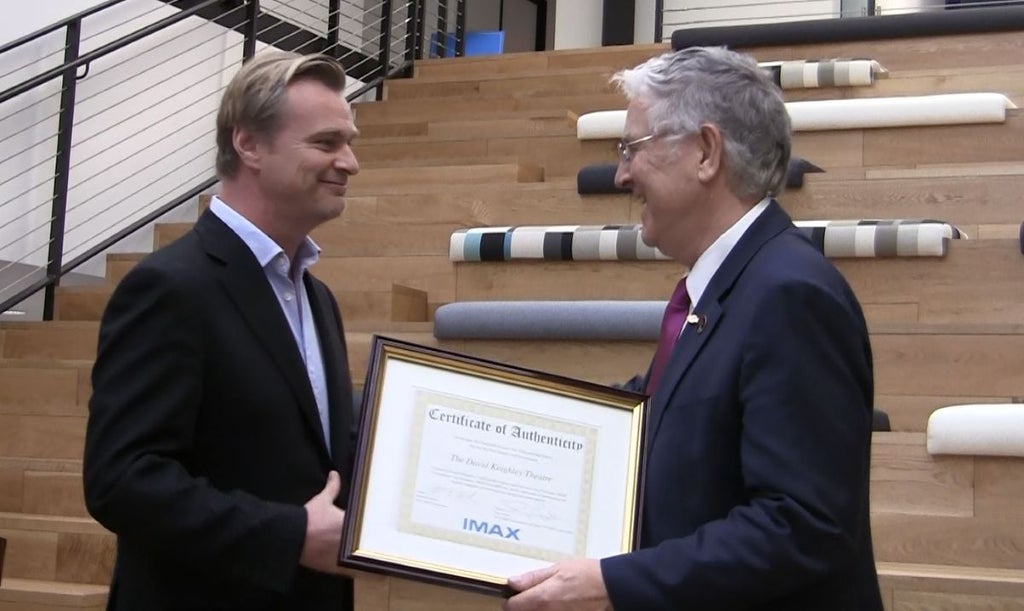
David Keighley passed away shortly after principal photography on “The Odyssey” was finished, and his name was included in a brief memoriam card during the film’s credits. Patricia told TheWrap that those final months of his life completing a mutual passion project with one of his closest friends and collaborators were deeply meaningful for both her and her husband, and their work has not been taken for granted.
To date, the 41 theaters that have screened “The Odyssey” in Imax 70mm have grossed nearly $20 million and, as of last Sunday, had a per theater average of $412,000. Those numbers will only keep growing not just this weekend, but for the next six, as Imax will keep “The Odyssey” in those theaters through at least Sept. 16.
As TheWrap noted on its opening weekend, “The Odyssey” has not only elevated Nolan’s status as a box office draw, but has greatly advanced the filmmaker’s dream of preserving a global love among moviegoers for celluloid film, one that he shared with the Keighleys. Patricia recounted to TheWrap when she got a call from Kodak in 2014 when its new CEO wanted to meet with Nolan and his wife and producing partner, Emma Thomas.
When the Keighleys arranged the meeting, they and the Nolans got a big shock: the CEO, Jeff Clark, said that he had been brought in to make Kodak more efficient, which would mean shutting down most if not all of its film processing plants. He was going around Hollywood asking studios and filmmakers what their final order of film stock was going to be.
“They didn’t know if they were going to keep making film in a significant way for anybody, and while Jeff had been trying to rally demand for film, he hadn’t been getting very far and needed Chris and Emma’s help,” Patricia said. “So they were able to make calls and get some commitments, and while they didn’t all rush out to buy film, he got enough that Kodak was able to financially justify making it going forward. I think that was when Chris understood the fragility of it all.”
But after their hard work, Nolan and the Keighleys have yielded a film that is the end result of two decades of collaboration, shown in a format they fought to preserve, as the London theater where they first met stays open round the clock to serve cinephiles that share their passion.
