
While Hollywood is abuzz this week over Kane Parsons’ “Backrooms” and Curry Barker’s “Obsession,” the YouTube-to-Big Screen pipeline is not as new as some might think. Just ask David F. Sandberg.
It’s been a decade since the filmmaker from Jönköping, Sweden, whose filmography includes two “Shazam!” films with DC and an adaptation of the Playstation horror game “Until Dawn,” first came to America after “Lights Out,” a no-budget horror short he made for a film contest with his wife Lotta Losten, went viral on YouTube and Vimeo.
The film attracted the attention of “The Conjuring” director and Atomic Monster co-founder James Wan, who worked with Sandberg to produce a feature-length version of the short.
“We just made the film for the competition and moved on, and then I think the Vimeo version was shared on a Reddit page a couple months later and suddenly it was everywhere,” Sandberg told TheWrap. “At first it had 600 views, then we checked after that post and it had 17,000. We clicked ‘refresh’ and suddenly it had 70,000.”
As of today, the “Lights Out” short has a combined 29 million views from YouTube and Vimeo.
While YouTube’s role in the entertainment world has grown dramatically over that time, there are several parallels between Sandberg’s rise a decade ago and what Barker and Parsons are experiencing now. He offered his perspective on this latest crop of viral filmmakers and where things go from here.
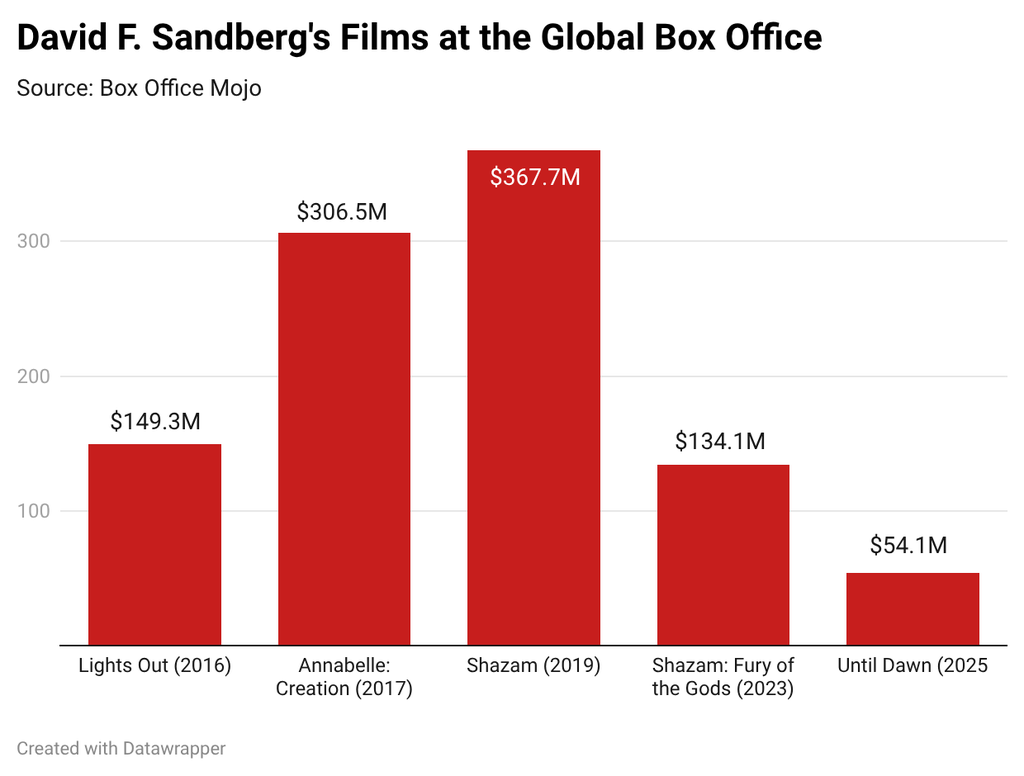
In 2016, Sandberg’s feature version of “Lights Out” grossed $149 million worldwide at the box office against a $5 million budget. A year later, Sandberg and Wan worked together on the “Conjuring” spinoff “Annabelle: Creation,” which made $306.5 million.
Wan, who worked with Parsons on “Backrooms,” said his history with Sandberg is partly why the horror maven isn’t too surprised that “Backrooms” and “Obsession,” two films whose directors also trace their roots to YouTube, are all the rage right now. “Lights Out” demonstrated how filmmakers with the right skills and a killer concept can become the basis for a rapidly growing following.
“A filmmaker can take a very simple concept idea, shoot it, make it work, put it out there, and if the hook is great, it can find a mass audience very quickly,” Wan told TheWrap. “And if that audience gets big enough, soon Hollywood can come and ask if they want to turn that idea into a feature film.”

Over the course of 2014 and 2015, Sandberg made the jump from homemade shorts to the Hollywood system, and it was a long one. Along with meetings with Wan, Warner Bros., New Line Cinema, agents and managers, there was the rush of trying to move to a new country — as well as learning how the entire process of feature filmmaking works.
“There was a lot to learn in very little time,” Sandberg said. “I would interview script supervisors and I would ask them, ‘Describe to me what you do.’ I also had to learn things like how to work with actors on set. I would say ‘Cut!’ and the actors would be like, ‘Were you happy with that?’ because they were looking at my face for any cues of whether what they were doing was working.”
Advice came pouring in from Wan and Hollywood veterans left and right, the sort that Parsons, Barker and others coming from YouTube are likely to hear when making their feature debuts:
- Be sure to film the intense, scary scenes early in the day when the cast has more energy.
- Save the easier dialogue scenes for later.
- Always have an immediate answer for your department heads’ questions, even if it is wrong, because those questions pile up if you tell them you’ll get back to them. It can be fixed later.
What Wan tried not to do, either with Sandberg or with Parsons, was get in the way of their creative vision. His goal as a producer was to make their experience working on a Hollywood set as streamlined as possible and make it easier to get their vision into the final cut uncompromised.
“Kane came into the production super well-prepared. He would use his own technology and system to make this world, because that’s what he did with the ‘Backrooms’ shorts,” he said. “What I just tried to do was to help him understand the infrastructure of a ‘Hollywood’ movie and how to interact with the cast and crew, but we all completely trusted him as the leader of his own project.”
Sandberg’s post-“Lights Out” career is where his path begins to diverge from Parsons and aligns more with Barker. Parsons told Matthew Belloni on his “On the Town” podcast that he has extremely little interest in IP filmmaking. While he isn’t ruling out more work on “Backrooms,” he wants to focus on new ideas.

“I do this because it’s my way of processing life, as is art. And I typically find needing to step into someone else’s view of life tends to just kind of damage the initial point for me,” he said.
Barker, on the other hand, will be heading into franchise filmmaking as “Obsession” remains on a glide path to becoming Focus Features’ highest grossing film of all time. His next project will be A24’s reboot of “The Texas Chainsaw Massacre,” the 1974 Tobe Hooper film that defined many of the common tropes in slasher films and was previously remade by New Line in 2003. While the budget of that project isn’t known yet, it will almost surely be higher than the $1 million spent on “Obsession.”
Budget-wise, “Annabelle: Creation” wasn’t a big budget leap for Sandberg at just $15 million, and since he dove right into it shortly after finishing “Lights Out,” he said he didn’t think much about how his debut was received. But when it came time to make “Shazam!,” a $100 million film, he said he didn’t feel as much pressure to perform the way he did with “Lights Out,” a film he thought could make or break his professional career.

“With ‘Shazam,’ I just had the mindset of, ‘I am going to try something new, and if that doesn’t work, I can just go back to making horror movies.’ And after doing two ‘Shazam’ films, that’s just what I did,” he said.
Losten, who continues to work with Sandberg as his producing partner, said that mindset has extended to their entire career in Hollywood after 10 years. When asked what advice they would have for Barker, Parsons and any other filmmakers who get into Hollywood via YouTube, they said that having a constant willingness to “switch lanes” is key.
“I think it is easy to fall into that trap where you think that your films have to get bigger and bigger and bigger, and that doesn’t have to be the case,” Losten said. “It’s so much healthier if you know what you want to get out of your career. If you find you like making things on a smaller budget, that’s OK.”

“It’s funny because I’m in this weird position thanks to ‘Lights Out’ that I’ve made studio films for 10 years, but I’ve never made an indie film,” added Sandberg. “I think at some point I would like to make an indie film or something along those lines where I have more limitations but more control as well.”
But Sandberg and Losten note that this is advice Parsons and Barker might not need. The young filmmakers have gotten plenty of guidance from industry vets when making their smash hit debuts, and both seem to have clear visions about what they want to do next with the momentum that they have.
It’s that assuredness that makes the couple so excited about the future of filmmaking, as a new generation of directors are attracting audiences with their authenticity.
“I think the movie business is a little bit in a weird state, where the studios don’t know what to do now because it’s like some of the huge movies we have been making haven’t really been working,” Sandberg said. “In the past there have been big shakeups in the ’70s and the ’90s and maybe this is the next big shakeup.”
“I think it’s also great that, at a time when everyone’s talking about AI in Hollywood, these two filmmakers don’t want anything to do with that,” added Losten. “The humanity and the craftiness of these films is what is drawing people to them.”
