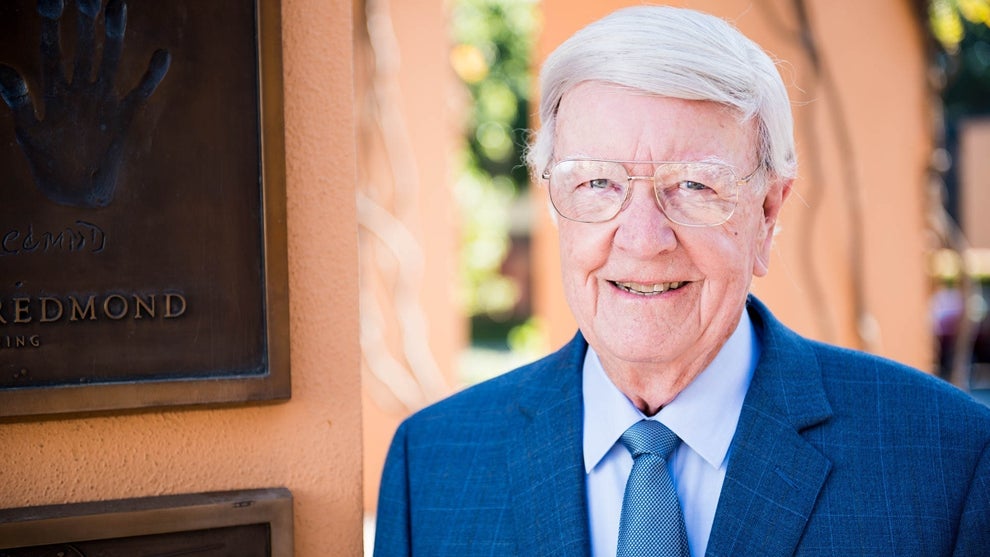
Don Iwerks, a Disney Legend and the son of Mickey Mouse co-creator Ub Iwerks, has died at 96.
On July 9 — just days before his 97th birthday — Iwerks died while “surrounded by the love of family and friends,” according to an obituary shared by his family, per Deadline.
During his career, Iwerks, the father of documentarian Leslie Iwerks, contributed to countless films and attractions. He became a Disney Legend in 2009, honored as “having made a significant impact on the Disney legacy.”
He also won two Academy Awards. In 1988, he was awarded the Gordon E. Sawyer Award (famed former sound director at Samuel Goldwyn Studio), given each year by the Academy of Motion Picture Arts and Sciences to “an individual in the motion picture industry whose technological contributions have brought credit to the industry” (other inductees include Pixar co-founder Ed Catmull and effects whiz Douglas Trumbull). And in 1998, he received a Scientific and Technical Achievement Oscar for a breakthrough known as the Iwerks 8/70 Linear Loop projection system. It helped large-format theaters by eliminating the huge, circular rotors of rolling loops, which led to better image quality that could fit into smaller theaters and onto curved screens. Everything from large-format theaters to simulation attractions wound up using the technology that Iwerks and his team developed.
Iwerks, with his father, has a window on Main Street at the Walt Disney World’s Magic Kingdom. It reads, in part, “Repairs | Modifications, No Two Exactly Alike.”
Born in Dallas, Texas, Iwerks grew up in Southern California (first in West Hollywood, later the San Fernando Valley) and began his career with Disney in 1950. He was drafted into the Army in 1951 to fight in the Korean War, serving for a year-and-a-half in Germany as a Signal Corps photographer.
He returned to Disney in 1952, first in the Disney Process Lab until an allergic reaction to the photographic chemicals forced him to transfer to the Studio Machine Shop.
Of course, his love of photography and the photochemical process would never leave him. As the Walt Disney Company obit read, Iwerks was known as a “pioneer in the development of numerous camera, projection, and other systems for Disney parks and films.”

He spent the next 34 years developing cameras, optical printers, special effects systems, and technologies that would shape Disney films, attractions, and theme parks for generations. Though he never received a formal engineering education, Don was, in every sense, a self-taught engineer with a uniquely intuitive understanding of complex mechanical systems,” wrote the Walt Disney Family Museum.
Iwerks was involved in all of it — the earliest days of audio-animatronics, working on Walt Disney’s miniature Barbershop Quartet and serving as the model for Abraham Lincoln’s hands for the Great Moments with Mr. Lincoln attraction (first at the 1964-65 World’s Fair and later at Disneyland, where it is still performed today). “Iwerks hands,” as they were known, were used in countless attractions around the world.
He worked as a camera technician on “20,000 Leagues Under the Sea,” helped develop the Circle-Vision format that was viewed at Disneyland and later in EPCOT Center and was a photographer on Walt’s Oscar-winning “True-Life Adventure” films, helping to invent the nature documentary format.
In the 1960s, he helped create the xerography format with his father Ub, that helped modernize Walt Disney Feature Animation. (Without xerography, animated features like “101 Dalmatians” would have been impossible — think about how many spots they have.) He worked on a “traveling matte process” that was utilized by “Mary Poppins” and Alfred Hitchcock’s “The Birds.” And he designed next-generation projection systems for projects at Walt Disney World and Tokyo Disneyland, along with Disneyland and EPCOT Center. Without Don Iwerks, the “endless loop” film attractions at these parks would have been impossible.
As the Walt Disney Family Museum noted, his career was defined by “innovations in projection technology, 3D and large-format filmmaking, and immersive attractions that transformed the way audiences experience stories,” including Disney’s Circle-Vision films which surrounded you with 360-degrees of photography, to the 3D camera systems that captured Francis Ford Coppola and Michael Jackson’s “Captain EO” attraction to what the Walt Disney Family Museum describes as “next-generation giant-screen theaters and motion simulator attractions,” via his own Iwerks Entertainment group. The Museum noted that “his work helped shape the future of location-based entertainment and inspired generations of filmmakers, Imagineers and inventors.”
The original version of Star Tours is another crown jewel in Iwerks’ insane list of accomplishments.

“The Disney Company has honored over 300 people as being Disney Legends, and Don Iwerks occupies a space at the top,” said former Imagineer Jim Shull. “During our conversations, Don was always encouraging and insightful and his passing leaves a void in the theme park and leisure industry.”
After leaving Disney in 1985, he started Iwerks Entertainment with partner Stan Kinsey. As a contemporaneous Los Angeles Times article noted in 1993 (less than a decade after he had started the new venture), “Iwerks has become one of the top designers of special-format movie theaters for theme parks and world expos. The closely held company expects revenues of $35 million this year.”
Later in life, he helped restore one of the camera rigs he worked on during “20,000 Leagues Under the Sea” and wrote the definitive biography of his father, 2019’s “Walt Disney’s Ultimate Inventor.” He was also frequently interviewed by his daughter Leslie, for projects like her indispensable Disney+ series “The Imagineering Story” and “Disneyland Handcrafted,” which debuted earlier this year on Disney+ and YouTube. She has a new documentary about Disney creativity set to debut at this year’s D23 fan expo in Anaheim, California. We wonder if she got any final pearls of wisdom from her father.
“There was a ‘can-do’ attitude I learned from Walt and my father,” Iwerks once said. “If you’re doing a really first-class job, you don’t need to worry about the money. It will come. Walt gave everyone a feeling that they were creating things that others had never thought of before, of being a part of history.”
Iwerks’ legacy — part of a familial continuum of innovation and groundbreaking creativity — cannot be overstated. It’s because of Iwerks that so many of us have foundational Disney memories full of wonder and awe; whether this came from stepping inside one of the international pavilions at EPCOT Center or cruising through the galaxy on Star Tours, stepping inside the massive Hall of Presidents at the Magic Kingdom or tapping our toes along to “Captain EO.” There are so many tiny breakthroughs from Iwerks that sat alongside his massive technical leaps, all of them adding up to a profound accomplishment and contribution to American storytelling and technology. He will be sorely missed.