
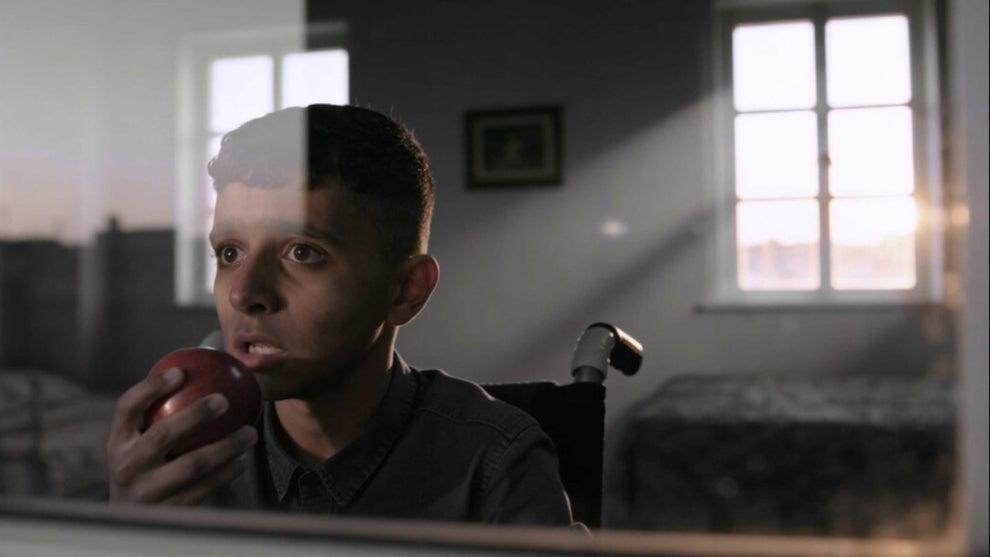
Before discussing whether “Dreams of Violets” works as a film, it’s impossible not to acknowledge the elephant in the room. Ash Koosha’s 74-minute feature debuted at the Tribeca Film Festival, marking the first fully AI-generated feature film accepted into a major festival. For some audience members, that fact alone will be enough to spark curiosity. For others, it may be enough to provoke immediate skepticism.
What makes “Dreams of Violets” interesting, however, isn’t simply how it was made… it’s why it was made.
Set against the backdrop of anti-government protests that erupted in Iran late last year, Koosha’s film attempts to capture the fear, grief and resilience of ordinary citizens living through political violence. Rather than following a traditional narrative, the film drifts between interconnected stories: a surgeon confronted by authorities while treating a protester, a young musician searching for hope through art, an aging woman reflecting on memories of a life once lived freely, and a wheelchair-bound boy who witnesses the brutality unfolding outside his window.
The result often feels less like a conventional feature and more like fragments of memory stitched together. Scenes emerge and fade as characters cross paths, without necessarily creating a clear narrative throughline. At times, the experience is meant to feel like watching a documentary, though it evokes emotions akin to flipping through a collection of postcards from a traumatic moment in history.

Oddly enough, that fractured quality becomes one of the film’s greatest strengths and ultimate weaknesses.
Trauma rarely arrives in neat three-act structures, and the artificial intelligence behind this film doesn’t do much service to revolutionize trauma on screen. Memories blur together, and faces appear and quickly vanish like vignettes without a motive. Whether intentional or not, the dreamlike nature of AI-generated moving imagery often mirrors emotional reality rather than depicting actual emotions through acting or historical reenactments. Though Koosha desperately wants the audience to know that the events depicted in this film are based on true events.
The limitations of current technology are impossible to ignore on the artificial intelligence front. Characters frequently move with an unnatural stiffness while Koosha lingers on close-ups of eyelashes and tears to signify the detail that AI is supposed to be good at creating. Facial expressions often feel generic rather than lived-in, and frequent quick cuts are distracting at best. The dialogue, much of it generated from Koosha’s own vocal performances and modified through common AI tools, can sound muddy and disconnected from the images on screen.
When a film like this, despite its short runtime, is asking viewers to engage with real human suffering, that emotional disconnect can be difficult to overcome.
The faces in “Dreams of Violets” often feel ghostly, almost suspended between existence and disappearance. The streets of Tehran seem simultaneously real and imagined, sort of like Spike Jonze’s “Her” without the authenticity of its central characters. Rather than recreating reality with documentary precision, the film exists in a liminal space between memory and testimony.
There are times when “Dreams of Violets” feels like an obvious political statement, but it also concentrates its efforts much like an experimental art piece combined with a sordid demonstration of the latest technological advances in modern filmmaking. Those competing identities create a fascinating tension, but they also prevent the movie from achieving the emotional depth it seeks. The strongest moments arrive when Koosha focuses less on spectacle and more on human experience, though these are few and far between and obviously not actually human.
By the end, I found myself less interested in whether AI should replace traditional filmmaking and more interested in what opportunities it might create for filmmakers who otherwise could not tell certain stories at all. Koosha wants the audience to understand the restrictions that prevent many artists from openly depicting governmental abuses in Iran. Viewed through that lens, “Dreams of Violets” becomes less a novelty created by artificial intelligence and more an attempt to bypass censorship altogether.
I’m just not sure if audiences will embrace that approach in the short term.
As an experimental and timely film, “Dreams of Violets” is uneven, frequently frustrating, and undeniably flawed. As a snapshot of where both filmmaking and AI technology currently stand, it may ultimately prove more significant than the movie itself. What cannot be denied is that it leaves an impression, whether good or bad, and the movie deserves the conversation that will undoubtedly surround it.
At the very least, “Dreams of Violets” remains one of the most unusual and thought-provoking films playing at Tribeca this year.
