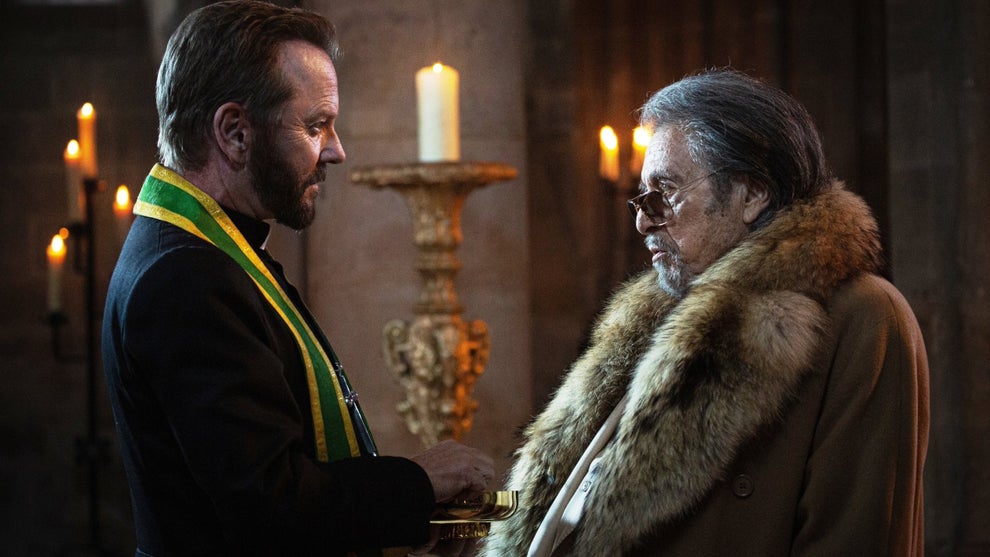
Written by Luc Besson, Barthélémy Grossmann’s directorial debut “Father Joe” is a goofy pastiche of mafia movies and religious hitmen that is not without its charms. Set in New York City against a nebulous “nineties” backdrop, it follows a gun-wielding vigilante vicar (an intense Kiefer Sutherland) obsessed with taking down the mob led by the sluggish Gio Falcone — played by Al Pacino, who, perhaps for lack of material, phones it in. Far from dramatically rigorous and often flat in its visual telling, the film is nonetheless coherent enough to be entertaining.
Sutherland’s eponymous assassin is a man of contradictory codes, which yields curiosity, but which the story seldom confronts. It begins with a standard mob meetup at a covert drug lab, during which low-level enforcers are executed with brutal efficiency from off-screen. Sporting clerical robes, a wide-brimmed hat and a protective leather vest, Joe quickly kills his way up the food chain and confronts a mobster middle-manager (Michael Rispoli), only to suddenly spare him. Why? Well, on one hand, the demands of the crime and action genres deem henchmen expendable and featured characters necessary for exposition. On the other hand, the movie reverse-engineers an amusing justification for this too: Joe wants to add rich men to his flock so he can keep an eye on them while extracting donations.
He also injects each target with a mysterious poison, hilariously offering them a weekly antidote when they reluctantly show up for mass on Sundays. Joe is meticulous and methodical, but his methods are steeped in utter madness. Each reveal of his mission is a riot, but scenes tend to repeat themselves to diminishing returns. As the priest clears column after column of the mafia’s trade, he demands that each underboss stop selling drugs. Not altogether, mind you; his condition is no sale to anyone under 21. His victims are as perplexed as any audience is likely to be, because it’s quite a strange demand. And yet, it’s another one the movie retroactively justifies through backstory details about Joe’s dead family and the way he sees the world.

Joe isn’t alone in this mission either. His Church is both a haven for Vietnamese orphans as well as a heavily armed stronghold, and his relationships with local Muslim and Jewish leaders are as much about faith as they are about weapons and safe houses. It’s “John Wick” by way of the saccharine religious pluralism of a ‘70s Bollywood melodrama (if you know, you know), a naïveté that is, in its own way, wonderfully optimistic.
Once Gio gets word of Joe’s antics, the mob and the clergy begin closing in on one another, unearthing ludicrous new details at every turn, from nun chucks hidden within crutches, to crucifixes doubling as daggers, to the aforementioned orphans being proficient with throwing stars. This combination of Old Testament wrath and New Testament beneficence borders on sacrilegious, but its imagery is never subversive (or exploitative) enough to feel truly volatile.
Daredevil be damned, Father Joe is the Catholic Batman — a comparison the movie also makes — down to drafting children into his holy war, à la the fascistic Frank Miller version of the caped crusader. It’s all a bit silly, with a touch of broad orientalism, but Sutherland’s straightforward commitment to the bit is a delight unto itself. Joe, however, is a man in emotional stasis, which makes for a less-interesting series of events. There are numerous parallels between him and the drug lords he fights (down to his own Batcave behind a statue of Mary Magdalene, hidden away exactly like a drug lab behind a mannequin in lingerie). However, the film seems disinterested in using his hypocrisies as fodder for dilemma or spiritual inquiry, rendering null its apparent themes of redemptive violence.
When things take a suddenly lurid turn — via the almost random appearance of a child trafficking ring — the movie’s tone cannot keep pace. Rather than adjusting on the fly, it attempts to counterbalance this serious subject matter by introducing a quippy sidekick, the wayward teenager Felicity (Ever Anderson, a spitting image of her action legend mother Milla Jovovich), who Joe takes under his wing. But despite the evolution of its plot, “Father Joe” remains visually stagnant, with flat spaces and dull tableaus made even murkier by the frequent use of vibrant stock footage from the era as establishing shots. It’s a deft decision on its own, but it makes everything else look worse by comparison.
Like many an action oddity, the film is inexpensive, but it fails to hide its seams. Alongside its cheap production value and smooth sets, it also strains to engender suspension of disbelief. The culprit here is languid action editing, which leaves too much physical and temporal space for viewers to wonder why henchmen armed with guns don’t simply pull the trigger when attacked with swords or baseball bats. Perhaps pointing out plot holes in such an absurd premise is a fool’s errand, but a film like “Father Joe” works by leaning into that absurdity, which it only does on occasion.
Whatever lurid deliciousness the film might have conjured ends up flattened into a borderline-functional façade, wherein hails of bullets fly across the screen, but rarely feel buoyed by the righteous anger of which its characters so often speak. The story is right there, visible just beneath the surface, waiting to be mined for its fiery emotional potential.
Instead, we get a mere facsimile of something more exciting.
