
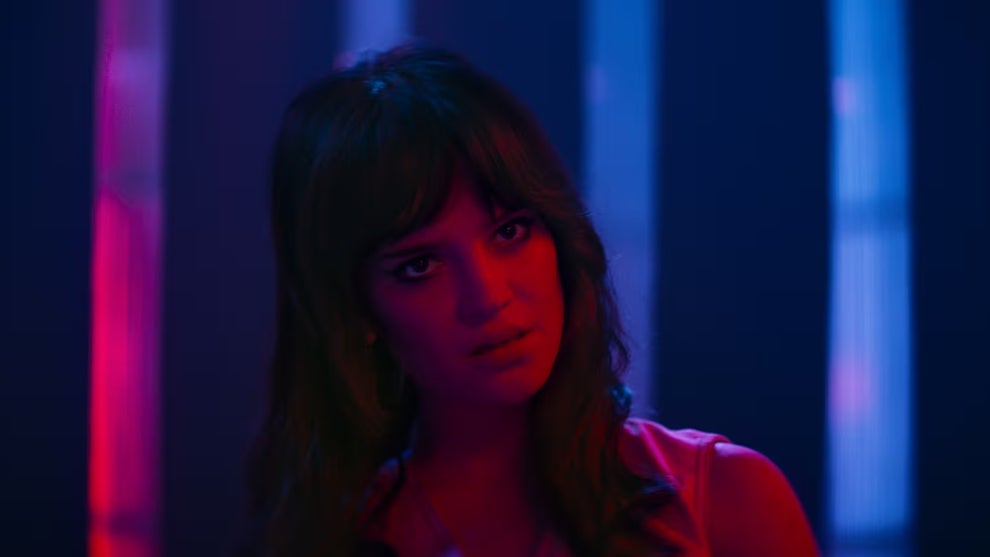
When I ask Nicolas Winding Refn, the Danish director of “Drive” and “The Neon Demon,” where his latest film, the dazzling, phantasmagoric “Her Private Hell,” came from, he says that he died.
He’s wearing a black Prada shirt and is seated in front of a wall with a large painting on it. He’s in a New York hotel. Or maybe a conference office. “I’m sitting in front what looks like the hand of God opening a book, so it’s all very mysterious,” Refn said.
Sure, it was a metaphoric, creative death, after shooting two grueling streaming series that he had entirely directed himself — 2019’s “Too Old to Die Young” for Prime Video, with episodes that routinely stretched to feature-length, and 2023’s “Copenhagen Cowboy” for Netflix.
“I’d come to my creative finale. I had nothing left in me to say. I had nothing left that I wanted to make,” Refn said. He had gone overseas to make a short film with Prada. It felt like a pretty good way to end things – “with some wonderful people in Italy,” he said. Refn was intrigued by the possibilities following, as he called it, his “last painting.”
What would the next 20 years of his life even look like?
And then he died. Like literally died.
It was in the middle of an operation on his heart and he flatlined. He had what he described as a “leaking heart,” where your blood runs backwards through your heart. His lungs filled with blood. By his own estimation he was dead for 20 or 25 minutes. When he told the story of his near-death experience at Cannes earlier this year, where “Her Private Hell” debuted to some befuddled critical notices and standing ovations, he broke down in tears.
“I realized I’ve been given a gift because without knowing it, I asked God to change my existence, and He did so. God’s always been on my side in certain ways, because through my career, always been giving opportunities that just came out of the blue. So now He killed me and He brought me back,” Refn told me over Zoom. “I realized the gift was that I could start over. I still had the power of wanting to live and create, even though I’d gone through a very difficult heart surgery. I still had gasoline in me and I realized what I needed to do was to make a movie.”
Refn was gripped by the desire to make “a movie for the cinemas, a cinematic experience.” He wanted to make a movie that, in his words, “went against all the notions of what a film is today, because everything today is so pre-manufactured and algorithm-based and very soon AI-driven. I needed to make something that you could not duplicate, and I didn’t know what it was.”
He was on the phone with Neon co-founder Tom Quinn, who asked Refn when he was going to make another movie – it had been nearly a decade since Refn had directed a feature, after all. Refn told him he was going to make one now. Quinn asked him how much he needed. When Refn gave Quinn a number, Quinn told him, “I’ll guarantee that.” Now, Refn had to figure out what the movie was. “Now there was a check on the table,” Refn said.
There were two competing ideas that he was toying with – one involved Private K (played in the film by Charles Melton) on a trip to hell; the other involved a woman (Sophie Thatcher) arriving in a “city that does not exist.” What linked the two ideas was that they were “artificial and take place in a world that doesn’t exist.” He needed a third element to the story and soon came up with the idea for The Leather Man, a serial killer that murders young woman, “a glam monster.” “Now there were three main ideas that would create a story,” Refn said.
But there was still something that nagged him from his near-death experience, something that he applied to “Her Private Hell” – the relationship between a father (Dougray Scott) and daughter (Thatcher).
“Now that I was back alive again, I’d realized that I had made peace with my wife and my eldest daughter when I was going to die, because you kind of have to, and I was ready to leave Earth,” Refn said. “But I realized that I couldn’t go yet because my youngest needed me to come back.” He constructed a father/daughter relationship that served as a parallel to his earlier film “Only God Forgives,” which centered around a mother/son relationship. “It was like ying and the yang,” Refn explained.

Refn said that he thought back to the images and experiences that enamored him as a child (“They gave me dopamine”) and it was never cinema. It was television – clicking through channels when he was very young. “In a way, this is very much what everyone is doing on their cell phones, especially young people. The idea of scrolling – they’re so advanced, they’re so fast. I thought, I don’t know what a movie is anymore, because I’m year one. I know what I made in the past, but I don’t know what it is now,” Refn said. (“Year one” meaning that he has started his life over and this is his first year.)
Instead of overintellectualizing the process, he gave into his instincts. He asked himself, What do I find interesting? He had multiple ideas and wanted to cover them all. (“I like horror. I like sci-fi. I like fantasy. I like melodrama. I like music. I like sex. I like violence. I like camp. I like kitsch, mayhem, color,” Refn said.) Instead of tackling the story in a linear fashion, he decided to approach it like a fairy tale.
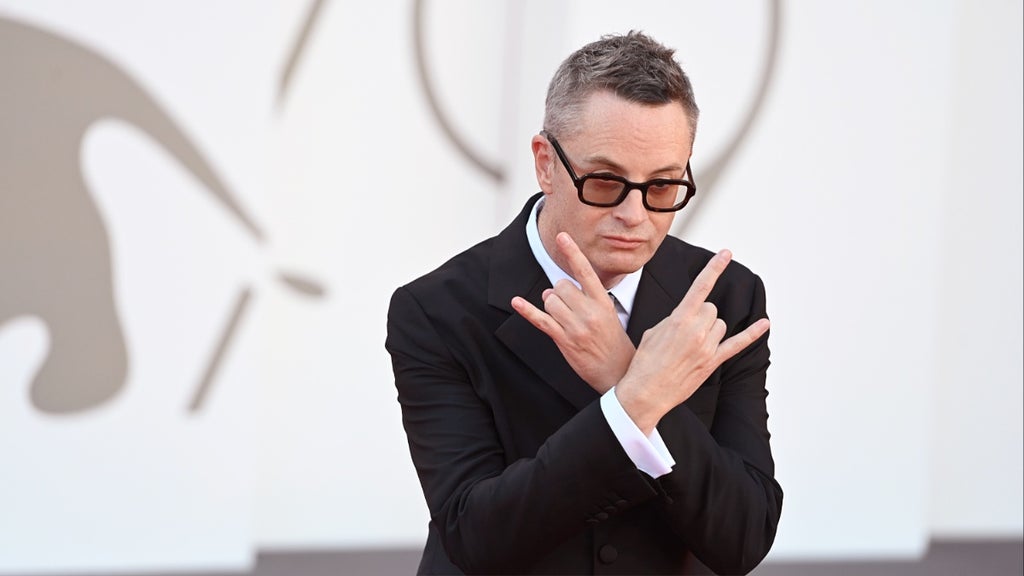
Refn pulled a piece of paper up into his camera. He said, “Most entertainment today is like this – lines of code, information that informs you.” He’s showing the flat side of the paper, with text. “Fairy tales are like this – paper thin on top,” Refn said, showing the edge of the paper. “The narrative is one sentence. It’s why you can, again and again, read them, dissect them, generation to generation. Because when you go like that,” he turns the paper around, “the thin top becomes infinity of interpretation and now you have an experience. And that was everything combined in the film.”
“Her Private Hell” is pure Refn – beautiful women walk in slow motion through expertly appointed hallways, a milky fog rolls over a neon-lined city, yakuza members stalk the city streets, a mysterious killer rips his victims apart. Everything is bejeweled and sparkly; even the murderer has diamonds on his gloves. And tying it all together is a lush orchestra score by Pino Donaggio, who has done the music for movies by Nicholas Roeg, Brian De Palma and Lucio Fulci.
Refn said that this was the first time he had made a movie where he didn’t know what the soundtrack would be before he made it and the first time utilizing a composer who didn’t come from the world of pop music or contemporary music. (Refn’s usual musical collaborator is Cliff Martinez, a composer whose other notable work is with the Red Hot Chili Peppers.)
But as he worked through where he was going to shoot the movie – first he wanted to go to Tokyo, then Seoul, then back to Tokyo – he came to an epiphany. “I realized the world that I have does not exist. I’ll never find it. I have to build it, which then became very operatic. Suddenly, everything was on stage, and I saw that’s what God was trying to tell me – I’m going to make an opera because the themes were operatic,” Refn said. “Mayhem, sex, color, sets, design, fashion, design that is borderline kitsch. Those things were operatic.”

The Best Horror Movies of 2026 (So Far)
He then went looking for a composer “that both knew film music and opera.” He thought of his favorite Italian film composers and realized that “they’re all dead, except Pino.” He reached out and found that Donaggio was retired, living in Venice. Refn asked him, “Would you be interested in writing an opera with me?”
“He’s always wanted to write an opera so great timing. I said, ‘You’re probably going to die soon, so could you make it a requiem?’” Refn said. “He said, ‘Sure.’ Then he said, ‘Oh, by the way, I started my career with Nicolas Roeg. I guess I’ll die with Nick Refn.’ I found that funny.” (Donaggio’s first score was Roeg’s 1973 masterpiece “Don’t Look Now,” which “Her Private Hell” certainly borrows from.)
Typically, on an opera, the composer would write the music first and then everything would come after. “I’ve done reverse engineering on it. I’m going to bet on black on a Russian roulette and I have one chip because the music is going to have to tie this entire movie together,” Refn told Donaggio. “Your music is going to be the bloodline that’s going to run through every single scene and combine the finale and you’re going to tie it up in a bow.” And Donaggio did just that. “The guy’s a genius,” Refn said, still sounding amazed.
One night, he and Donaggio went out after recording the score and had a few glasses of wine. Soon enough Donaggio was “singing like Elvis because he was originally a very successful pop singer in Italy.” Refn suggests that he sold 10 million records in Italy; he actually sold 80 million worldwide with “You Don’t Have to Say You Love Me,” which was later covered by Elvis Presley and Dusty Springfield. Listening back to the cover versions, you can really tell it’s an Italian song – the Springfield version in particular.
When it came to casting, Refn said that Thatcher came along at the very end of the process. Refn and his casting directors had seen 10,000 young girls for the role of Elle, a young American in a strange city shooting a cheesy sci-fi movie. The production start date was looming. And finally he met Thatcher, whose credits include horror hits “Heretic” and “Companion.” “I knew it was her when I met her,” Refn said. He had already seen and liked Havana Rose Liu for Dominique, Elle’s former lover and current stepmother; and Kristine Froseth as Hunter, a young ingenue who is also starring in the movie and falls under the seductive spell of Elle and Dominique. But he couldn’t cast them until he found his Elle, who he said was, “still going to be the top of the triangle. I couldn’t decide until I knew what the top was going to look like.”
For the role of Private K, a former military man who descends into desperation following the kidnapping of his young daughter (at the hands of the leather-clad serial killer), he found Melton while watching “Riverdale” with his daughter. It was one of the episodes set in the 1950s (the show was wonderfully, energetically bonkers) – “He had great hair, leather jacket, and I was like, That’s him. That’s Private K. How do I get him out of the television into the movie?” Refn said.

And for the role of Elle’s father, Johnny Thunders, Refn cast Scott, perhaps best known as the man who was meant to play Wolverine in Bryan Singer’s original “X-Men.” But when the “Mission: Impossible 2” shoot ran long, Scott had to stay in Australian and finish the film and the Wolverine role went to Hugh Jackman, who is still playing the part to this day.
“The father was going to be the mystery. Who was going to play him? And how could he be played? I met with some wonderful actors of notoriety, but because I named him Johnny Thunders, there was a rock and roll iconography to him. When I met Dougray, there was something about this mystery of the ultimate kind of iconography of complete narcissism that he was able to portray,” Refn explained. “When his daughter describes him, she’s essentially, obviously describing myself. But having him playing me, like everything else in what I make, all parts of me, just felt very right. And I remember saying to Dougray when he came to Copenhagen, think heroin, and that unlocked it.”
When reflecting on how his work with the streaming services informed his approach on “Her Private Hell,” he said that he “really enjoyed making both ‘Too Old to Die Young’ and ‘Copenhagen Cowboy’ and working at these big conglomerates… to a certain extent.”
“I saw that as much as you would give, it was always about the algorithm, and so the shows that I created were almost like the antidote. Once I decided to come back and work again, I just I was like, No, it has to be films, because cinema is still what brings us all together in a different way,” Refn continued. “There’s a democracy in a cinematic experience. It’s like free healthcare, free education. Art brings us together and humbles us completely. The inequality in our world is such a horrifying thing. If art can help to stabilize all this, well, then it’s the cinematic experience. It’s about going out together and not just staying at home.”
Going out to see a movie, Refn said, is like deciding to attend a concert. It’s about a collective experience shared with strangers and a careful use of your free time “but also something in return for your time.” He was excited by the idea of returning to moviemaking, particularly since, as he notes, “now is the worst time to make cinema because it’s so it’s so in flux.”
“Her Private Hell” is not the kind of movie that you could (or should) passively experience on streaming while you’re making a tuna fish sandwich or folding laundry. It envelops you completely in its hallucinogenic haze of light and sound and color and giant crystals. What, you thought there weren’t going to be giant crystals?
As for its life at home, Refn promised that “Her Private Hell” would get the 4K physical media treatment. Refn recently sold a deluxe 4K box set of his early “Pusher” films on his personal website. The box set was festooned with extras and included movies that inspired his films. “I’m huge advocator for physical media. I think 4K Blu-ray is like the second coming. I can’t get enough of it,” Refn said. “And I think anything that is you can touch with your hands, which is obviously an obsession of my own work, hands are very much part of the narrative, is amazing. Just a vinyl or CD or anything you can feel.”

Indeed, in the lore of “Her Private Hell,” the masked killer can only be defeated by cutting off his hands.
“I’m going to do all of them,” Refn said, of releasing special editions of all of his films. Next up is his 2009 Viking movie “Valhalla Rising” starring Mads Mikkelsen, which he plans to make available via his official site.
“Remember that slogan that says, Support your local politician? Well, it’s going to be a new one – support your local artist,” Refn said.
As we were saying goodbye, I told him I hoped that he was really as committed to making movies as he said he was. That he was using his new life to follow through on his plans. Refn said, “Oh yeah, ‘Maniac Cop’ ’27.”
Originally, back in 2016, Refn had intended to produce a remake of William Lustig’s wonderfully derange 1988 horror movie, with John Hyams on board to direct. Years later it was developed as a series for HBO and Canal+, with Refn’s “Too Old to Die Young” collaborator Ed Brubaker writing some of the scripts, Refn producing and Hyams directing the pilot. That didn’t move forward either. But now, the intention is for Refn to shoot the film later this year or early 2027, with MUBI on board to produce and distribute.
Nicolas Winding Refn – back from the dead and better than ever.
“Her Private Hell” is in theaters now.
