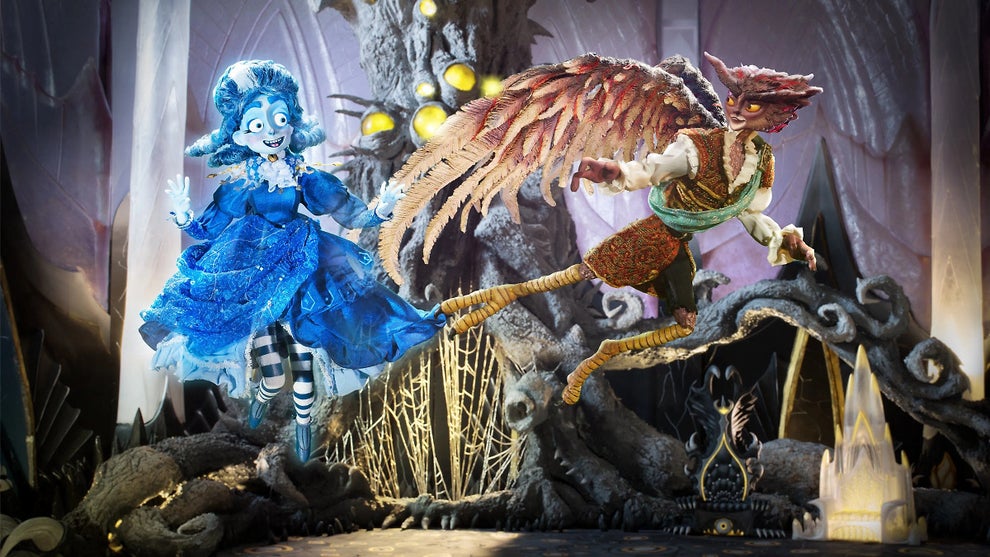
On a technical level, Arturo and Roy Ambriz’s “I Am Frankelda” is a stunning work of stop-motion animation. It’s inventive, unexpected and beautifully handcrafted. A prequel to the TV series “Frankelda’s Book of Spooks,” it’s the first Mexican film made entirely using stop-motion, and it’s the kind of work you could happily watch with the sound off just to marvel at the artistry on display.
However, the storytelling never matches the visuals as the plodding narrative struggles to get off the ground. It’s a movie that’s constantly telling you stakes and what the characters want but rarely letting you invest in a shared sense of wonder. Instead, you have a film that announces the connection between reality and imagination without letting the images speak for themselves.
Set in the mid-19th century in Mexico, we follow young Francisca Imelda (Habana Zoé), who seeks to be a writer despite the constant discouragement from her peers and grandmother. The stories Francisca writes feed into the realm Topus Terrenus, a land of delightful horrors that rely on the nightmares of humans. However, the young prince Herneval (Juan Pablo Monterrubio) can see his kingdom is struggling since its “nightmare-teller” Procustes (Luis Leonardo Suárez) continues to churn out mediocre hack work.

Ten years later, the fortunes of both Francisca (Mireya Mendoza) and Herneval (Arturo Mercado Jr.) haven’t improved, and he decides to enter the human world and take her to Topus Terrenus where her stories can reinvigorate the kingdom. Francisca jumps at the chance to go where her work will be appreciated, but once there, she’s belittled and marginalized by Procustes, who seeks to steal her stories and rule the kingdom for himself.
I am not surprised that Guillermo del Toro worked in an advisory capacity on the movie, and given how much the film celebrates the creative power of nightmares, it almost feels like something he made directly. But that probably speaks more to the influences on display in the film, which include not only del Toro, but also animated classics like “Monsters, Inc.” and “The Nightmare Before Christmas.”
It’s a little funny that this is coming out in the middle of summer as it feels much better suited to spooky season, but like its inspirations, there’s so much richness in the world that you don’t mind dropping in no matter the time of year. The Ambriz Brothers understand that the “nightmarish” offers plenty of avenues into creative expression, and they take full advantage of letting their imaginations run wild.
Unfortunately, the movie stutters trying to get the story where it needs to go. Jumping the narrative forward 10 years does little to deepen the stakes beyond making it OK for Francisca and Herneval to form a romance, one that never fully clicks since Herneval is Francisca’s creation. Yes, sometimes authors fall in love with their own creations, but the movie keeps stumbling over a blurred line of fiction and reality.
The central claim that an imagined world can be as real as anything is usefully conveyed by the stop-motion animation, but the movie never gets past that thesis statement to let the characters breathe. Francisca and Herneval are in love, but there’s little definition to their relationship beyond the shared goal of reinvigorating Topus Terrenus.
Instead, we get loads of palace intrigue, which is the least interesting element of the story. It would be like watching “Monsters, Inc.” and spending a huge chunk of the narrative on what Henry J. Waternoose is up to. That material can help you with your plotting, but it’s ultimately bland and tangential to what our protagonists want. Procustes, with his insecurities and duplicity, is the most interesting and relatable character in the piece whereas Francisca’s journey rarely amounts to more than “believe in yourself.” Granted, that’s a fine message for a younger audience, especially those inclined to dark, weird tales, but they also deserve something more than the one-dimensional characters on display.
The idea of Francisca taking on the nom de plume “Frankelda” doesn’t feel like a transformation as much as a straightforward progression of a young girl who writes horror fiction. That’s not enough of a catharsis to match the grandiose setting.
For parents who aren’t sure if their children are old enough to handle something like Del Toro’s “Pinocchio” but have already burned out their copies of “Nightmare Before Christmas” and “Corpse Bride,” there’s certainly nothing wrong with showing them “I Am Frankelda.” But when you see the clear inspirations at play and the breathtaking animation, you can’t help but wish the storytelling and characters were equally magnificent.
“I Am Frankelda” is now streaming on Netflix.
