
Little is subtle and nothing is quiet about Danny Boyle’s ink-stained “Oppenheimer,” which is likely appropriate, all things considered. Kicking off this year’s Venice Film Festival with a brash, bash-you-over-the-head maximalism that knows no indoor voice, “Ink” is more biopsy than biopic, tracing the roots of wretched tabloid culture — in other words, modern culture, full stop — to one particularly cancerous pairing. It’s an old-media story born of the current For You tab, looking backward to ask: well, how did we get here?
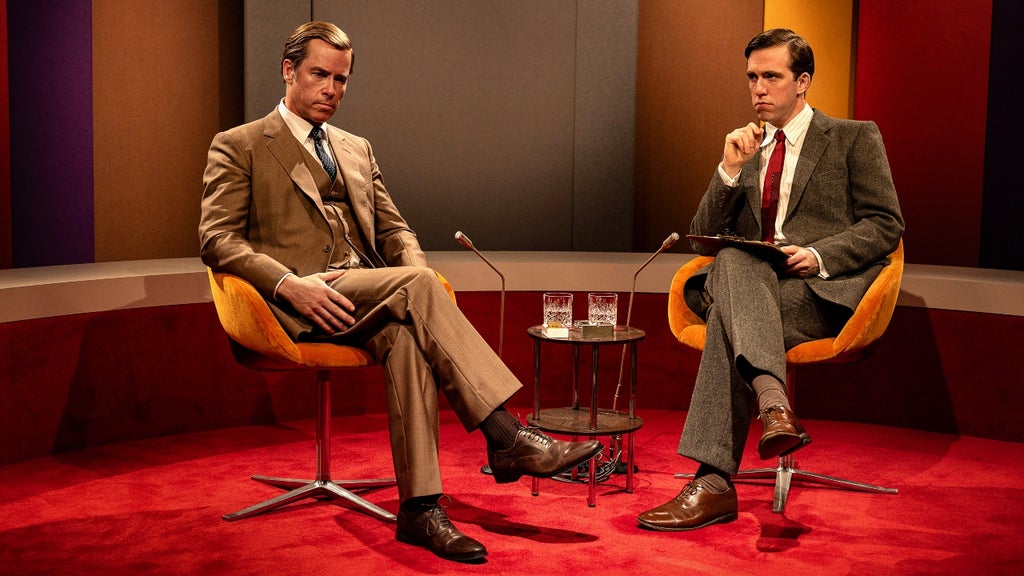
For Boyle, the trail leads back to central London, to a night in October 1969 when a Yorkshireman and an Australian walked into a bar. The punchline, it turns out, is very much on us. You already know the Aussie. He’s Rupert Murdoch (a debonair Guy Pearce, channeling the same rakish charm he brought to “The Brutalist”). The Yorkshireman, however, is less familiar.
Adapting his own play, screenwriter James Graham makes that asymmetry part of the pitch, betting that anyone far removed from Fleet Street knows comparatively little about newsman Larry Lamb (Jack O’Connell, whose boyish features give new meaning to “tyke”) — then using that gap to subvert expectations.

On one level, it’s a classic devil’s bargain. Lamb’s professional stature and moral weight move in inverse directions once he takes the reins of a piddling Murdoch paper called The Sun. Don’t take the protagonist’s all-too-perfect name at face value, though, and don’t overlay Murdoch’s wrinkled public image — the all-powerful old coot, so ornery he outlived a prestige drama premised on his decline — onto Pearce’s rather smoother complexion. If anything, our cultural villain ends up the partnership’s more sympathetic figure, the one left staring into the camera with a forlorn look that seems to scream, my God, what have I done?
Getting there is half the fun. Fresh off a successful meeting, Lamb strides onto Fleet Street with a masthead to assemble and an ace up his sleeve: grievance. Neither Yorkshireman nor Aussie will ever have the right accent for London, and as we know all too well, that cocktail of elite scorn and personal shamelessness can hit pretty hard. In Rupert’s own words, “It’s business … and it’s revenge.”
Boyle certainly gets punch-drunk off the mix, spinning his camera in every direction as he pulls from his teeming bag of tricks, riffing on everything from “The Matrix” to the GoPro to the narcotic effects of stimulants in an effort to ape a certain kind of tabloid cadence, one that frames everything as sensational as possible. It has the same exhilarating, exhausting effect as reading a tabloid front to back in one sitting — which is the point, of course, but also something no one actually does.
Still, the dope fiends and delinquents filling the newsroom know cheap thrills, and it’s a rush watching them reinvent the race to the bottom from first principles. Jules (Claire Foy, terrific as the newsroom’s sole, ever-so-slight voice of moral dissent) couches her slide into the gutter as a win for feminism. But really, every misfit in Lamb’s ragtag crew comes off as sympathetic, riding the same stick-it-to-the-establishment posture that never, ever goes out of style. Hell, we love a Slobs-vs.-Snobs story! It worked in “Caddyshack” and “Meatballs.” It built a career for Howard Stern, then a whole generation of podcasters after him. And it’s certainly proven most effective in politics, animating both the president of 1970 and the president of today. Don’t worry. “Ink” won’t let you miss the connection.
That ubiquity is something of a double-edged sword. Boyle’s speed-addled style can only do so much with a story whose central idea is essentially a race to the bottom, repeated from a thousand different angles as Lamb and Murdoch try to out-sensationalize the competition. That relentless, episodic one-upmanship may be true to the news business, where every day is frenetic and every day’s the same. Over the course of a feature, though, one does feel the drag.
If we are all products (and victims) of what the Sun wrought, then so too is “Ink.” A third act devoted to the paper’s apparent final debasement, an act so horrid it forever changed the game — and, if you’re wondering, yes, sex sells — can’t help but feel impossibly tame by modern standards, casting the distance between then and now into stark relief. Not to mention teller and tale. Odd as it sounds, the film might have benefited from the loose relationship with facts pioneered by its subjects. Go big or go home, and if it bleeds it leads.
“Ink,” in other words, could stand a little more Fake News.
