
Studio La Cachette, a small French animation studio “hidden in Paris” (as they say on their website), has built a reputation in recent years as one of the most stylistically audacious and deeply felt animation studios working in the medium. They have contributed to big, commercial titles, segments of the “Star Wars” anthology series “Visions” (“The Spy Dancer” from the second crop) and Netflix’s critically acclaimed first season of “Love Death + Robots” (“Sucker of Souls,” which won an Emmy). They did a flashback episode of Netflix’s “Devil May Cry” and made a video game commercial for “Prince of Persia.”
Each of these, no mater how seemingly minor, reinforce how exciting Studio La Cachette really is. Their style is both unique and evolving; timeless (they focus on traditional, 2D animation) and totally contemporary. Each project is bigger and bolder than the last, with more energy, more emotion, more of what the French would call a certain je ne sais quoi.
If you know them from anything, it’s probably their ongoing collaboration with Genndy Tartakovsky, the legendary Russian-American animator. Studio La Cachette animated all three seasons of Tartakovsky’s outstanding Adult Swim series “Primal.” (The third – and best – season just wrapped earlier this year.) And together they also crafted “Unicorn: Warriors Eternal,” a pulpy, vaguely steam-punk adventure that sadly only ran for a single season.
All of this experience – working with one of the most celebrated animators of his generation, stretching their boundaries on projects big and small, refining and honing their craft – has led to “Mu Yi,” the studio’s feature debut that is currently playing in competition at the Annecy International Animation Film Festival. And it’s a doozy.
“Mu Yi” was co-written and directed by Studio La Cachette co-founder Julien Chheng, who also wrote and directed “The Spy Dancer.” It’s an epic fantasy on an intimate scale and an absolutely astounding debut feature. If Studio La Cachette keeps this up, they could be France’s answer to Studio Ghibli. Or maybe Pixar or Cartoon Saloon. Who knows.

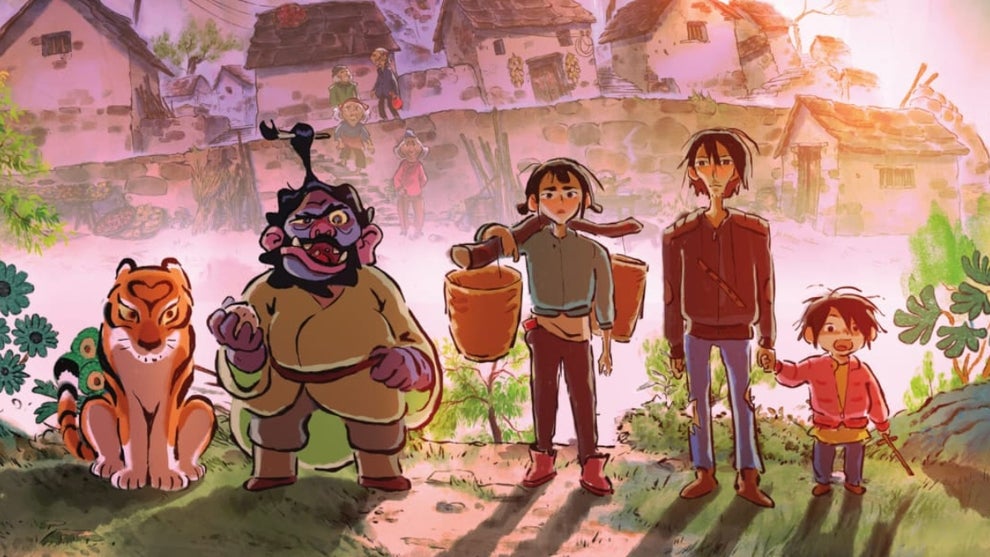
The film follows a young girl name Mu Yi. She lives with her grandmother in a quasi-magical village that consists only of older women (men are expressly forbidden). Mu Yi leaves the confines of the village on the back of her beloved water buffalo Little Horns, and causes mischief with a couple local peasant kids, hawking tchotchkes to local tourists and setting off fireworks. Mu Yi struggles to understand why she lives the way she does and like the heroines of many animated fables longs for something more.
Mu Yi and her buddies come upon a troupe of traveling female performers. They are looking for the treasure of the Handsome General, a local legend that has originated from near where Mu Yi and her grandmother live with the rest of the women. A highly superstitious lot, the performers agree to put on their play for the village, in exchange for communing with the spirit of the Handsome General to put his soul to rest with some help from Mu Yi’s female neighbors (who are regularly referred to as witches). Clearly, there is something supernatural swirling all around them. And if Mu Yi can help sort it out, great.
The actors put on their performance, which stylistically shifting into something closer to shadow puppetry is one of the most stunning moments in a movie composed almost exclusively of stunning moments. One moment will even remind you of Francis Ford Coppola’s old timey prologue to “Bram Stoker’s Dracula.” It’s in this sequence that you realize how slippery Studio La Cachette can be; it also teaches you to expect the unexpected.
After the performance, Mu Yi learns a hard secret about her own past and escapes into the forest, where she encounters an impish demigod (who is looking to capture some roaming spirits). This encounter is the first in a series of dominoes that ends with our characters, including the demigod’s vegetarian tiger and, of course, Little Horns, being zapped backwards in time, to “the fifth or sixth century,” according to one character. That’s right – the Handsome General’s power is sending them back to his time.
Now, Mu Yi and the gang have to discover the secrets of the village, find the Handsome General’s treasure and return to the present by gently mending the trauma of the past.
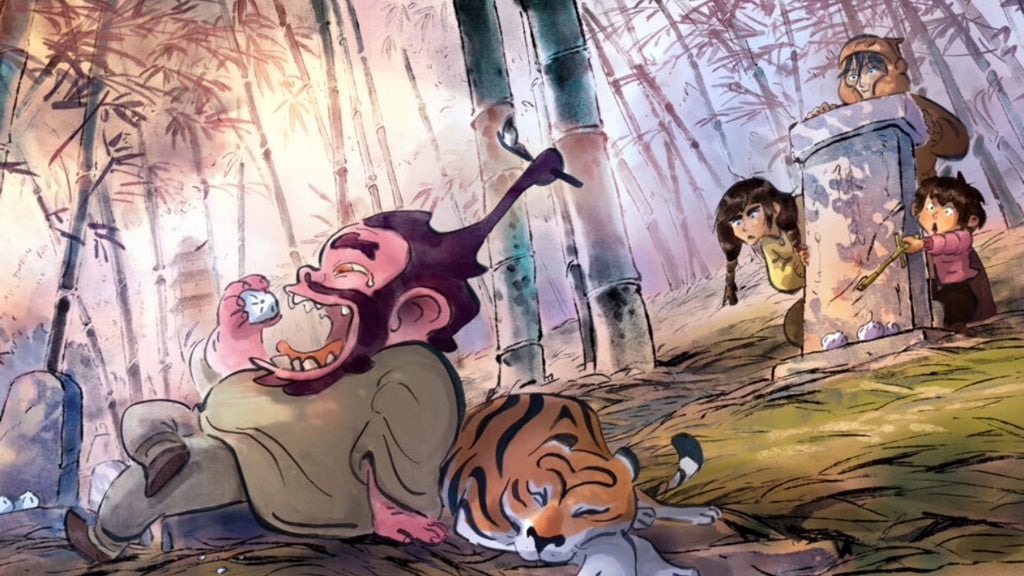
The movie takes on a completely different look after going back in time. Up until this point, it had been defined by the typically fluid character animation and killer designs the studio is known for, set against some gorgeously splotchy watercolor backgrounds. But when they wind up in the past, that all shifts – a calligraphic style takes over, with flat backdrops that could be mistaken for deeply etched maps (or perhaps the 2D backdrop of some cherished RPG video game from the 1980s). The characters’ designs are simplified further. They are just as expressive but distilled into their absolute essences. And it all just feels different, without drawing a huge amount of attention to itself.
And just as eye-popping as the visuals in “Mu Yi” are, the emotions are even more powerful. This is particularly true in the movie’s home stretch, where secrets are further revealed, about both Mu Yi herself and the village that she lives in. It’s really beautiful stuff, never overplaying its hand or giving into trite sentimentality, which would have been very easy to do, particularly in the storybook-ish animated world.
Chheng is clearly a visionary; another studio that he helped found, Duetto, was also a part of the production. Not that you can tell. It’s a seamless, harmonious collaboration. And it says a lot that Chheng was inspired by actual stories from the region that he and his co-writer Sujuan Xu heard while traveling in China.
Chheng has something to say with “Mu Yi” – about community, gender, how history becomes legend and legend becomes fact – but wisely wraps it in a fantasy film that feels just as big as any epic, but with an intimate emotional center that makes everything that much more engaging. It’s really about a handful of characters trying to figure themselves out and their place in the world, against a fantastical backdrop, full of sequences that will actually take your breath away (there’s a oner in the last act, in the middle of a battle, that is almost beyond belief) and tough scenes that will likely make you cry.
Either way, best to bring a tissue. Or a handkerchief. Whatever works.
