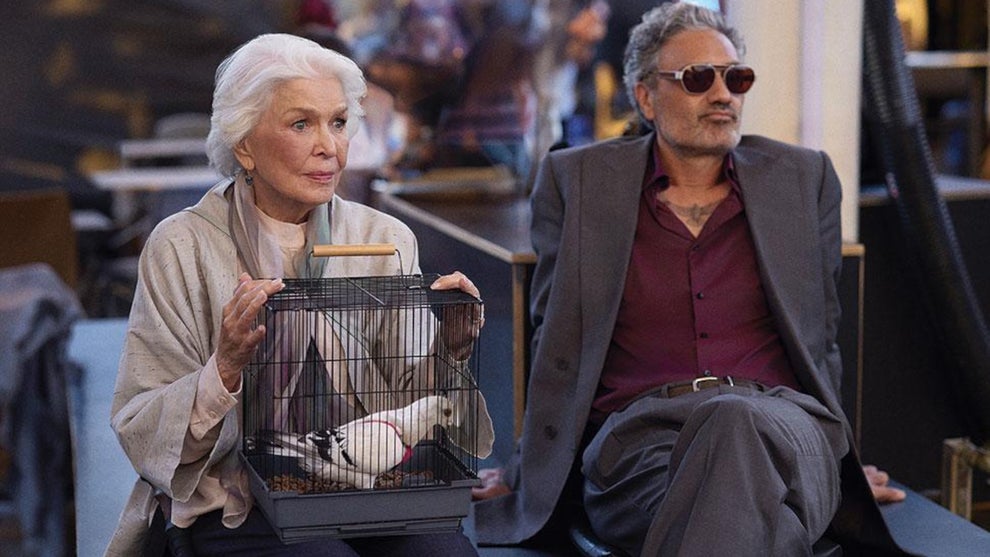
A gentle coming of (old) age two-hander, “Place to Be” finds Hungarian auteur Kornél Mundruczó imbuing a straightforward genre — the road trip comedy-drama — with sentimentality. He directs Ellen Burstyn in a deceptively simple role, resulting in a career-capping performance that proves why she’s still one of our greatest actresses. It is, after all, the challenge of a lifetime: acting opposite an intrusive racing pigeon (in addition to an unpleasant, accidental companion played by Taika Waititi).
It begins with Burstyn’s character, Brooke Graham, wandering through the Chicago cemetery where her artist husband has been laid to rest. Back home, where she lives alone, she overhears her children Ron (Murray Bartlett) and Molly (Pamela Anderson) discussing which of their late father’s paintings to sell in order to move her to a facility for elder care. It’s not a callous proposition, though it comes from a place too casual (and too materialistic) for Brooke to consider. That same night, fate sends a precocious white pigeon flying through her bedroom window, who she names Intruder because it won’t leave her alone.
Using the ID ring on its talon, Brooke traces Intruder’s owner to New York City and decides to set off on a mission to return it, rather than sticking around to argue with her kids. At the train station, ahead of her 22 hour journey, she comes across the wealthy, recently-divorced Nelson Greene (Waititi) as he drops his reluctant teenager Z (Aradia Horo Benge) off at a camp they don’t want to attend.
As Nelson rushes off to take a phone call, Brooke tenderly hands Z a tissue to wipe their tears. This, however, is the last we see of the anxious teen on screen; their presence from this point on is at the other end of Nelson’s phone, revealing, in the process, surprising layers to what appears to be just another deadbeat dad selling luxurious real estate.

Before this can happen, Nelson and Brooke must first have their inevitable skirmish aboard the train before going their separate ways; terrible first impressions are everything in this kind of movie. But a mix of coincidence and sheer luck (call it “fate” as Brooke seems to, a notion Nelson rejects) keeps pulling them back into each other’s orbits. Before long, they’re unwitting partners on a secondary road trip to track down the pigeon’s rightful owner, resulting in sweet and funny character drama with some unexpected flourishes.
Mundruczó is perhaps best known for his mind bending, room-spinning sci-fi odyssey “Jupiter’s Moon” and his canine drama “White God,” films of spectacle imbued with epic, religious sweeps. “Place to Be” isn’t that kind of movie, nor should it be, but it contains some of the director’s aesthetic sensibilities when it comes to its shots of birds flying overhead — on which he holds for lengthy periods. He captures each wild flock like a moving cloud before cutting back to Burstyn’s bedazzled reactions, as though she herself were a bird only recently uncaged.
The movie’s life-affirming fabric is further unearthed through fluid, naturalistic conversations. Waititi’s straight-man Nelson is appropriately obnoxious, but Burstyn plays the kind of elderly woman who you’re thrilled to discover has had a fascinating, complicated life, and whose prim façade hides a yearning to return to some past liberation — if she ever truly had it in the first place.
Mundruczó dramatizes this sense of memory using brief flashes of faded, grainy celluloid footage, of people and places, standing in for traditional flashbacks and gesturing towards a life lived. All the while, Burstyn constantly reveals startling dimensions to Brooke, whose zest for life is gradually rebuilt. It certainly helps that the several dozen pigeons chosen to play Intruder are all imbued with a sense of mischief through rapid cutting, adorable sound design and Burstyn’s delightful asides.
Nelson, although he starts out a broad stock type familiar to American family cinema, finds himself in the odd position of wanting to get on board with his child’s gender dysphoria, but having to deal with too much change in his life at large. Z’s gender exploration is subtle enough that one might miss it — they are, after all, a background character existing mostly on the phone — and yet, this approach brings a sense of verisimilitude to the tale of a middle-aged man and a much older woman who, although they’re no longer as “with it” as they once were, have their hearts no less open.
Their interpersonal issues arise as quickly as they’re resolved, but each bump in the road brings them closer, as the unlikeliest of friends. Like Z, Ron and Molly exist mostly as disembodied voices over concerned phone calls, but Bartlett and Anderson help Burstyn craft an entire family history through brief interactions — something revealed to be a strength of Mundruczó’s, key in this exposition-heavy form where things can’t get too morose. “Place to Be” is the kind of film that has an emotional ceiling, but it soars right up to that limit.
The movie’s lighthearted nature is always rooted in looming thoughts of mortality, as the precarious freedom embodied by Brooke’s new avian companion is revealed to be more fragile than initially thought. The result is an amusing film of perfectly rendered sappiness, buoyed by a lust for life and a radiant performance by a Hollywood icon, who you can practically feel echoing her own remarkable, six-decade career.
