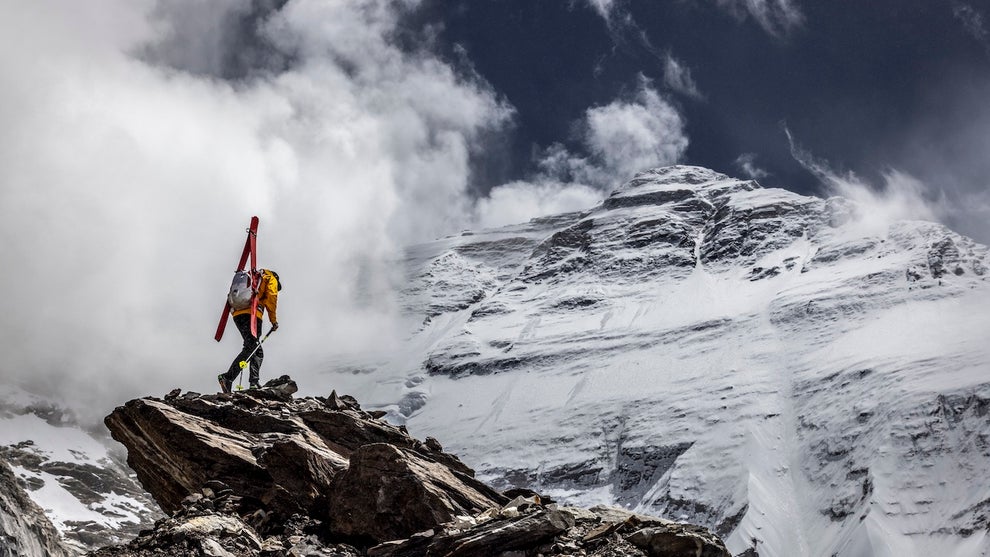
The Himalayas look serene from a distance. However, “Everest: The Other Side” — from “Free Solo” directors Jimmy Chin and Elizabeth Chai Vasarhelyi — gets up close and deeply personal with the world’s highest, most unforgiving peaks. It follows a daring climber couple with their heads in the clouds, who seek to not only scale the perilous north face of the world’s highest summit, but against all odds, ski back down. What seems, at first, like a thrilling but familiar daredevil documentary soon reveals a harrowing work of self-reflexive cinema that’s as tragic as it is triumphant.
Jim Morrison and Hilaree Nelson fell in love while scaling mountains. Along with Hilaree’s sons from a previous marriage (who occasionally tag along, with hilarious reluctance), the quartet surmounts major challenges the world over. The middle-aged couple have made a life together at 25,000 feet, the personal cost of which Chin and Chai Vasarhelyi detail while marveling at the pair.
It isn’t long before mountaineering begins to feel like a metaphor for moviemaking — the planning, the long trips away from home, and the irresistible pull of the art form — but “Everest: The Other Side,” which had its world premiere on Thursday at the Venice Film Festival, isn’t quite so simple.
Those unaware of Jim and Hilaree will no doubt be endeared to them before the movie takes a major turn, recontextualizing its narrative through the use of international news clips. The directors are soon forced to become central characters in their own story, whose emotional gut-punches give way to ethical dilemmas about the production itself. These range from examining the cultural dynamics of paying impoverished Nepali sherpas to aid their mission, to the sheer perversion of pointing cameras at near death experiences — a question broached in “Free Solo” as well. This time, the fears that informed the narrative tensions in the filmmakers’ previous works (including their other rock climbing achievement, “Meru”) are finally realized.

The movie is as much about alpinism as it is about the emotional baggage one carries up the mountain, and all the things one leaves behind. It unfolds over several years, detailing every possible hurdle from snowstorms to raging grief, gradually thinning the wall between mountaineering as a symbol for filmmaking and mountaineering as the film itself. While “Everest” contains plenty of drone footage and landscape photography, its aesthetic foundations are built atop hair-raising footage shot by the climbers in real time, via a combination of helmet-mounted GoPros and portable digicams that are at constant risk of plummet. It feels dangerous to watch.
When stitched together with the more calming interview segments — notably filmed prior to each challenge, so the subjects’ fates remain ambiguous — these varying perspectives fill out the emotional space in borderline cubist fashion, detailing the story from every visual and emotional angle, all at once. The result is both hair-raising and overwhelming, as nature’s unrelenting ferocity comes charging down the mountainside directly at the lens. The troubling thought of whether you’re about to watch someone’s final moments is never far away — though little can prepare even hardened viewers for when this question is eventually answered.

Amid early tableaus of cloud-capped mountains, one of Hilaree’s interviews features a revealing line that buoys Chin and Chai Vasarhelyi’s modus operandi. “Die young as late as possible,” she says, informing the movie’s adrenaline-fueled peaks and agonizing valleys alike. These end up refracted through the lens of Hindu and Buddhist beliefs on karmic rebirth, by way of rituals that become part of the subjects’ lives the more time they spend in the region.
“Everest: The Other Side” may not get literal with its religious musings (its title is more Abrahamic in nature), but its observations of Eastern spiritual traditions, as its subjects’ lives unfold on the mountainside, introduce unspoken ideas about the ghosts of the past manifesting as energy and matter.
Once all the movie’s cards are on the table, it’s hard not to feel the presence of something intangible in the ether, as though broad notions of “the indomitable human spirit” — found throughout daredevil cinema — were previously missing a divine ingredient. However, the film never ceases to be visceral and jolting at every turn, yielding a moving, multifaceted experience that needs to be seen to be believed.
“Everest: The Other Side” will be released by National Geographic Documentary Films in theaters and IMAX worldwide on Oct. 30.